
From the Kotha to the Gramophone: The Women Who Shaped Calcutta’s Music
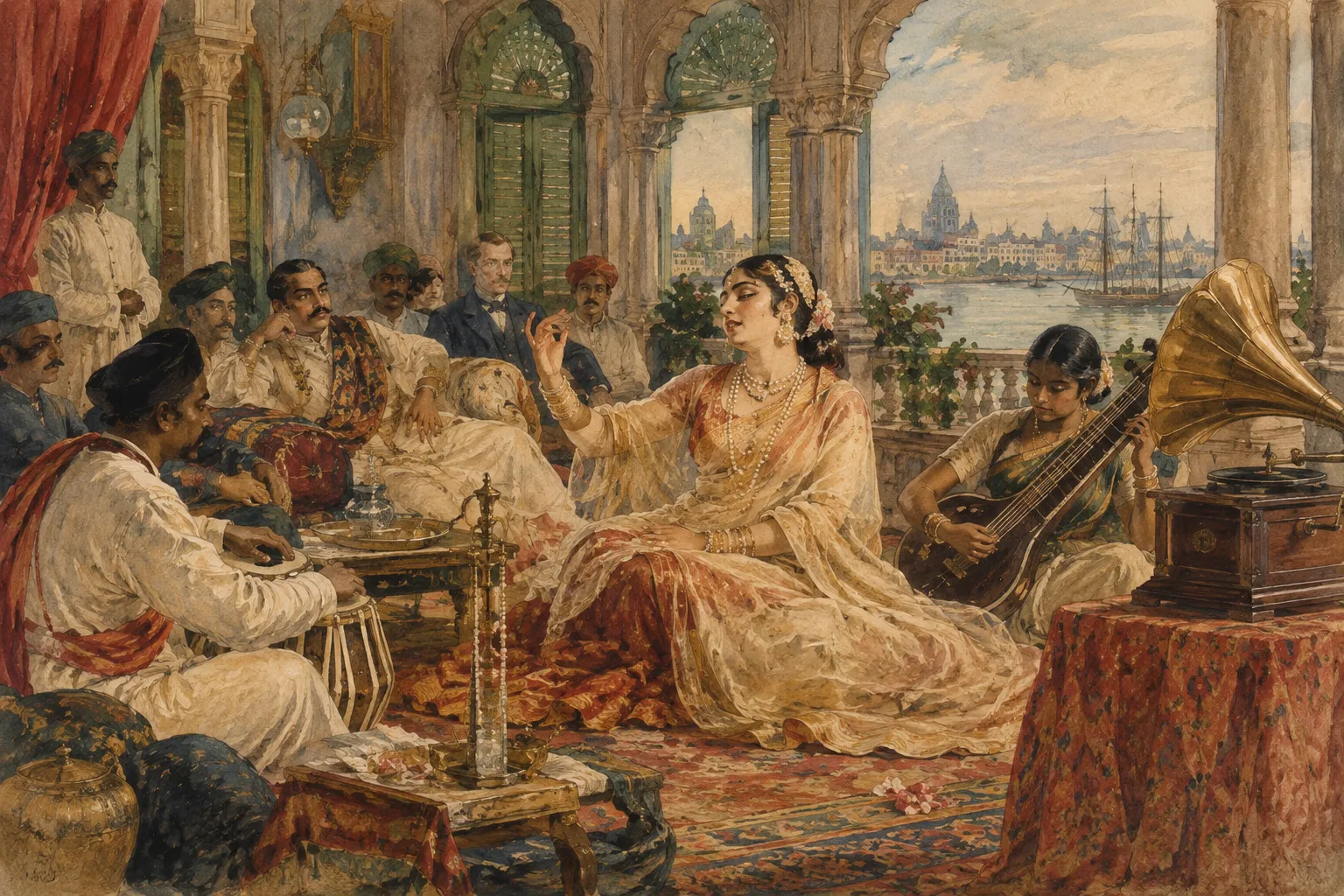
In nineteenth-century Calcutta, some of the city’s most important musical spaces were not theatres, concert halls or temples. They were kothas—salons where women performed, taught, entertained, conversed and cultivated the arts.
The women at the centre of this world were known variously as Baijis or Tawaifs. Later colonial and reformist narratives often reduced them to the category of the prostitute. But that description obscures the role they played in the cultural life of Bengal.
For much of the nineteenth century, these women were among the city’s most accomplished professional performers. Their world connected music, dance, poetry, etiquette, patronage and commerce. And when that world began to disappear, one of its most famous voices—Gauhar Jaan’s—found an unexpected route into the modern age: the gramophone.
How Calcutta became a new home for North Indian music
A major change came after 1856, when the British annexed Awadh and exiled Nawab Wajid Ali Shah to Metiabruz, on the outskirts of Calcutta.
Wajid Ali Shah was himself a patron and practitioner of music and dance. His arrival was followed by the movement of musicians, dancers and courtesans from Lucknow and other centres of North Indian culture towards Bengal.
Calcutta already had wealthy patrons willing to pay for sophisticated entertainment. The newcomers found an expanding market.
In neighbourhoods such as Chitpur and Bowbazar, Baijis established kothas that functioned as much more than places of entertainment. They were spaces where music, poetry and conversation flourished, and where performers could cultivate both artistic reputations and professional networks.
This was an important cultural transfer. Forms associated with North Indian courtly traditions—including thumri, dadra and Kathak—became part of Calcutta’s musical landscape.
The Baiji was a professional, not simply a patron’s companion
The world of the kotha was also more socially complex than later descriptions suggest.
The research distinguishes between elite Tawaifs, professional nautch performers and lower-status street performers. Women such as Niki Bai, Hingan Bai, Malka Jaan and Gauhar Jaan belonged to the upper levels of this artistic hierarchy.
Some were wealthy property owners and taxpayers. They commanded substantial performance fees and possessed specialised repertoires of music and poetry. Their knowledge was itself a form of professional capital: in an age before modern copyright, compositions and musical techniques could function almost like trade secrets.
Malka Jaan, who established herself in Calcutta, was both a vocalist and poet. Her daughter, Gauhar Jaan, would eventually become the most famous symbol of this transition.
The women were not merely supplying entertainment to the Babu households. They were helping determine what sophisticated entertainment in Calcutta sounded like.
Then the city began to turn against them
The same society that had made Baijis valuable gradually began to regard their world as a problem.
By the late nineteenth century, the Anti-Nautch movement brought together British missionary ideas about sexual morality with Indian reformist concerns about respectability and social reform.
The emerging bhadralok middle class was constructing a new ideal of womanhood: educated, respectable, domestic and removed from the public world of professional performance.
The Baiji represented almost the opposite.
She was publicly visible, professionally independent, musically trained and economically connected to men outside the domestic household.
The distinction between an elite Tawaif and a prostitute was increasingly erased in public discourse. Reform campaigns encouraged respectable Indians to boycott nautch performances, while official pressure weakened the patronage networks that had sustained them.
Colonial legislation added another layer of pressure. The Contagious Diseases Act of 1868 subjected women suspected of prostitution to police registration and medical examination. The research argues that such measures further blurred the distinction between professional performers and sex workers.
Some performers moved out of British-controlled Calcutta towards Chandannagar, where the legal environment was different.
The cultural geography of the city was changing.
And then Gauhar Jaan entered the gramophone
There is a remarkable irony at the end of this story.
Just as the social world that had sustained the Baiji was being dismantled, technology created a new way for her music to travel.
In 1902, Gauhar Jaan recorded for the Gramophone Company in Calcutta. The research presents her as a bridge between the old jalsaghar and the emerging commercial music industry. Her recordings separated the voice from the physical space in which the performer lived and worked.
A listener no longer needed to enter a kotha to hear her.
The music could now enter a drawing room as a physical object.
That change was larger than it first appeared. The gramophone did not simply preserve performances. It changed the economics of music itself, turning a live artistic encounter into something that could be recorded, sold, owned and repeatedly played.
The Baiji’s world was disappearing, but her voice was becoming portable.
What Calcutta forgot
The story of the Baiji is therefore not simply a story of decline.
It is also a story about who gets remembered as a creator of culture.
The women who performed in Calcutta’s kothas helped transmit musical traditions, trained and developed repertoires, commanded audiences and shaped elite cultural life. Yet the social reforms that followed increasingly separated their artistic legacy from the women who had carried it.
Later generations could inherit thumri, dadra and Kathak as respectable cultural forms while forgetting the professional women who had helped sustain them.
The old jalsaghar eventually became a symbol of a vanished world. But its music did not disappear completely.
It travelled—from the kotha to the record, from the record to the listener, and eventually into the cultural memory of modern India.
The rooms disappeared. The voices remained.