
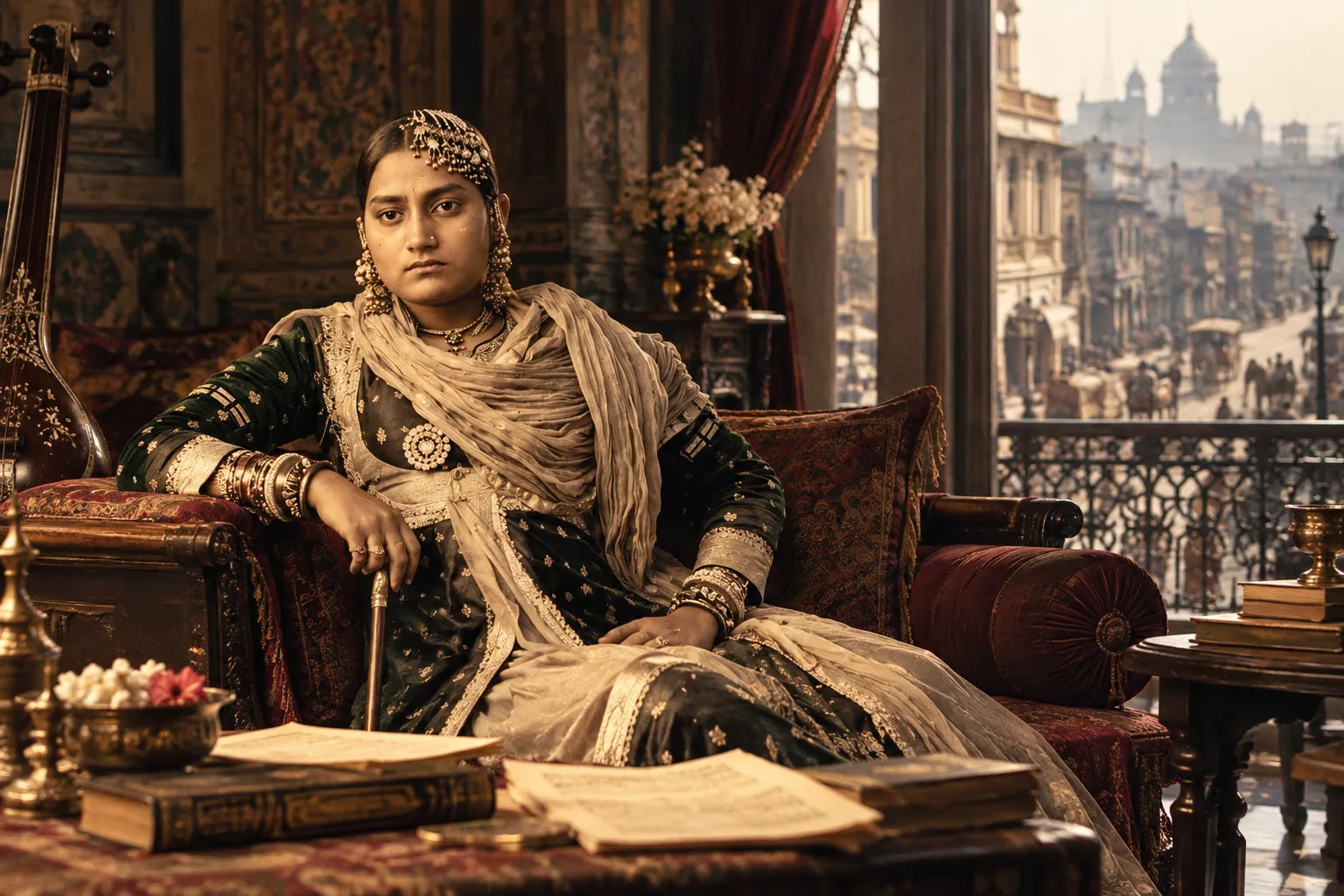
Malka Jaan: The Baiji Who Built Her Own World
In nineteenth-century Calcutta, a woman did not need to be born into a wealthy family to build a life of wealth, artistic authority and cultural influence.
Malka Jaan did it through music.
She arrived in Calcutta in 1883 after a difficult personal journey that had taken her from marriage and financial hardship to Banaras, where she entered the world of the tawaif. Within a few years, she had established herself among the city’s elite performers, acquired a substantial property on Chitpore Road, published poetry and created a household that became a centre of music and learning.
She is often remembered simply as Gauhar Jaan’s mother.
That description misses the more remarkable story.
A life rebuilt through art
Malka Jaan’s early life was far removed from the position she would eventually occupy in Calcutta.
After the breakdown of her marriage in the late 1870s, she moved to Banaras with her daughter. There, she entered the professional world of music and dance and adopted the name Malka Jaan. She became known as Badi—or elder—Malka Jaan, distinguishing her from other celebrated performers who shared the name.
For a woman facing financial uncertainty, the world of the tawaif offered something unusual: a professional identity based on skills that could generate substantial income and social connections.
Music was not merely entertainment in this world. Training in singing, dance, poetry, language and etiquette could create cultural capital—and, for successful performers, considerable economic independence.
By 1883, Malka Jaan had chosen Calcutta.
The city was then one of the most important centres of wealth and cultural patronage in British India. Nawab Wajid Ali Shah’s court at Matiaburj had also created an important new centre for North Indian music and culture around Calcutta.
Malka Jaan found her place there.
From performer to property owner
The most striking detail in Malka Jaan’s story is not that she became a successful singer.
It is what she did with that success.
Within a few years of arriving in Calcutta, later biographical accounts say that she purchased a building at 24 Chitpore Road, now Rabindra Sarani, for ₹40,000.
The exact purchase price is not independently documented in the research material, so ₹40,000 should be treated as a figure reported by later accounts rather than an unquestionable archival fact. But the larger point is secure: Malka Jaan had accumulated enough wealth and standing to establish herself in property and create a substantial cultural household.
And this is where her story becomes more interesting than a tale of a wealthy courtesan.
She did not simply consume the money she earned.
She built something with it.
Her Chitpore Road home became associated with music and poetry. She was also recognised as a poet, and a collection of her Urdu poetry, Makhzan-e-Ulfat-e-Malka Jan, was published in Calcutta. Another account records the publication of her Dīwān-i-Malkā Jān in 1886, whose elaborate frontispiece presented her almost as a literary queen—“Bibi Malka Jan of Benares Now at Calcutta.”
For a nineteenth-century woman who had rebuilt her life outside conventional domestic respectability, this was a remarkable accumulation of property, profession and cultural authority.
What would ₹40,000 be worth today?
It is tempting to put the ₹40,000 purchase price into a modern inflation calculator.
But there is a problem.
We do not know that prices rose at a constant 6% every year between the 1880s and today. Historical inflation was neither constant nor uniform, and a nineteenth-century property cannot be meaningfully converted into today’s rupees simply by choosing one annual rate.
Still, a 6% calculation can be used as a mathematical illustration.
If ₹40,000 were compounded at exactly 6% every year from 1883 to 2026, for 143 years, it would become roughly ₹16.6 crore.
But that is not the modern market value of Malka Jaan’s house, nor a reliable measure of its purchasing power. It simply shows how dramatically a long period of compound growth changes a number.
The more historically meaningful fact is that ₹40,000 represented serious wealth in nineteenth-century Calcutta—wealth that Malka Jaan had converted into an asset in her own name.
A mother who invested in a future
Her greatest legacy may have been inside that house.
Malka Jaan invested heavily in the education of her daughter, Gauhar. Rather than treating music as a casual accomplishment, she assembled an extraordinary network of teachers for her.
Gauhar studied different forms of Hindustani music and dance under specialist masters, including teachers associated with the Patiala tradition and Kathak. The home on Chitpore Road thus became more than a residence: it was part household, part salon and part training ground.
The daughter would eventually become one of the most famous recording artists in India.
But that career did not begin with the gramophone.
It began much earlier—with a mother who understood that talent needed investment, training and a platform.
The power of choosing your own identity
There is something striking about Malka Jaan’s trajectory.
She moved from a failed marriage and financial uncertainty into a profession that respectable society increasingly stigmatised. Yet within that world, she acquired skills, income, property, literary recognition and influence.
That does not make her story a simple tale of liberation. The tawaif world itself depended on wealthy patrons and existed within a deeply unequal social order. Malka Jaan’s success was exceptional, not necessarily representative of the women who entered the profession.
But her life does reveal a form of female agency that conventional histories of colonial Bengal often overlook.
She did not wait for respectability to give her a place.
She created a place for herself first.
And when she did, she used it to build a cultural world around her—one in which her daughter could receive an education few women of the period could access.
By the time Malka Jaan died in 1907, Gauhar Jaan had already entered the world that would soon be transformed by recording technology. The fame that followed belonged to Gauhar.
But behind that famous voice stood a woman who had first built the house, the network and the education that made it possible.
Malka Jaan was not merely the mother of a star. She was an artist, property owner, poet and cultural entrepreneur who turned a difficult life into a world of her own.