
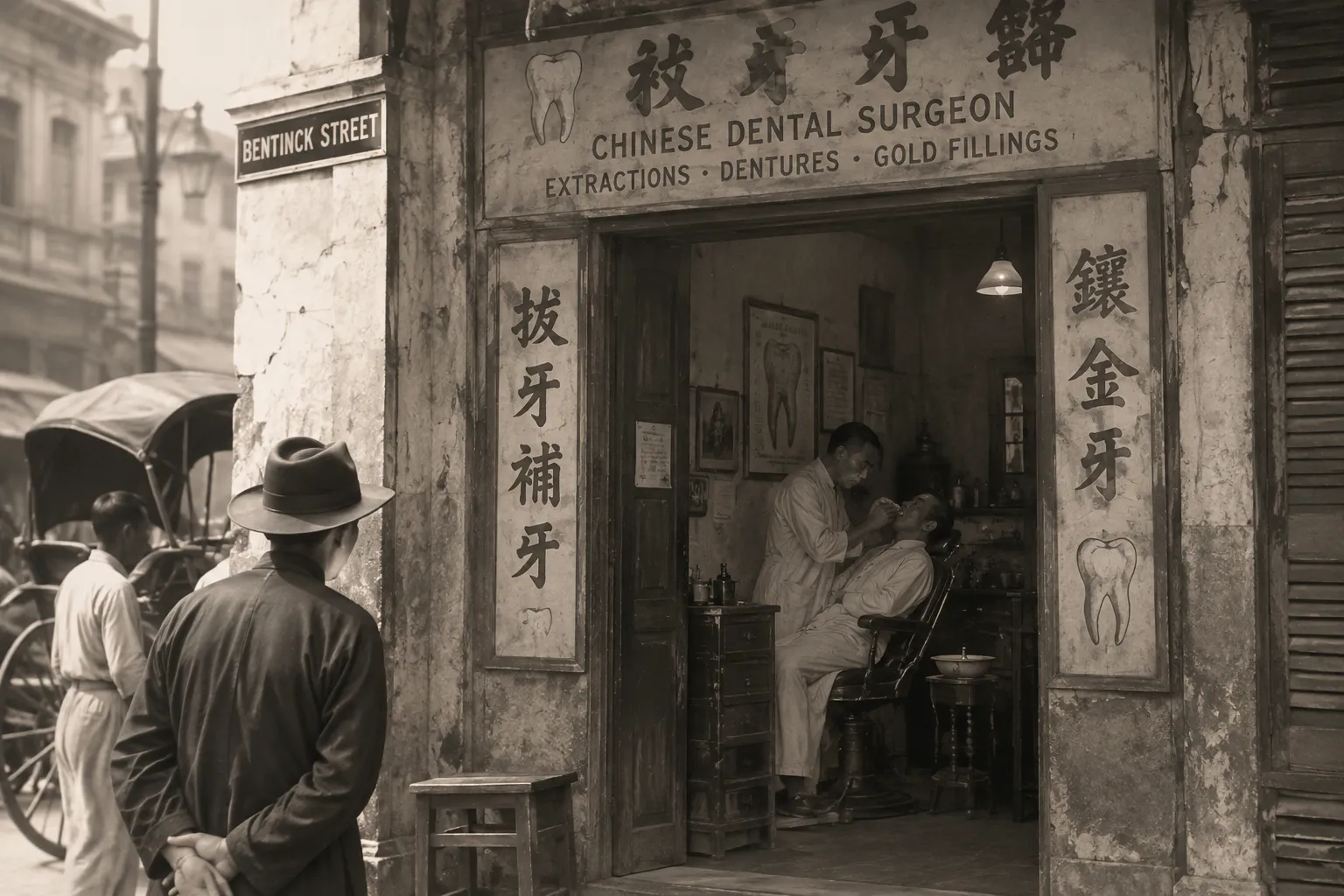
The Chinese Dentists of Calcutta’s Streets
Bowbazar, Bentinck Street and the migrant medical networks that made a distinctive place in the city
In old Calcutta, a toothache could lead a patient into a world shaped by migration.
Along the streets of Bowbazar and Bentinck Street, Chinese dental practitioners built a distinctive presence in the city’s medical marketplace. Their small practices served people beyond their own community. Some became known for affordable treatment and skilled dental work; others travelled beyond Calcutta, carrying their tools and expertise to towns across Bengal.
They were not simply an exotic footnote to Chinatown. Their story reveals how a migrant occupation could take root, change with its surroundings and become part of everyday urban life.
The question is not only why Chinese dentists came to Calcutta. It is how dentistry became one of the occupations through which a particular migrant network made its living—and what happened when the world around that network changed.
A Chinatown made by work
Calcutta’s Chinese settlement did not emerge as a single, uniform community. It developed through different migrations, occupations and neighbourhoods.
The early settlement around Tiretta Bazaar became associated with Chinese residents working in trades such as carpentry and commerce. Over time, other groups established their own occupational niches: Hakka migrants became associated with shoemaking and leatherwork, while migrants from Hubei—also written as Hupeh in older sources—became known for dentistry.
This occupational geography matters. It helps explain why the history of Chinese Calcutta cannot be told only through restaurants, temples or community institutions. The city’s Chinese residents also made their place through skilled work: repairing ships, making shoes, tanning hides and treating teeth.
The dental story belongs to this larger history of migration and livelihood. But it has its own route.
From Hubei to Calcutta
Chinese migration to Bengal had begun long before the arrival of the Hubei dentists. The familiar early account centres on Tong Achew, a Chinese sugar manufacturer associated with Achipur in the late eighteenth century.
The dental migration described in the research belongs to a later period. Hubei practitioners arrived in greater numbers during the early twentieth century, with the 1920s–1940s emerging as an important period of movement.
Their journeys were not necessarily direct. Research describes routes through Southeast Asia and Burma, connecting the movement of people with wider networks of travel and work.
The crucial distinction is that the history of Chinese settlement in Bengal and the history of Chinese dentistry in Calcutta are not the same story. The former stretches back much further; the latter developed through a more specific occupational migration.
The evidence points to a mobile network rather than a single wave of settlers arriving together.
Why teeth—and why this kind of dentistry?
The Hubei dentists’ specialisation raises a fascinating question: why did this particular occupation become associated with them?
The answer appears to lie partly in inherited occupational knowledge and partly in the way skills travelled through families and migrant networks. Research on Chinese communities in India describes occupational specialisations shaped by regional origins and family-based enterprise. Contemporary reporting also records dental knowledge passing between generations.
But it would be misleading to imagine a single, unchanged “ancient Chinese dentistry” arriving intact in Calcutta.
The more nuanced picture is of a working tradition that adapted. Rishav Chatterjee’s study of Chinese migrant dentistry in Calcutta, covering 1920–1960, describes a heterogeneous practice that combined biomedical knowledge with indigenous methods. It also emphasises the practitioners’ mobility and entrepreneurial efforts to preserve some autonomy while responding to changing conditions.
That suggests the dentists’ success was not simply a matter of bringing an old skill to a new place. It depended on making that skill useful within Calcutta’s particular medical and commercial environment.
A clinic on the street
The dental practices became visible in the city’s everyday geography. Bowbazar, Bentinck Street and the surrounding central-Calcutta streets formed part of the older Chinatown corridor.
Their appeal, according to the research account, included comparatively affordable treatment and practical services such as extractions and the making of dentures and crowns. Their clientele extended beyond Chinese residents to include Bengali patients and other communities.
This was a form of urban integration built through repeated encounters. A patient did not need to share a practitioner’s language, ancestry or neighbourhood to seek treatment. The relationship could begin with something immediate: a painful tooth, a missing tooth, or the need for a replacement.
The trade also had a material dimension. Dental work required tools, technical skill and the ability to make or fit objects to individual mouths. It was a craft as well as a medical service.
The research describes practitioners making dentures and other dental appliances, while contemporary reporting recalls the popularity of decorative gold teeth in the mid-twentieth century. Gold caps could function not only as dental work but also as visible adornment and status display.
The clinic was therefore more than a place of treatment. It was a small business operating at the intersection of health, craftsmanship, affordability and taste.
Not all the dentists stayed in one place
One of the most revealing findings in Chatterjee’s research is the mobility of the practitioners.
Some Hubei dentists did not remain permanently in Calcutta. They travelled to other districts, where demand for dental services and lower competition could make work more attractive. Such movement could require temporary premises, portable equipment and help from professional contacts.
The example of Kan Hoonfa, discussed in the thesis, points to circular migration. Other cases show practitioners moving between locations rather than building their entire working lives around a single clinic.
This changes the image of the Chinese dentist from a fixed Chinatown shopkeeper into something more dynamic: a travelling professional whose business depended on networks, local opportunity and the ability to establish trust in unfamiliar places.
The city was a base, but not necessarily the limit of the market.
The pressure of regulation
The practitioners’ working lives were also shaped by the state.
The Dentists Act of 1948 became an important turning point in the regulation of dentistry in India. For practitioners whose knowledge had been acquired through apprenticeship or family practice rather than formal university qualifications, the changing regulatory environment created serious difficulties.
Yet the history should not be reduced to a simple clash between “traditional” and “modern” dentistry. Chatterjee’s work describes practitioners negotiating professionalisation and adapting their practices, including through engagement with biomedical methods.
The 1962 Sino-Indian War brought a different and devastating kind of pressure. Chinese residents in India faced surveillance, restrictions and internment; migration and dispersal reshaped communities and businesses. For the dental network, these events compounded the challenges already facing the occupation.
The result was not an overnight disappearance, but a gradual thinning of a once more extensive professional presence.
What survived?
Some family practices continued. A 2023 report in The Times of India documented Chinese dental families still working in Kolkata, including practitioners whose histories connected earlier generations of informal or inherited knowledge with later formal dental education.
That continuity complicates any story of disappearance. The occupation did not simply vanish; it changed, with some descendants gaining formal qualifications and adopting newer technologies.
The deeper legacy is therefore not just a handful of surviving clinics. It is a record of how migration created a specialised livelihood, how skill could travel through families and across regions, and how a city’s medical life was shaped by practitioners who stood between different traditions of knowledge.
The old Chinatown streets remember more than a community’s presence. They hold the trace of a profession that moved—from Hubei through transnational routes, into Calcutta’s neighbourhoods, and outward again across Bengal.
A toothache brought patients through the door. Behind that ordinary encounter lay a much larger history of migration, adaptation and belonging.