
The Ancient Port We Can Still See in Terracotta
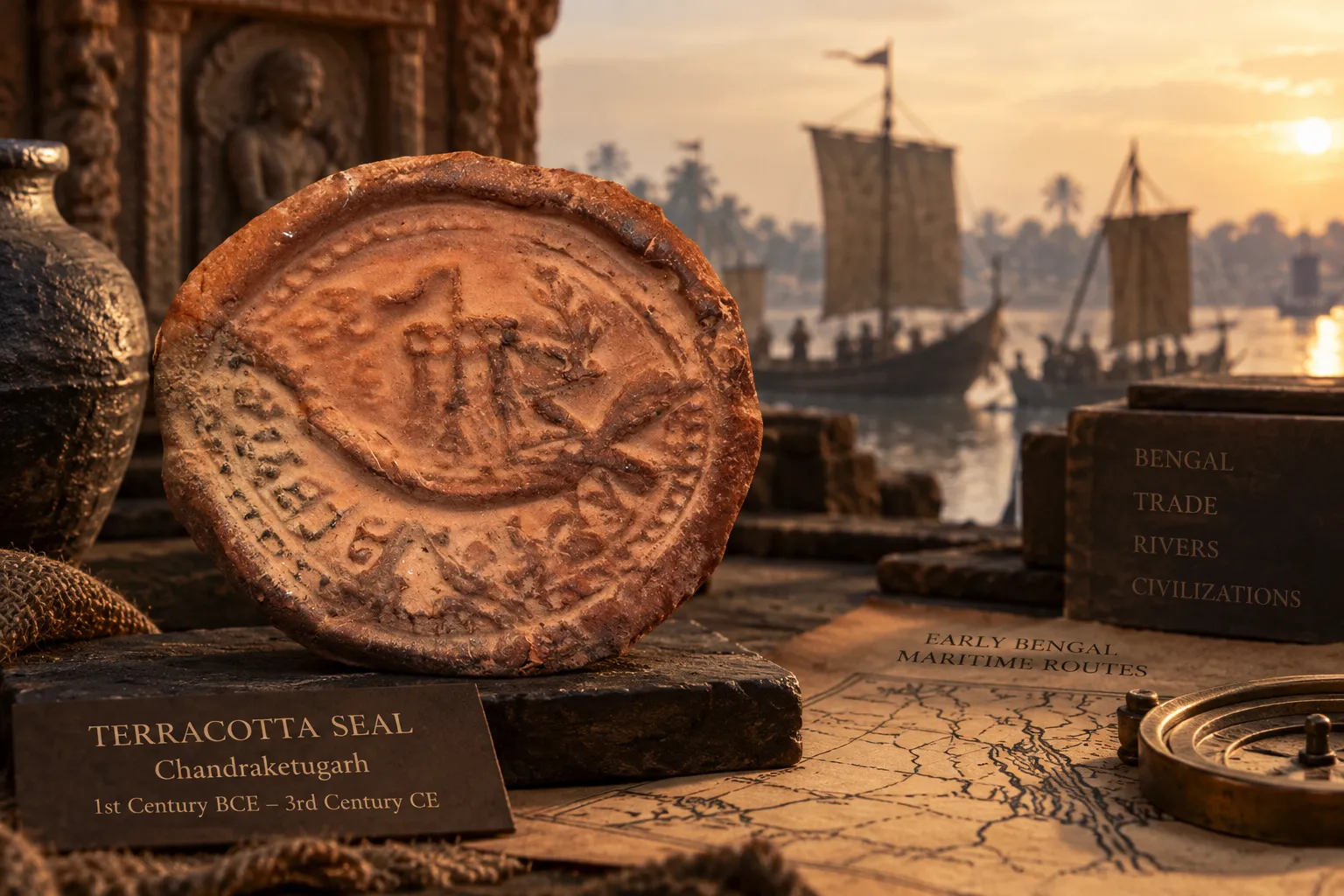
A wooden ship can disappear. Its timber rots, its ropes decay, and the river that once carried it may change course. But at Chandraketugarh, in the lower Ganges region of Bengal, a few small terracotta seals have preserved something of that lost maritime world: ships with masts and banners, references to journeys, and even a vessel associated with the transportation of a horse.
These are not grand monuments. They are modest objects, small enough to hold in the hand. Yet their inscriptions and images offer an unusually intimate glimpse of early historic Bengal’s connections with riverine and maritime trade. The challenge is to read them carefully—because the details are fascinating, but not every interpretation is equally secure.
A ship, a name, and a merchant’s world
Chandraketugarh, in present-day North 24 Parganas, was an important early historic settlement in the western Ganges delta. Archaeological finds from the site include terracotta objects bearing images of masted vessels. Some of these seals carry inscriptions in Kharosthi-Brahmi, a mixed script that scholars have studied for clues about the people and commercial networks active in the region.
One particularly intriguing sealing bears a ship image and an inscription read by epigraphist B. N. Mukherjee as trapyaga—a term connected by scholars with the trapyaka vessel mentioned in ancient maritime literature, including the Periplus of the Erythraean Sea. The sealing has been described as showing a long hull and a single tripod mast. A horse appears aboard the vessel.
The connection is striking, but it needs to be stated precisely. The inscription’s reading and the identification of the ship type depend on scholarly interpretation; the object is not a labelled technical drawing. Still, it provides a rare point of contact between an archaeological image from Bengal and a vessel-name known from wider maritime writing.
The unexpected passenger
The horse aboard the ship opens a different window onto the past. It reminds us that maritime transport was not limited to compact, easily stored cargo. Animals could also travel by sea, requiring space, handling and a vessel capable of carrying them.
Ranabir Chakravarti, discussing the sealing in his study of coastal trade, identifies it as the earliest known visual representation of horse transportation by ship from an Indian port. That is a significant scholarly interpretation, not a claim that we know the horse’s destination or the details of its voyage.
The image cannot tell us whether the animal was being traded, transported for a military purpose, or carried for some other reason. But it changes the scale of what we imagine when we think of ancient shipping. A vessel was not simply a line connecting two ports; it was a working space in which people, animals and goods had to be moved.
Grain, ships, and the business of a voyage
Another set of terracotta sealings from coastal Bengal depicts vessels associated with grain. One, from Bangarh rather than Chandraketugarh, is described as showing a bowl-shaped sailing craft filled with corn, flanked by symbols including a conch and a taurine. Its inscription has been read as Sasyadidhrita Sthali, referring to a vessel containing grain.
A related Chandraketugarh sealing depicts a masted ship with a banner, an ear of corn and a taurine symbol. Its inscription has been interpreted as referring to a voyage in three directions or to three regions, associated with a person named Yasoda and wealth in the form of food.
These readings connect maritime imagery with merchants and agricultural goods. They do not, by themselves, establish the volume of grain exports or prove that every depicted vessel carried the same cargo. But they suggest that the sea-going world represented on these objects included the movement of food, not only precious or exotic commodities.
What does a seal actually prove?
A seal is a compact record, not a complete archive. Its image may simplify a ship; its inscription may preserve a name or claim whose full context is lost. A phrase interpreted as a long-distance voyage does not provide a route map, and a ship image does not automatically identify a naval vessel or prove that the settlement was a military port.
The broader archaeological picture also requires care. Chandraketugarh’s importance as an early historic settlement is well established, but scholars continue to examine how its material evidence relates to trade networks and coastal life. Interpretations of individual inscriptions and their implications for the scale or direction of commerce should not be treated as settled simply because they are vivid.
What the seals do preserve is meaningful in its own right: ships were represented, merchants and journeys were named, and cargo could form part of the imagery. These small objects make maritime activity visible at the level of everyday exchange.
A vanished voyage, still partly legible
We cannot recover the precise route of the horse-bearing vessel, reconstruct the full journey behind the grain-trader’s inscription, or identify every ship represented in clay. But the seals let us move beyond the abstract statement that ancient Bengal had maritime connections.
They give us particular clues: a mast, a banner, a horse aboard a ship, grain linked with a voyage, and names preserved in an unfamiliar script. Each clue has limits, yet together they make the past more tangible.
The ships themselves have vanished. What survives is a small, imperfect record of what people carried, how they pictured their vessels, and the journeys they wanted to remember.