
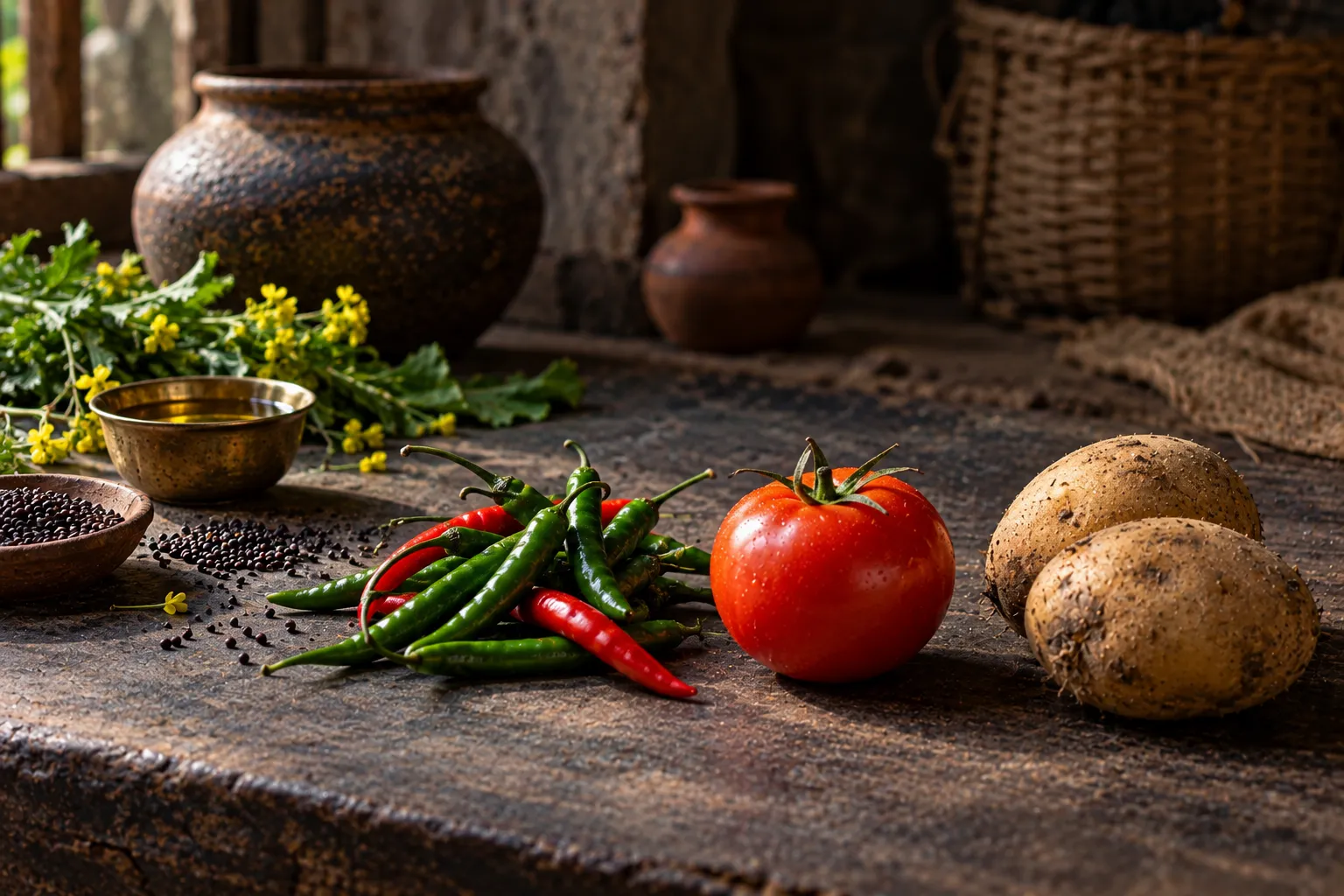
The Bengali Kitchen Without Chilli, Potato or Tomato
Clear a modern Bengali kitchen table of its most familiar colours. Lift the chillies that announce heat before the first bite. Take away the tomato that brightens a fish gravy with sharp, red sourness. Remove the potato that thickens a dal, fills a torkari, or softens the plate with starch. What remains is not a thinner copy of today’s cooking. It is a different sensory world—one that Pala-era Bengal, roughly a thousand years ago, actually inhabited.
That is among the cleanest facts in the research behind this story. All three are New World crops, with no pre-Columbian history in Afro-Eurasia. None could have flavoured a Bengal kitchen between about 900 and 1100 CE. For chilli alone, the absence runs five to six centuries—not a close call.
The question that follows is specifically sensory. If those three late arrivals now carry so much of what people experience as heat, sourness and body on a Bengali plate, what did flavour mean without them?
Heat without chilli
Begin with heat, because it is the marker most readers treat as ancient.
Chilli belongs to the genus Capsicum. Food historian K. T. Achaya and the wider crop-history consensus place its arrival in South Asia with Portuguese maritime trade in the sixteenth century, entering through west-coast footholds such as Goa and spreading across the subcontinent over the following one or two centuries. A tenth- or eleventh-century Bengal cook could no more have reached for a green chilli than for a refrigerator. Slipping one into a Pala kitchen is not artistic licence; it is an anachronism measured in half a millennium.
Heat, however, is older than chilli. Black pepper (maricha) and long pepper (pippali) were already established substances in the classical Ayurvedic corpus—compiled and redacted well before the Pala window—across the Sanskrit-literate world. Their antiquity in India generally is among the better-settled facts in South Asian food history. What this research could not locate is a Bengal-specific 900–1100 CE citation naming either locally. It would be surprising if Pala Bengal stood outside that subcontinent-wide vocabulary; it would also be dishonest to invent a dated Bengal hearth inventory we do not have.
So the plate was not bland. It was differently hot. Where modern Bengali cooking often builds a bright, immediate chilli sting, the earlier kitchen—if it used the pepper family at all—could have drawn on a warmer, slower pungency: peppercorn heat rather than Capsicum fire. Mustard and sesame appear as crops in the Bengal delta’s archaeobotanical record by the eleventh century; pressing those seeds into cooking oil is a strong inference rather than a residue claim, but mustard’s own seed-sharpness would have sat ready either way. Flavour without chilli is not flavour without intensity. It is intensity without the vegetable that later taught the tongue what “spicy Bengali food” should feel like.
Sourness without tomato
Tomato performs a quieter theft of the past. It is so common in fish curry and everyday torkari that many eaters treat tomato-based sourness as the natural register of Bengali gravy. It is not.
Tomato, like chilli, is a New World crop introduced to India via Portuguese trade after 1492, with wider culinary adoption belonging mainly to the colonial period. In 900–1100 CE Bengal it was simply not there. The claim that modern Bengali fish curries have “always” taken their sourness from tomato collapses on contact with that chronology.
What replaces it is harder to say—and that difficulty is part of the story. Tamarind is textually attested elsewhere in South Asia by this era, but the research used here did not confirm it for Bengal in this exact century. Other souring possibilities remain plausible in a delta ecology, yet none can be named as the period’s standard agent without inventing a recipe book the sources do not supply. The careful conclusion is negative and precise: tomato-based sourness cannot be projected backward. The absence of tomato does not prove the absence of sour taste; it proves the absence of one particular fruit that later colonised the idea of sourness itself.
Continuity of appetite is not the same as continuity of ingredient. A cook a thousand years ago may well have wanted brightness against oil and fish. The tool later generations reached for to deliver that brightness had not yet crossed an ocean.
Body without potato
Potato is the third absence, and in some ways the most intimate, because it changed the architecture of the everyday plate rather than only its top notes.
The potato reached India after the Columbian Exchange, via Portuguese and later European trade, from the seventeenth century onward, and entered Bengal’s commercial kitchen significantly later still through British-era diffusion. No potato existed anywhere in Bengal in 900–1100 CE. The soft cubes in aloo posto, the starch that fills out a dal or torkari, the filler that turns a vegetable dish into a meal—those roles belong to a later economy of fullness.
Without potato, body came from sources already in the soil. Rice was the staple of the wet delta; pulses sat beside it. Flotation-recovered seeds at the Buddhist monastery site of Raghurampura in Vikrampura, Bangladesh—studied by Rahman, Cobo Castillo, Murphy, Rahman and Fuller (2020)—confirm that grain–pulse economy at the tail of this window, in a monastic rather than village context. Mustard and sesame appear in the same record: crops directly; cooking oil by strong inference. Rice and dal already structured fullness long before tuber starch arrived to thicken the plate. The landscape was not poor or empty. Of the ingredients now hardest to imagine Bengali cooking without, several had simply not arrived yet.
What “flavour” meant
Put the three absences together, and the sensory profile sharpens. Heat, if present, was more likely pepper-warm than chilli-bright. Sourness, if used, was not tomato-red. Body came from rice, pulse and fat rather than potato starch. Mustard and sesame—crops already in the agricultural repertoire, and the strong candidates behind the fats Bengali cooking still treats as defining—held the meal’s older architecture in place even while the notes that now advertise “Bengali taste” were young.
Neighbouring absences deepen the picture without becoming this story’s spine. Standardised panch phoron has no located evidence near the Pala window; the milk-sweets that became Bengal’s famous exports rest on a chhena-curdling technique food historians place considerably later. Those facts belong to adjacent tellings. The engine here remains the three New World crops and the flavours they later installed: heat, tomato sourness, potato body.
Rice, pulses, river fish and mustard-sesame fats form a base with deep local roots; the older kitchen need not have been austere to taste unlike a modern jhol. No published domestic kitchen from 900–1100 CE Bengal has been excavated, so what we can recover is the logic of ingredients—not the look of the room. The signature many people now call timeless was layered onto something older—not invented from nothing after an ocean crossing.
After the ocean crossed
The Columbian Exchange did not merely add exotic plants to an unchanged plate. In Bengal, as across much of South Asia, it rewired everyday flavour. Chilli taught the tongue a new kind of heat and then made that heat feel traditional. Tomato offered a convenient sourness that later generations mistook for inheritance. Potato remade the economics of fullness. By the time those three felt ancestral, they had already done the historical work of invention.
Return to the cleared table. Without chilli, tomato and potato, the Bengali kitchen of a thousand years ago was not an empty stage waiting for modernity. It was a working cuisine whose intensities came from other places—pepper and mustard rather than Capsicum, oils and dals rather than tuber starch, and sourness from agents we can no longer name with confidence. The shock is not that the past lacked flavour. The shock is how much of the flavour signature people now call timeless arrived only after ships had crossed an ocean, and how completely those latecomers learned to pass as memory.