
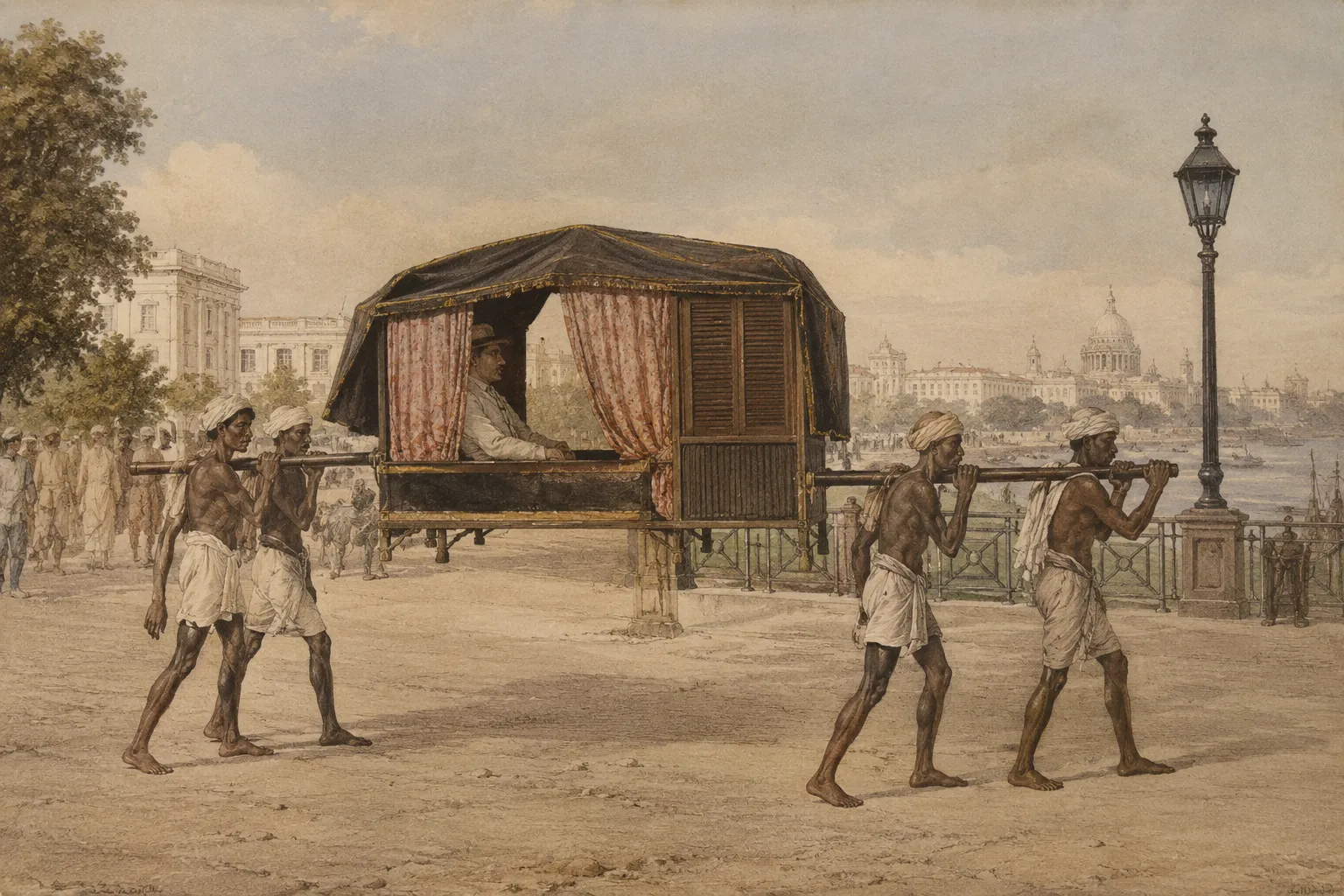
The Day the Bearers Put Calcutta Down
In May 1827, a group of workers whose livelihood depended on carrying other people through Calcutta’s streets refused to work. They gathered in protest against new colonial regulations—and briefly turned an ordinary journey across the city into a question of power.
They were the Oriya palanquin-bearers: migrant workers whose labour helped keep colonial Calcutta moving.
Their story is not simply about an old form of transport. It is about the people beneath the palanquins, the community they built far from home, and what happened when the government tried to dictate the terms on which they worked.
A city carried on human shoulders
Before motorcars, trams and buses transformed urban travel, the palanquin was one of Calcutta’s principal means of transport. A passenger sat inside a covered carriage suspended from long poles, carried by a team of men.
For many passengers, the journey might have seemed effortless. For the bearers, it meant coordinated physical labour, often over considerable distances and through the heat and congestion of the city.
The work was closely associated with migrants from Odisha, particularly men described in colonial accounts as “Balasore bearers.” By the late eighteenth century, they had become a prominent presence in Calcutta’s transport and domestic-service workforce.
Historian Ritam Sengupta, in his study of labour in colonial India, describes the Oriya bearers as part of a wider community of migrants whose work extended beyond carrying palanquins. They could also serve in households, performing tasks that included drawing water and other domestic duties.
Their working lives connected Calcutta to places far beyond its boundaries. They came to the city to earn, but their identity and social relationships did not necessarily end at the workplace.
The community behind the carriers
The bearers were not simply isolated individuals looking for daily employment.
Historical accounts describe an organized Oriya community in Calcutta, sometimes referred to as a “commonwealth,” with chiefs and Paramanicks who exercised authority among its members. These leaders could settle disputes, collect contributions and intervene when workers faced difficulties.
That collective structure mattered.
It offered a way to coordinate action and negotiate with employers and authorities. It could also impose rules on members, making the community a source of both support and discipline.
The colonial administration, however, increasingly sought to regulate the bearers directly. The issue was not only how much they earned, but who had the authority to determine the conditions under which they worked.
When the government changed the rules
The confrontation had a history.
In 1819, thika palanquin-bearers—workers hired to carry passengers for particular journeys—stopped work in protest against a system that calculated hiring rates according to distance.
Then, in May 1827, the government introduced a new set of regulations. These included compulsory registration, badges and payment based on time.
For the bearers, the change raised practical concerns. A time-based system could leave them vulnerable to disputes over how long a journey had taken and how much a passenger should pay.
The regulations also represented a deeper shift: the state was asserting greater control over an occupation whose workers had their own established ways of organizing themselves.
The response was a general strike by Oriya bearers.
The day the bearers refused
The strike brought together workers who ordinarily spent their days carrying passengers through the city. Instead, they assembled to protest the new rules.
The action demonstrated the leverage created by collective labour. A palanquin could not move without its bearers. When enough workers withheld their services, passengers and officials alike faced the consequences.
But the strike did not end with a clear victory.
According to Sengupta’s account, by 4 June 1827 the opposition had considerably diminished, and the workers had largely given in to the government’s proposals.
The episode therefore reveals both the strength and the limits of collective action. The bearers could disrupt an essential service, but the colonial administration possessed regulatory and punitive powers that the workers did not.
More than a forgotten transport strike
The 1827 stoppage was not the last confrontation involving Calcutta’s transport workers.
In 1864, palanquin-bearers and horse-carriage workers struck against regulations under the Hackney Carriage Act. The law required registration and licensing and imposed restrictions on carriages and their use. The strikes were eventually broken, but not before creating serious challenges for the city administration.
Meanwhile, Calcutta’s transport system was changing. Horse-drawn vehicles increasingly competed with palanquins, and the number of registered bearers declined over the later nineteenth century.
The workers’ story was therefore also a story of occupational change: a migrant community adapting to a city whose streets, technologies and rules were being remade.
The palanquin has largely disappeared from everyday urban life. The labour behind it is easier still to overlook.
Yet the strike of 1827 leaves a revealing trace. Calcutta’s movement depended on people whose names rarely entered the grand narratives of colonial progress. For a moment, those workers refused to carry the city—and made their importance visible.