
The Ice That Crossed the World: From Massachusetts to Calcutta
In September 1833, a ship arrived at Calcutta carrying something that seemed almost impossible to bring there: 180 tons of ice from Massachusetts.
The cargo had travelled across sixteen thousand miles of ocean, through equatorial waters and around the Cape of Good Hope. It had come from frozen ponds and lakes in New England to a city where ice was scarce, expensive and difficult to produce.
The ship was the Tuscany. Its cargo belonged to an ambitious American entrepreneur, Frederic Tudor, who believed that frozen water could become a global business.
Calcutta was about to discover that ice could be more than a seasonal curiosity. It could be imported, stored, sold—and turned into an industry.
Before Massachusetts, there was Hooghly ice
Calcutta was not entirely unfamiliar with ice before Tudor’s arrival.
During the cool months of December and January, producers around Hooghly and Chinsurah used a method of natural cooling to collect thin layers of ice. Shallow, porous terracotta pans—known as sarais—were placed across open fields lined with straw. Under favourable conditions, a thin crust formed on the water overnight.
Before sunrise, workers collected the ice and packed it into insulated underground pits, using straw and coarse fabric to slow its melting.
It was an ingenious response to the climate. But the result was far from the clear ice that modern refrigerators produce.
The locally made product, known as “Hooghly Ice,” could be muddy and brackish, with straw residue mixed into it. It was also expensive, reportedly costing as much as four annas per pound.
It was not usually placed directly into drinks. Instead, melting ice mixed with saltpetre was used to cool wine and water carafes from the outside.
Calcutta had found a way to make ice. What it did not yet have was a reliable supply of clear natural ice on a large commercial scale.
The American who tried to sell winter
Frederic Tudor saw a business opportunity in the difference between climates.
In Massachusetts, winter produced a resource that was abundant for part of the year: frozen water. Tudor’s challenge was to turn that temporary abundance into a commodity that could survive a long sea journey.
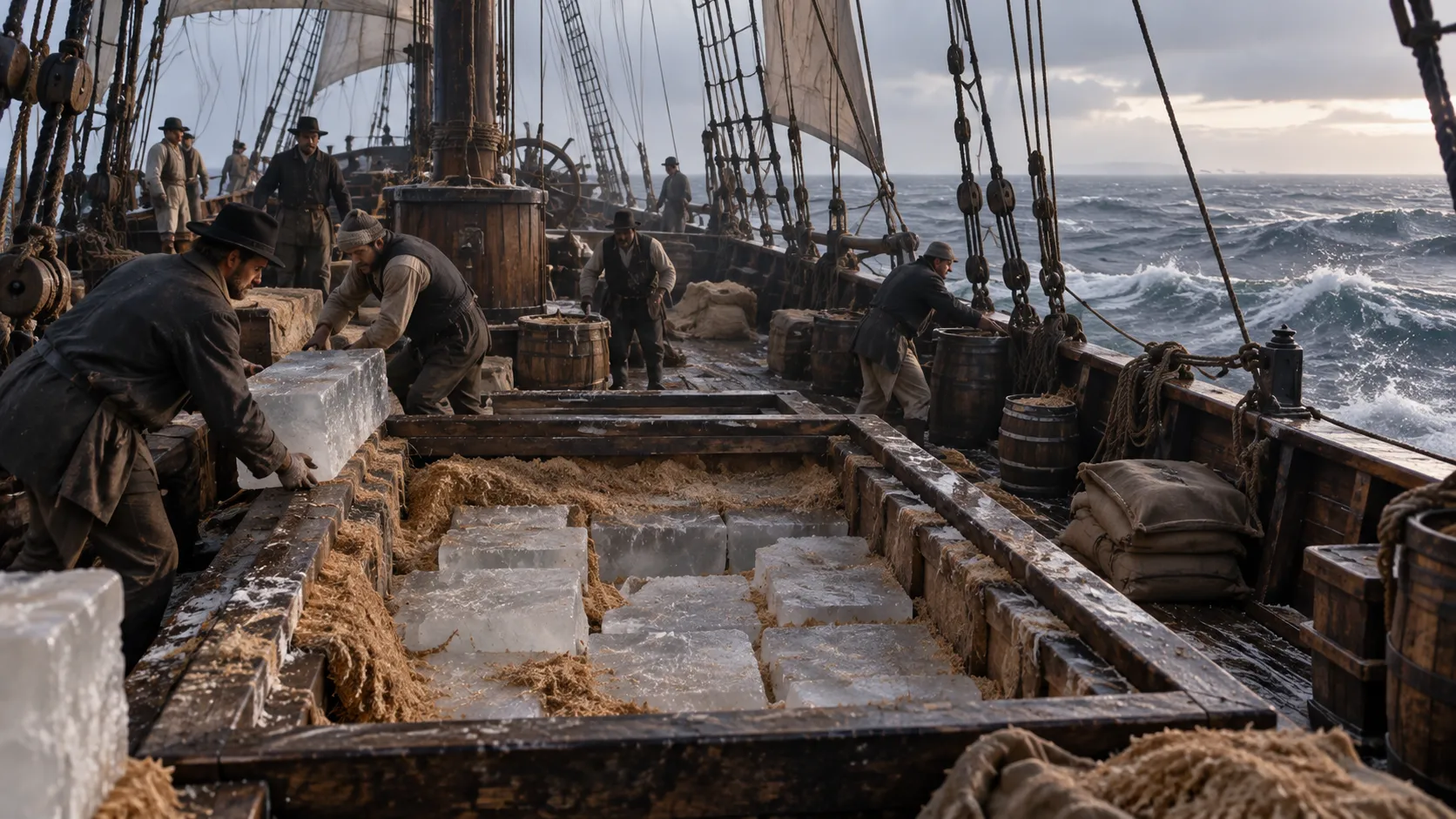
The ice was quarried from the frozen surfaces of Fresh Pond and Wenham Lake. It was packed inside timber ships, insulated with New England pine sawdust and straw.
The method depended on keeping the cargo cold through thousands of miles of travel. The ship’s hold became a giant insulated container, carrying winter into warmer parts of the world.
When the Tuscany reached Chandpal Ghat in September 1833, more than one hundred tons of its original cargo had reportedly survived the journey.
The scale of the achievement was remarkable. Ice had crossed the tropics not as a scientific specimen or a novelty, but as merchandise intended for sale.
Cheaper ice, a new building
Tudor’s imported ice was reportedly sold in Calcutta for three to four paisa per pound—less than half the price of the local Hooghly product.
That price difference helped transform the arrival into a commercial opportunity. European residents formed an Ice Committee and raised subscriptions to build a dedicated storage and distribution centre.
The result was the Calcutta Ice House on Bankshall Street, near the Small Causes Court and Strand Road.
The building was designed to protect the imported ice from the city’s heat. Its circular, double-brick walls and insulated underground vault helped preserve the stock until it could be distributed.
For nearly five decades, the Ice House served as the principal depot for Tudor’s ice business in Calcutta.
A commodity that had once depended on favourable winter conditions near Hooghly could now arrive by ship from the other side of the world and be stored in a purpose-built urban facility.
From luxury to the hospital
Imported ice was associated with European domestic life and dining, but its uses extended beyond private comfort.
According to the research, the Medical College Hospital and British cantonment infirmaries established regular commercial arrangements with the Ice House. Ice was used in attempts to lower fevers, treat heatstroke and preserve clinical specimens.
The same cargo that cooled drinks could therefore become part of colonial medical practice.
This was one of the striking features of the trade: a material harvested from frozen Massachusetts lakes was becoming useful in the daily life of a tropical city—not only in its dining rooms, but also in its hospitals.
When Calcutta began making its own ice
The transatlantic trade did not last forever.
By the late 1870s, local commercial refrigeration began to challenge the imported supply. The research identifies steam-driven ammonia plants associated with the Bengal Ice Manufacturing Company as part of this transition.
Once ice could be manufactured commercially in India, the long journey from Massachusetts became harder to justify.
In 1882, the Bankshall Street Ice House was closed and dismantled. The era of imported American lake ice in Calcutta came to an end.
The business had depended on a striking imbalance: winter was plentiful in one part of the world and difficult to reproduce in another. Refrigeration changed that relationship.
The distance between a frozen lake and a Calcutta street
The story of Tudor’s ice is more than an unusual episode in the history of colonial luxury.
It reveals a city connected to distant places through the movement of goods, labour and technology. Massachusetts supplied the frozen water; ships and insulation carried it across the oceans; Calcutta’s merchants, storage facilities and customers turned it into a local commodity.
For almost half a century, the city’s ice trade depended on transporting winter across the world. Then technology made that journey increasingly unnecessary.
The Ice House disappeared, but its story preserves a remarkable moment in Calcutta’s commercial history: when a frozen lake in Massachusetts became part of everyday life in a city beside the Hooghly.