
The Strange Business of Selling Leeches in Colonial Calcutta
In nineteenth-century Calcutta, some of the city’s medical supplies came not from a pharmacy or a factory, but from Bengal’s wetlands.
Among them were medicinal leeches: small, slippery creatures collected from shallow water, transported to the city and supplied to hospitals. What might seem an unlikely business connected rural harvesters, commercial contractors and colonial medicine in a trade built around a living animal.
The leech had become something that could be counted, priced and delivered.
From Bengal’s wetlands to the city
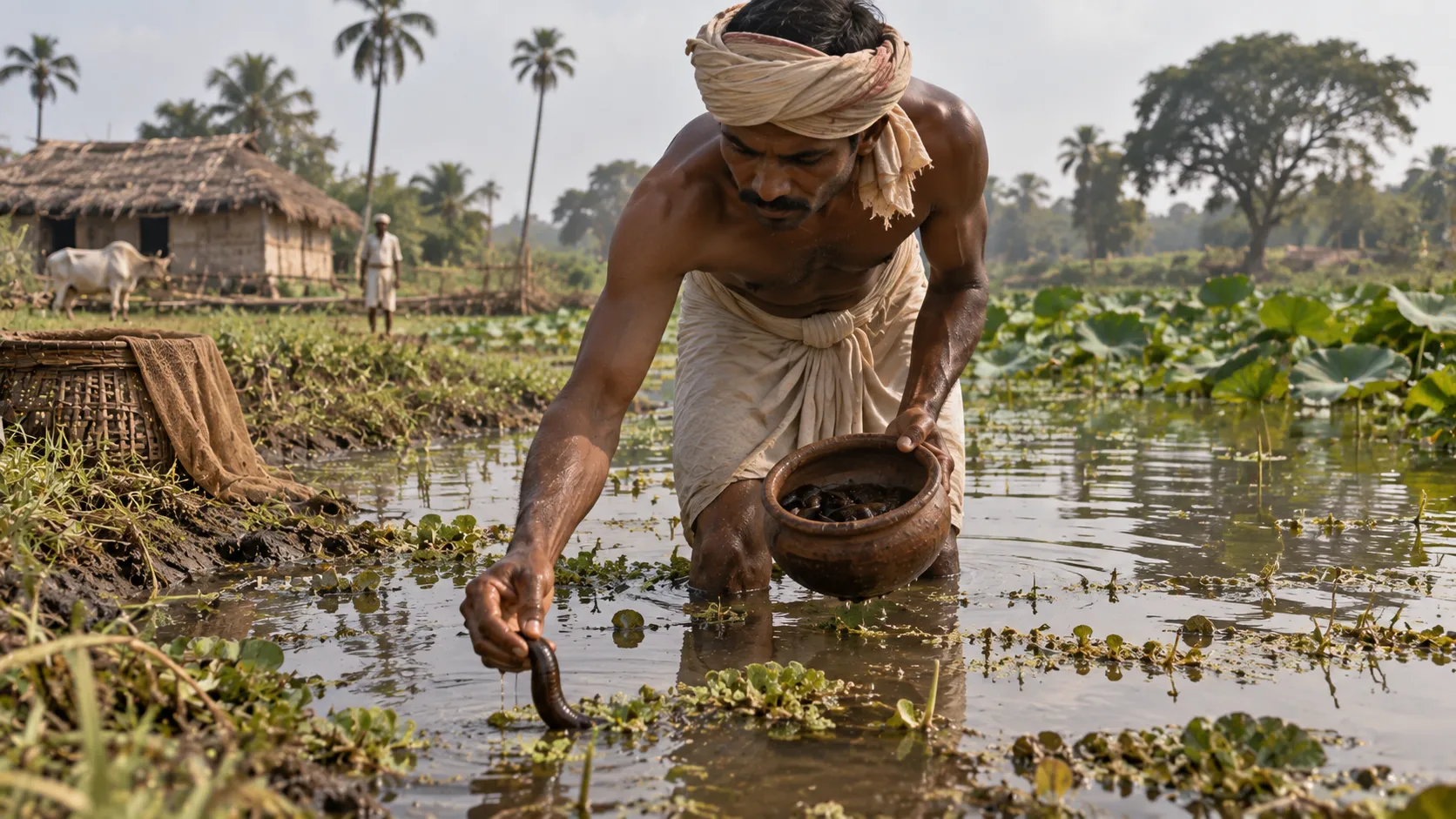
The story began outside Calcutta, in the watery landscapes where leeches could be found. The research account identifies places including Dhapa’s Salt Lakes, the Sundarbans and parts of rural Burdwan as sources of supply.
The people who collected them were known as jonk-wallahs—literally, leech sellers or leech workers. Their work brought them into close contact with the wetlands, where they gathered creatures that would eventually be used in medical treatment.
The collection itself was only the first step. Leeches had to be gathered in sufficient numbers, kept alive and moved to the institutions that required them. That made the trade dependent not just on the availability of leeches, but on the people and arrangements capable of delivering them.
A creature living in a marsh had entered an urban supply chain.
A medical commodity
To understand why anyone would buy leeches in large quantities, we have to enter the medical world of the nineteenth century.
Bloodletting—the removal of blood as a treatment—was widely practised in European medicine and in colonial medical settings. Leeches offered one means of drawing blood, and physicians used them for a range of conditions according to the medical theories of the time.
Their use made them a recurring medical requirement rather than a one-off curiosity. Hospitals needed live specimens that could be kept until treatment, creating demand for reliable suppliers.
The research paper describes the Bengal Medical Board issuing tenders for live leeches. Contractors reportedly supplied quantities ranging from 100,000 to 300,000 annually, with prices of around two to four rupees per hundred.
These figures are remarkable, though they should be treated as reported estimates until confirmed against original procurement records. Even with that qualification, the account points to an organized market—not merely individuals selling a few leeches to local practitioners.
The business between marsh and hospital
The trade depended on more than the harvester and the physician.
Contractors connected collection to institutional demand. They had to assemble supplies, transport living creatures and meet the requirements of medical buyers. In this sense, leeches belonged to the same broad world of procurement that supplied colonial institutions with food, fuel and other necessities.
But the commodity was unusual. Unlike a sack of grain or a bundle of timber, leeches had to arrive alive and remain usable. Their value depended on handling and care as well as quantity.
The business therefore rested on knowledge of both the landscape and the creature: where to find leeches, how to collect them, and how to bring them into the city’s medical system.
The research account gives us a glimpse of that network, though it does not establish the names and individual histories of the harvesters or provide a complete picture of their earnings and working conditions.
The workers behind the treatment
The jonk-wallahs occupy an intriguing position in this history. They worked at the edge of a medical system whose practitioners and institutions often receive far more attention than the people who supplied it.
Their livelihood connected them to Bengal’s wetlands, while the market for their work was shaped by the needs of colonial medicine. The distance between those two worlds was bridged by collection, transport and contracting.
Yet the surviving account leaves important questions open. How were harvesters recruited? Were they paid by the quantity collected, or through intermediaries? How did seasonal changes affect their work? And how much of the final price reached the people who entered the wetlands?
Those details matter. Without them, the trade risks becoming a story about an astonishing number of leeches rather than the lives and labour that made those numbers possible.
When medicine changed
The demand for medicinal leeches was tied to medical practice. As the theories and treatments of medicine changed, so did the place of bloodletting.
That makes the leech trade a revealing kind of business: one whose fortunes depended not only on supply and transport, but on what doctors believed could heal the human body.
The research account describes the trade as declining in the later nineteenth century. Establishing exactly when and how that decline unfolded would require hospital procurement records and contemporary medical sources.
Still, the larger story is clear. A living creature from Bengal’s wetlands became part of a commercial system serving colonial medical institutions. Its journey connected harvesters and contractors to a changing world of medical treatment.
The leech was never just a creature in the water. For a time, it was a medical supply—and a livelihood.