
Before Satyajit Ray Made Films, He Designed How Bengal Read
Satyajit Ray was a multi-talented master, and for Bengalis he remains an extraordinary part of our cultural imagination. Most of us know him deeply as a filmmaker and writer. But before he became the Ray we know through his films and books, he had already mastered another form of storytelling: the art of the printed page.
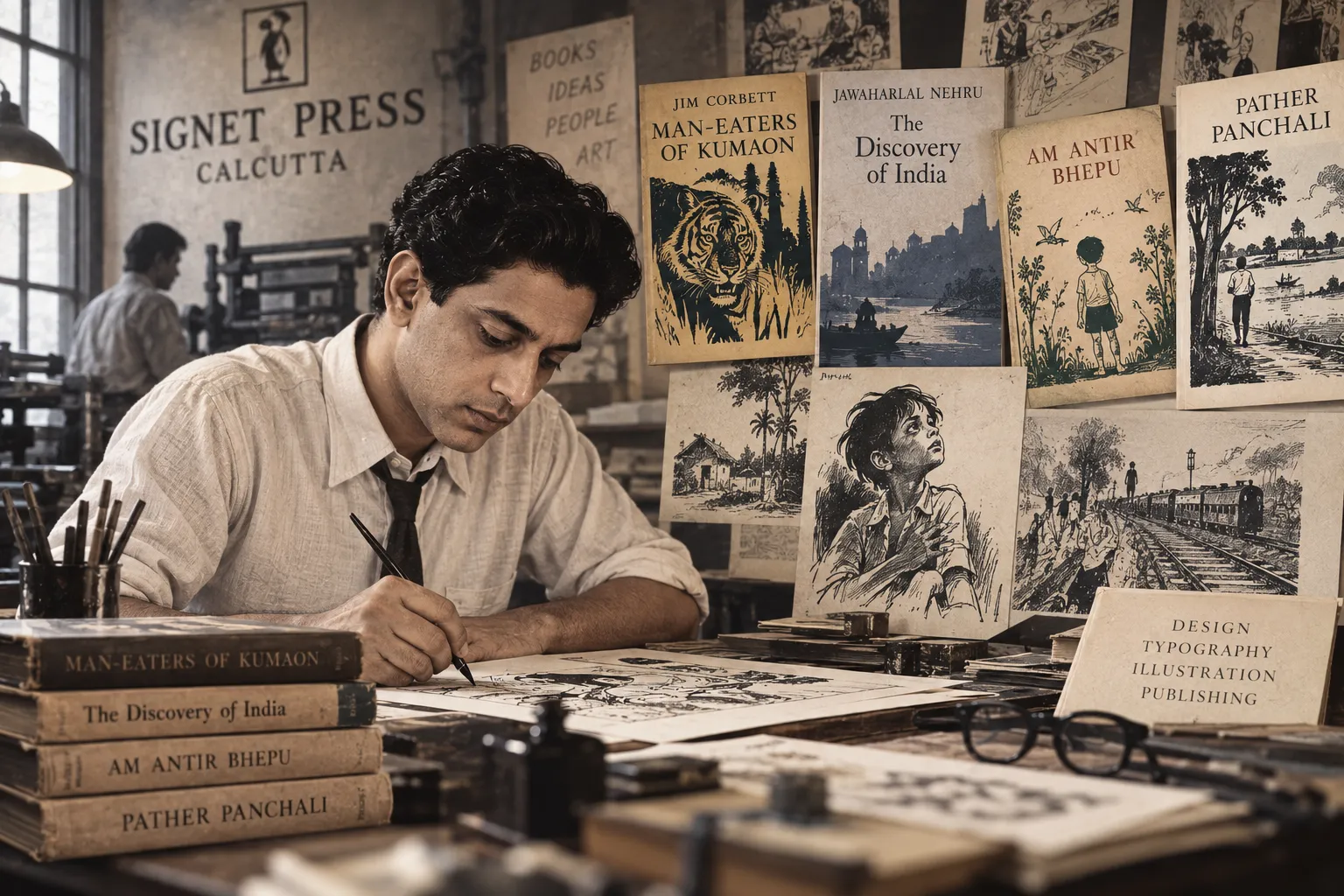
In the 1940s, Ray was working not with a film camera but with a drawing board. His work at Signet Press placed him at the centre of an important moment in Bengali publishing, where a book’s visual identity was becoming part of the reading experience. There, while designing and illustrating books, he encountered a Bengali novel that would eventually become Pather Panchali.
The young designer at Signet Press
After joining the advertising agency D. J. Keymer in 1943, Ray moved into publishing and joined Signet Press, the influential Calcutta publishing house headed by D. K. Gupta. There he was given considerable freedom to design covers for books published by the press. His work included covers for books ranging from Jim Corbett’s Man-Eaters of Kumaon to Jawaharlal Nehru’s The Discovery of India, showing how widely he was already working across different kinds of books.
This was not decorative work in the narrow sense. A book cover had to communicate something about the world inside it before the reader had opened the first page. The designer had to decide what should be noticed, what should remain mysterious and how words and images could create an immediate sense of the book’s character. For a young artist, it was an education in visual storytelling.
Ray was learning how to make a reader curious with a single image.
Then he encountered Bibhutibhushan
The decisive connection came through Bibhutibhushan Bandyopadhyay. Signet Press published Am Antir Bhepu, a version of Pather Panchali adapted for younger readers, and Ray was involved in its visual design. He illustrated the book and designed its cover, bringing him into close contact with Bibhutibhushan’s world.
The encounter mattered. While working on the illustrations, Ray developed a growing interest in Pather Panchali, and that interest eventually became the foundation for his decision to make the story into a film.
This detail changes the familiar story of Ray’s filmmaking career. Pather Panchali was not simply a Bengali novel that a future director happened to discover and decide to adapt. Ray had already spent time looking at its characters and landscape through the eyes of an illustrator.
He was learning to see Apu before he ever filmed him.
A book designer learning to think in images
Ray’s work at Signet belonged to a period when Bengali publishing was becoming increasingly sophisticated in its visual presentation. A book was not only a container for written words. Cover design, typography and illustration could establish mood, attract a particular readership and give a publication its own visual identity.
Ray was particularly suited to this environment because his interests were never confined to one medium. His years at Santiniketan had exposed him to the work and teaching of artists including Nandalal Bose, while his advertising career had trained him to communicate ideas quickly through visual composition. Signet gave him a space where these different abilities could come together around the printed page.
The result was a body of graphic work that deserves to be remembered in its own right, even though it is often treated as a preface to the films.
From the page to the screen
The transition from book design to cinema may seem enormous, but the two forms share a fundamental discipline: how do you guide the eye?
A designer decides where the reader looks first, what information comes next and how separate elements belong together. A filmmaker faces a related problem with a moving image. The frame has to be composed; attention has to be directed; objects, people, light and space have to work together.
Ray’s years as a graphic designer therefore gave him more than a way to earn a living. They trained him to think visually before he had directed a feature film.
That visual instinct remained with him throughout his career. He designed posters and book covers, worked with typography and illustration, wrote and illustrated for Sandesh, and even created a typeface. His involvement in the visual details of his films was part of the same broader habit: he was interested not only in the story being told, but in how the audience would encounter it.
Why Pather Panchali mattered twice
There is another reason the Signet story is important. Ray’s relationship with Pather Panchali began through publishing, but eventually transformed into one of the defining films of Indian cinema. The same young man who had translated Bibhutibhushan’s prose into illustrations would later translate that world into moving images.
The transformation was not simply from book to film. It was from one form of visual interpretation to another. On the printed page, Ray had to imagine what Apu, Durga, Indir Thakrun and the Bengal landscape might look like; on film, he could make those images move through time and space.
The train, the pond, the village path, the monsoon and the family’s fragile everyday life could become experiences rather than illustrations. The illustrator had found a new medium.
The forgotten chapter before the camera
This is why Ray’s years before filmmaking deserve more attention. His career did not suddenly begin when he picked up a camera. It developed through a chain of experiences in which literature, illustration, advertising, typography and design continually fed into one another.
Signet Press was especially important because it placed him close to Bengali literature at the moment when he was developing his own visual language. The books he designed were not merely assignments. Some of them became encounters that shaped the stories he would later tell on screen, with Pather Panchali being the clearest example.
There is a useful way to think about this overlooked chapter of Ray’s career. Bengalis know the filmmaker who transformed Bengali stories into cinema, and they know the writer who created Feluda, Professor Shanku and other literary worlds. Before those two identities became so familiar, however, there was a young artist learning how to make a book communicate through its cover, its illustrations and its typography.
Before Ray showed Bengal to the world through cinema, he was already learning how to make Bengal look at itself through the printed page.