
The Printing Press That Made Modern Bengali Imagination
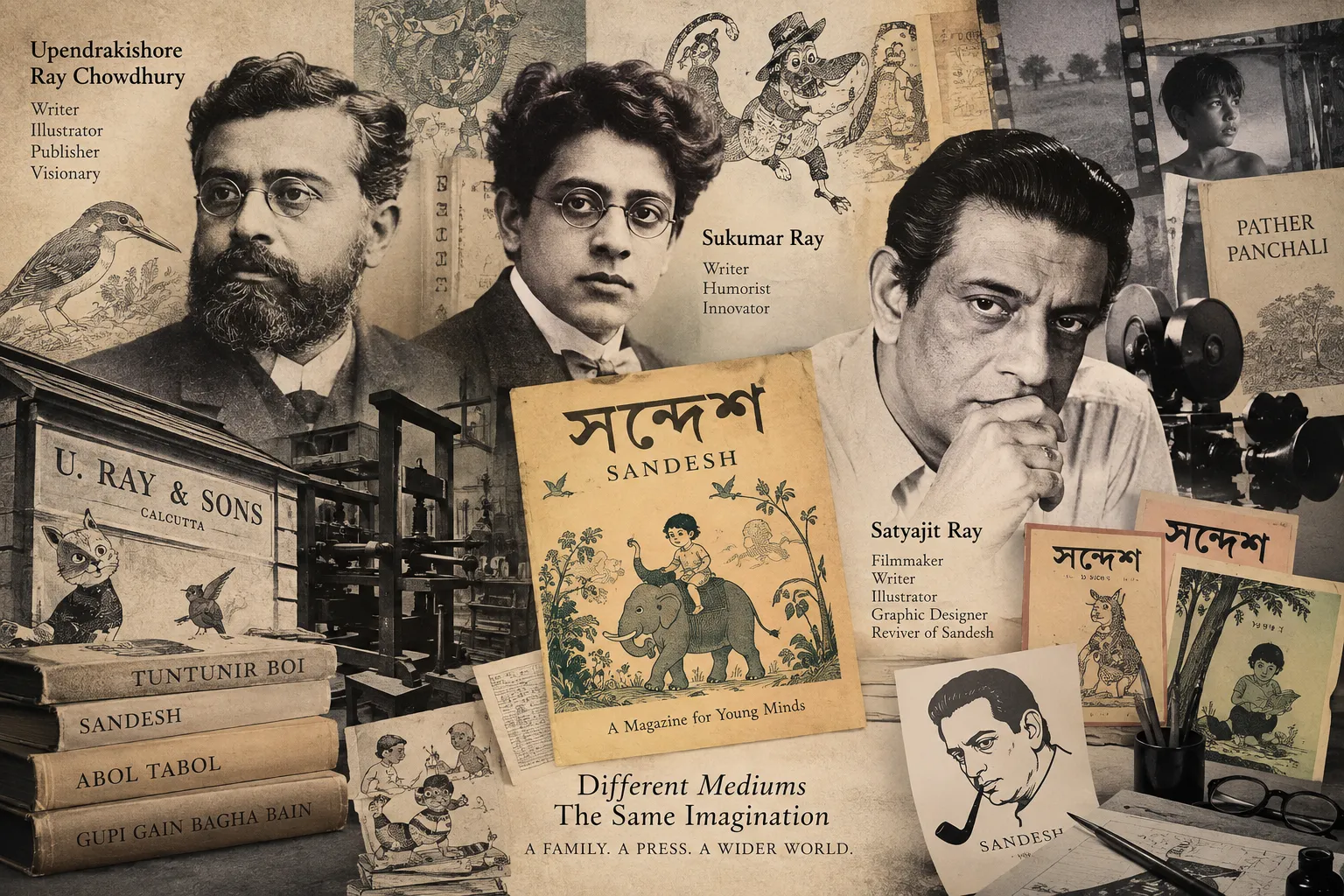
Long before Satyajit Ray made films that travelled around the world, his family was already changing the way Bengal saw and read. The story begins not in a film studio, but in a printing press in Calcutta, where Upendrakishore Ray Chowdhury brought together several interests that rarely occupied the same space: literature, illustration, music and the technology of reproduction. The press he established, U. Ray & Sons, became an important part of the family’s creative world and, through that world, left a mark on Bengali publishing.
Upendrakishore was not simply a writer who happened to own a press. He was deeply interested in the technical side of printing itself. The supplied script describes U. Ray & Sons as a significant development in the world of Bengali and Indian printing, and notes that works ranging from Tuntunir Boi to Sandesh were printed there. The family’s interest in printing technology also extended to the next generation: Upendrakishore sent his eldest son abroad to study modern printing methods.
When printing became part of the creative process
That combination of technical knowledge and artistic work is what makes U. Ray & Sons worth remembering. A printing press normally sits behind the finished book: the writer writes, the illustrator draws, and the printer reproduces the result. In Upendrakishore’s world, those activities were much closer together. Understanding how an image could be reproduced was itself part of the creative process, and the technology of printing became something to experiment with rather than merely a service to be purchased.
This mattered at a time when Bengali publishing was developing rapidly. Better reproduction meant that illustrations could become more important to the reading experience, while carefully designed pages could make books and magazines more visually engaging. Upendrakishore’s work therefore belonged to a larger transformation in which printing was not merely helping Bengali literature circulate; it was helping determine what a Bengali book could look like.
A family business became a cultural inheritance
The press also created an unusual environment for the Ray family. Sukumar Ray inherited not only a literary household but a family deeply involved with printing, illustration and new visual technologies. After studying science at Presidency College, he went abroad for higher training related to printing, photography and lithography, bringing another layer of technical knowledge into the family tradition. At the same time, he was developing the distinctive literary world that would eventually produce works such as Abol Tabol.
The important point is not that three generations of the family happened to be talented. Their talents developed within an environment where different forms of creative work constantly met one another. Printing could lead to illustration; illustration could lead to book design; publishing could create a readership; and a readership could encourage new kinds of writing. The family business became part of the infrastructure through which those ideas reached people.
Sandesh gave that imagination a readership
In 1913, Upendrakishore began Sandesh, the children’s magazine that would become one of the most enduring parts of the Ray family’s legacy. Its importance was not simply that it provided children with something to read. The magazine belonged to the same world in which writing, illustration, information and visual presentation were treated as parts of a single publishing experience.
That tradition survived long after Upendrakishore’s death. Satyajit Ray revived Sandesh in 1961 and contributed to it as a writer and illustrator. The supplied script specifically identifies the revival of Sandesh as one of Satyajit’s contributions and describes him as a writer, composer and graphic designer who also designed a typeface.
By then, the medium had changed considerably, but the underlying relationship between visual design and storytelling remained remarkably familiar. Satyajit was not beginning from nowhere. He had grown up within a family culture in which the printed page was already understood as a visual as well as literary medium.
Before cinema, there were books
This becomes especially revealing when we look at Satyajit Ray’s own career before filmmaking. In 1943 he joined Signet Press, where its head, D. K. Gupta, gave him responsibility for designing book covers. He worked on books ranging from Jim Corbett’s Man-Eaters of Kumaon to Jawaharlal Nehru’s The Discovery of India, and he also designed the cover for Bibhutibhushan Bandyopadhyay’s Am Antir Bhepu.
Then came Pather Panchali. Ray did not encounter Bibhutibhushan’s novel for the first time as a filmmaker. He encountered it through publishing. While working on the Signet edition, he illustrated the book as well as designing its cover, and the experience deepened his interest in Bibhutibhushan’s writing and in Pather Panchali itself.
That detail changes the way we might think about the beginning of Ray’s cinema. His journey towards Pather Panchali was not simply a filmmaker discovering a story he wanted to film. It was also a graphic designer encountering a Bengali novel through the physical act of making a book.
The printed page came first.
The visual language travelled with him
When Ray eventually moved into cinema, he carried this experience with him. His later reputation rested on filmmaking, but his work continued to cross boundaries between different forms of visual communication. He designed posters and book covers, worked with typography and illustration, wrote for Sandesh, composed music and approached filmmaking with an unusually broad control over its visual elements.
Seen from this perspective, the printing press at the beginning of the family story no longer seems like an incidental detail. It helps explain why the Ray tradition repeatedly moved between literature and visual art rather than keeping them in separate compartments.
Upendrakishore explored the possibilities of modern printing. Sukumar combined literary invention with visual and technical interests. Satyajit carried that inheritance into book design and eventually into cinema. The tools changed, but the habit of thinking across forms remained.
More than a press
It would be too much to claim that U. Ray & Sons single-handedly created modern Bengali visual culture. Bengal’s publishing world was shaped by many printers, publishers, writers, artists and institutions. But the Ray family’s press offers an unusually clear example of how technology can become part of a culture’s creative imagination rather than remaining invisible infrastructure.
That may be the most interesting part of its history. A printing press is usually remembered as a machine that reproduces what somebody else has already created. In the Ray family’s hands, printing became closely connected to the making of the work itself: to illustration, children’s literature, typography, book design and eventually cinema.
And that is why the story of Satyajit Ray does not really begin with a camera.
It begins with a family that understood that the way a story is reproduced can influence the way a culture learns to see it.