
How Rich Was Bengal Before the British Won at Plassey in 1757?
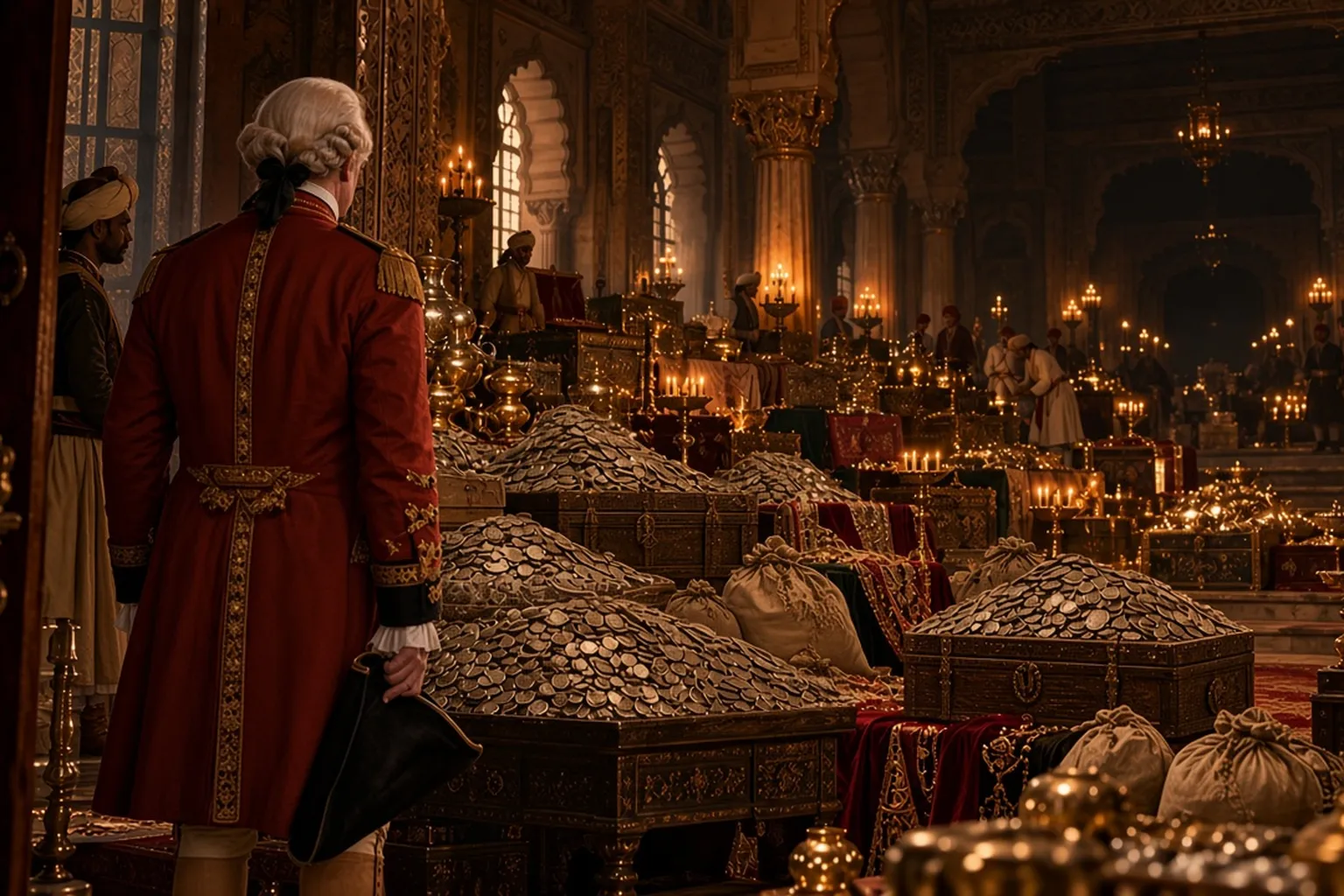
In 1773 Robert Clive stood before a committee of the House of Commons, defending the fortune he had carried home from Bengal. He asked the members to picture where the Battle of Plassey had left him in 1757. A great prince was dependent on his pleasure. An opulent city lay at his mercy. “I walked through vaults which were thrown open to me alone, piled on either hand with gold and jewels!” he said. “Mr. Chairman, at this moment I stand astonished at my own moderation.”
The vaults were in Murshidabad, then Bengal’s capital. So how rich was Bengal before Plassey? It was the richest province of the Mughal Empire. In 1722 its land revenue was assessed at just over 1.4 crore rupees (a crore is ten million), it sent the emperor in Delhi a crore a year, and around 1700 more than half the Asian cloth landing in Holland had been woven in Bengal. The people who grew the rice and wove the cloth were mostly poor. That is part of the story too.
You may have seen the claim that Bengal once held 12 per cent of the world’s wealth. Nobody has produced a document for that number. The numbers that do survive are surprising enough.
Free fertiliser, every monsoon
The Ganga, the Brahmaputra and the Meghna spread over the delta every rainy season. When the water drains away it leaves a fresh skin of silt, so the land never tires. A farmer could take two or three crops a year: aus rice before the monsoon, aman during it, boro at winter’s end.
The result was food so cheap that people turned it into legend. Shaista Khan, who governed Bengal from 1664 to 1688, was remembered for a time when rice sold at eight maunds, a few hundred kilos, for a single rupee. When he left Dhaka, the story goes, he had the city’s western gate shut with an inscription: let only the man who can show rice this cheap open it again.
The surplus went out by boat to south India, Sri Lanka, Southeast Asia and the Maldives, and from the Maldives came back the cowrie shells that still sit in the Lakshmi jhapi.
The river was the highway
In Gujarat or north India, goods went by bullock cart and camel, and the animals’ fodder went into the price of everything they carried. Bengal had water. When I was small, an auto ride cost five rupees, and I crossed the river by steamer for eight annas or a rupee. Water has always been cheap. Big country boats carried rice, cotton, salt and saltpetre from one ganj to the next. Around 1780 the surveyor James Rennell reckoned that Bengal’s inland navigation gave constant employment to thirty thousand boatmen. That was only the number he counted.
Cheap transport meant cheap food. If a family in Murshidabad could buy Burdwan rice cheaply, a worker could accept a lower wage, and things made in Bengal could be sold abroad at prices few could match. Bengal, in effect, had a factory floor of its own.
A million people at the loom
Around 1711 Bengal had something like twenty million people, and about a million of them worked at making cloth: spinning, weaving, bleaching, dyeing. Most of them were not in towns. Between planting and harvest, women spun yarn on a takli, a small spindle turned in a coconut shell. Hindu tantis and Muslim jolas wove it in neighbouring villages and sold into the same markets.
The odd part is that Bengal was not really cotton country. Its wet soil suited rice, mulberry and sugarcane. A special cotton, phuti karpas, grew near Dhaka and gave the legendary muslin, but the bulk of the raw cotton came in from outside, mainly from Gujarat. Bengal brought in the fibre and sent out the skill. Muslin gets the attention, but the real business was ordinary cotton cloth from looms between Burdwan and Dhaka, worn from Arabia to Indonesia.
Then there was silk. Mulberry grew around Kasimbazar, just south of Murshidabad, and between 1693 and 1720 Bengal supplied, on average, 88 per cent of all the Asian raw silk sold in Amsterdam.
Put cloth and silk together and Bengal dominated what Europe bought from Asia. Around 1700 about 55 per cent, by value, of the Asian textiles reaching Holland came from Bengal alone. For the English East India Company, Bengal supplied 42 per cent of the value of all the goods it shipped out of Asia in 1698–1700.
Paid in silver
Bengal wanted very little that Europe made, so Europe paid in silver. American silver came through Europe to the Hooghly and was struck into sicca rupees at Bengal’s mints. Before Plassey the Dutch alone were bringing in bar silver worth 36 to 37 lakh rupees a year. In the nine months from June 1756 to February 1757, ten Dutch ships sailed out of Bengal loaded with its goods.
Europeans were not even the biggest buyers. In 1763 Luke Scrafton, a Company official who had served in Murshidabad, looked back on the years before Plassey: “incredible numbers of merchants from all parts of Asia in general as well as from the rest of Hindustan in particular, sometimes in bodies of many thousands at a time were used annually to resort to Bengal with little else than ready money or bills to purchase the produce of these provinces.”
Much of that money passed through the mint at Murshidabad and the counting house of the Jagat Seths, a banking family whose story needs a chapter of its own.
What the treasury collected
The state took its share. By the early 1700s the emperor Aurangzeb had been at war in the Deccan for twenty years, and his soldiers’ pay was three years in arrears. From 1702 Bengal’s new diwan, Murshid Quli Khan, began sending a crore of rupees to the emperor every year. For a while, that money kept the empire breathing.
In 1722 Murshid Quli carried out a fresh survey of the province and fixed its land revenue at just over 1.4 crore rupees. Sixty years later, the British revenue expert James Grant still treated that figure as the true measure of what Bengal could pay.
What the travellers saw
In 1346 Ibn Battuta, the Moroccan traveller, reached Bengal after forty-three days at sea. “Nowhere in the world have I seen cheaper produce than there,” he wrote. He saw fat hens sold at eight for one dirham, and a fat ram for two. People from Khurasan, he added, called damp, gloomy Bengal “a hell full of blessings”. The locals told him the rice prices he saw were high.
Ralph Fitch, an English merchant, came to Sonargaon near Dhaka in 1586 and found “the best and finest cloth made of cotton that is in all India”, and so much rice going out “wherewith they serve all India, Ceylon, Pegu, Malacca, Sumatra, and many other places.” In the 1660s the French physician François Bernier wrote that Egypt had always been called the most fruitful country in the world, but after two visits to Bengal he believed “the pre-eminence ascribed to Egypt is rather due to Bengale.”
Whose house did Lakshmi live in?
The wealth did not sit evenly. In 1789 John Shore, a Company revenue official, estimated that out of every hundred parts of a crop, about forty-five went to the state, fifteen to the zamindar and his men, and forty stayed with the farmer. Those forty had to cover food, seed and debts. The economic historian Tirthankar Roy puts average income in Bengal around 1763 at about twelve and a half rupees a head. For the whole year. Cheap rice filled stomachs in ordinary years. There was little put by for a bad one.
After Plassey
Plassey put political power in the East India Company’s hands, and in 1765 it took the diwani, the right to collect that 1.4 crore of revenue. Clive’s vaults are where this story stops. The rest belongs to stories still to come here: the rivers that had already been moving Bengal’s centre east, the bankers of Murshidabad, the rumour about weavers’ thumbs, the famine of 1770, the salt monopoly, and a widow who lived by her spinning wheel and wrote to a Bengali newspaper in 1828.
On Kojagari night, the full moon of Lakshmi Puja, Bengalis say the goddess goes from house to house asking ko jagarti, who is awake? Before Plassey, Bengal had plenty of people awake: the spinner at her takli before dawn, and the banker counting silver in Murshidabad. Lakshmi visited both. She stayed longer with the banker.