
In Bengal, the Goddess of Wealth Keeps Seashells. They Were Once Real Money.
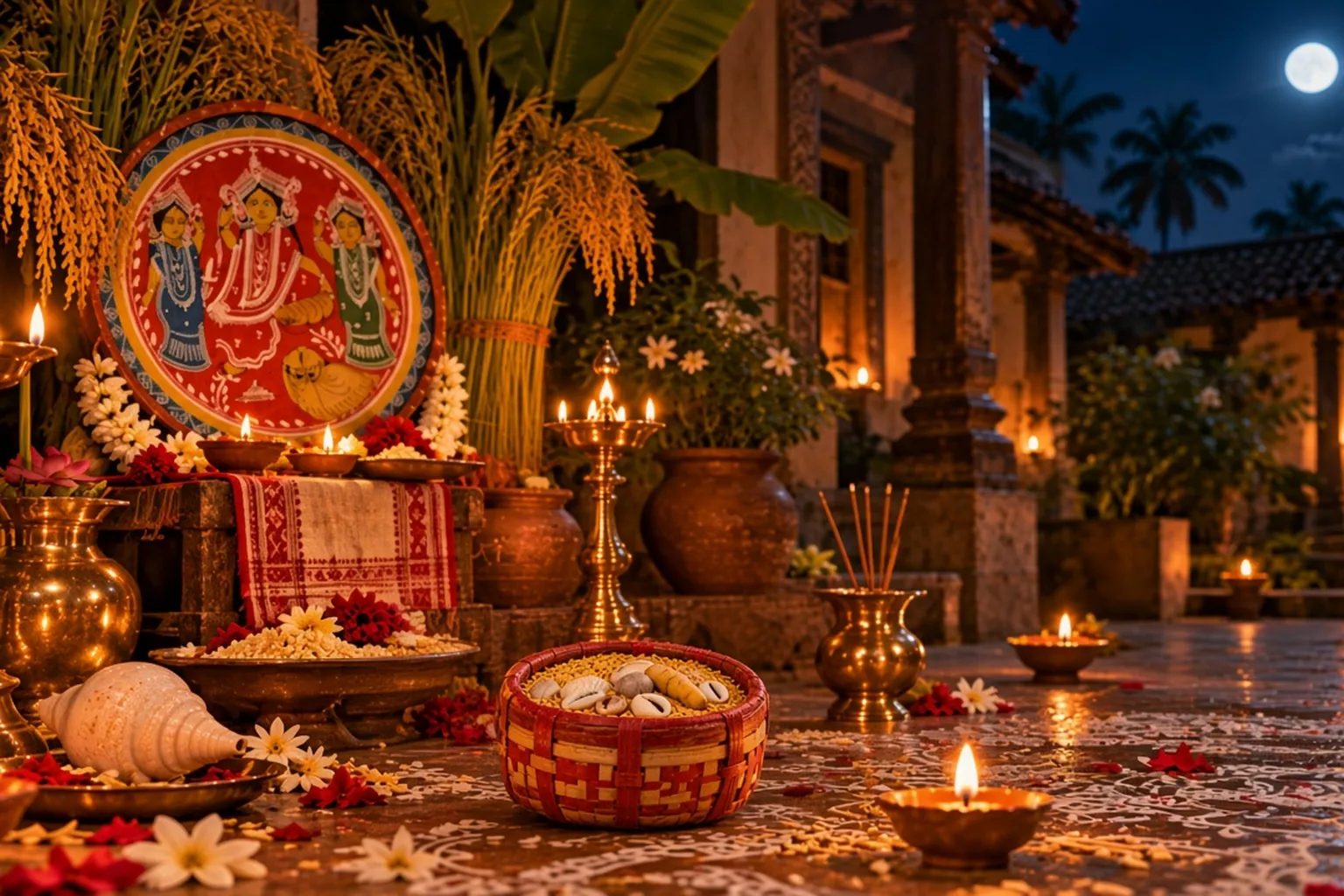
On the night of Kojagari Lakshmi Puja, the full moon that comes a few days after Durga Puja, somebody lifts the lid off a small cane basket and tips it toward the lamp. Paddy, gold-brown and dusty. And down among the grain, a few small white shells that click against each other when the basket moves.
Usually, in a Bengali Hindu family that does Kojagari Lakshmi Puja, there is a Lakshmi’s jhapi. It is kept full: paddy, kori, and in some houses ashtadhatu, the old alloy of eight metals. That jhapi is the sign of plenty. It comes down the family, generation to generation.
Here is the thing most of us were never told. Those shells, kori in Bengali and cowries in English, were money. Real money, the kind you paid the fishwife with. For centuries, people in Bengal bought their oil, salt and vegetables with shells that had come across the sea from the Maldives, and Bengal paid for the shells with rice.
A beach, and a boat full of rice
The Maldives are coral atolls, a thousand-odd specks of sand in the Indian Ocean. They grew coconuts and very little else. They could not grow enough rice.
What they had were cowries, the small glossy shell of a sea snail, Cypraea moneta. Islanders gathered them in the shallows, left them to rot clean, and piled the white shells in heaps. When Ibn Battuta, the Moroccan traveller, lived on the islands in the 1340s, he watched the trade. “They sell them in exchange for rice to the people of Bengal,” he wrote, in H. A. R. Gibb’s translation, “who also use them as money.”
So the boats went south heavy with Bengal’s rice and came back heavy with shells. Some of that rice left from Saptagram, the river port near Hooghly that later choked on its own silt. In exchange for that rice, huge quantities of sea cowries came to Bengal, and in Bengal’s markets they became the small change ordinary people did their daily shopping with. Korir kotha to amra shobai shunechhi. We have all heard of cowries. Fewer of us know that a port on the Saraswati is tied up in their story.
How far back does this go? The historian Bin Yang, who has written a global history of cowrie money, thinks it was in Bengal that the shells first turned into money, probably as early as the fourth century CE. By his account the same shells later carried trade as far as China and West Africa.
What visitors saw
Outsiders kept noticing it.
Minhaj-i-Siraj, writing in the thirteenth century about the last Sena king, Lakshmana Sena, said that in Bengal the cowrie was current in place of silver, and that the smallest gift the king gave was a lakh of cowries. A hundred thousand shells. Then, being a pious Muslim writing about a Hindu king, Minhaj added a little prayer that God might lighten his punishment in hell. Still, a lakh of shells. You can hear that he was impressed.
Under the Sultans, Bengal ran on two kinds of money at once. The historian John Deyell describes heavy, nearly pure silver tanka coins for the government and big traders, and cowries for everyone else. Ma Huan, a Chinese interpreter who came with the Ming fleets in the early 1400s, wrote it down too. Prices were reckoned in the silver tanka, he said, and “the cowrie goes by the foreign name of k’ao-li,” counted out in trade.
K’ao-li. Read it aloud. A man from China, six hundred years ago, heard a Bengali say kori and wrote it down as best he could.
Four kori make a ganda
Then there is the arithmetic, which a grandfather of a certain age can still rattle off.
In the old village pathshala, children chanted tables from the Shubhankari, a body of rhymes for counting and measuring. Some of it was about shells. Four kori make one ganda. Five ganda make one buri. Four buri make one pan. Sixteen pan make one kahan. You learned it the way you learned your own address, by saying it out loud until it stuck.
Work it out and one kahan is 1,280 cowries. How many kahan to a silver rupee, though, depended on where you stood and when. Robert Lindsay, a young Scottish Company official sent to collect revenue in Sylhet around 1778, reckoned four kahan to the rupee, which came to 5,120 shells. Other tables give ten. The shell market moved like any other.
Lindsay is worth staying with, because his problem was so physical. Sylhet paid its land revenue in cowries, about 250,000 rupees’ worth a year. That is well over a billion shells. He needed whole cellars to store them, and a fleet of boats to send them down to Dhaka, losing a share on the way. He couldn’t work out how shells from islands fifteen hundred miles away had become the only money of a district three hundred miles from the sea. “A question,” he wrote, “neither I or any other person has been able fully to explain.” Sylhet’s revenue was still being collected in shells until about 1801.
Copper coins slowly pushed cowries out. By the end of the nineteenth century they had mostly gone from Bengal’s markets.
What stayed
The words stayed, though. We still say kanakori-o nei, not even a blind cowrie, a broken one with a hole in it, to say a person is flat broke. Phelo kori, makho tel: put your cowrie down, then rub on the oil. Pay first. Something paid koray-gonday is paid to the last shell. And there are the old names, Ekkori, Dukori, Tinkori, Panchkori, Satkori. One cowrie, two, three, five, seven. Somebody’s great-uncle is almost certainly one of them.
And the shells stayed in the jhapi.
Did they go in because, once, this was simply what money looked like in a Bengali house, and you gave the goddess of wealth the wealth you had? I’d like to think so. Nobody wrote down why. The paddy makes sense to anyone. Lakshmi was a goddess of grain long before she was a goddess of bank balances, and a full basket of rice was the first kind of riches. The shells sit beside it as if they had always belonged there.
Pick one up. It is smaller than your thumbnail and heavier than it looks. The back is smooth and humped, cream going faintly yellow. Turn it over and there is the long, narrow mouth with its tiny teeth on both lips. Somebody on a beach in the Maldives once picked up one just like it.