
The Onion That Had to Find Its Place in the Bengali Kitchen
Imagine opening a Bengali cookbook from the early nineteenth century, looking for a meat curry, and discovering that something you expected to find is missing.
The meat is there. The recipes are there. The ambition to describe rich, elaborate cooking is unmistakable. But onion—the ingredient that many modern cooks might reach for almost automatically—is conspicuously absent from the recipes discussed by historian Utsa Ray.
This is not a story about an ingredient that suddenly appeared in Bengal one day. It is a story about how an ingredient found its place in a changing culinary world, where what people ate, what they considered appropriate to eat, and what a cookbook chose to record were not always the same thing.
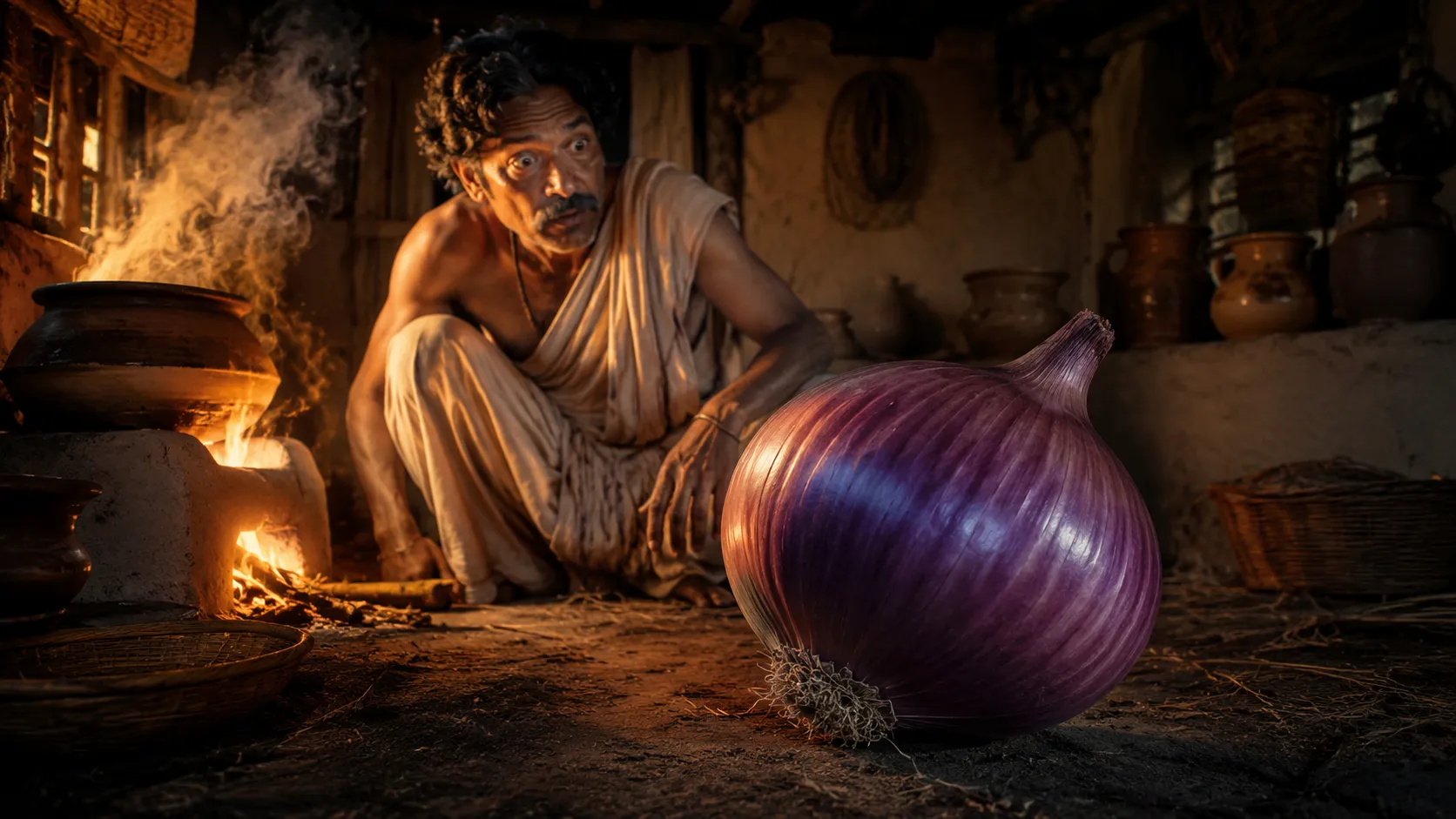
Image disclaimer: The accompanying illustration is an imaginative historical reference image, not an authenticated historical document or a depiction of a specific nineteenth-century Bengali cookbook.
A cookbook with an unexpected omission
In 1831, Pakrajeswar appeared under the patronage of the Burdwan royal house. It was an ambitious Bengali recipe book, containing elaborate dishes, including meat preparations associated with Mughal-influenced cooking.
Yet its treatment of onion is striking. As Utsa Ray explains in Culinary Culture in Colonial India, the author stated that since people in the region hardly consumed onion, he had refrained from listing it as an essential ingredient in the recipes.
That explanation changes the way we read the book. The omission was not necessarily a sign that the author did not know about onion, nor does it prove that nobody in Bengal ate it. Rather, the cookbook was responding to the tastes and expectations of its intended readers.
The recipes were not a census of everything being cooked across Bengal. They were a particular presentation of food, written for a particular social world.
Meat without the expected ingredients
The surprise becomes sharper when we consider the recipes themselves.
Pakrajeswar included rich meat dishes, but the near absence of onion and garlic in these preparations stood out to Ray. She argues that the book’s readers were largely Hindu and not yet accustomed to using these ingredients in their food.
This is a revealing complication in the history of Bengali cuisine. Meat-eating and onion-eating did not necessarily travel together as a single culinary package. A dish could draw on Mughal or Persianate cooking traditions and still be adapted to local preferences and dietary boundaries.
In other words, recipes travelled, but they did not arrive unchanged. Ingredients could be retained, altered or left out as cooks and patrons made unfamiliar culinary forms fit their own expectations.
The result was not simply “Mughlai food” copied into Bengali. It was a process of negotiation.
The cookbook landscape begins to change
Pakrajeswar was not the only early Bengali cookbook to follow this pattern. Byanjan-Ratnakar, published in 1858, also largely excluded onion and garlic from its repertoire.
But the record does not remain frozen there.
In 1879, Pakprabandha appeared with a different approach: it incorporated onion and garlic into its recipes. Ray notes that it was probably written by a woman who did not publish under her own name. That possibility is intriguing, although the author’s identity and circumstances should not be treated as settled fact.
The change matters because it appears within Bengali-language domestic cookery, not simply in a description of food eaten elsewhere. Onion and garlic were becoming part of a recipe-writing world that was itself changing.
By the late nineteenth century, Bipradas Mukhopadhyay’s Soukhin Khadya-Pak and the wider cookbook culture around it were contributing to new ways of thinking about household food. Ray places these books within the emergence of a Bengali middle-class cuisine that combined regional tastes with cosmopolitan influences.
The movement was not a simple march from rejection to acceptance. It was a gradual, uneven process, shaped by class, caste, gender, household ideals and changing ideas of taste.
What a recipe book can—and cannot—tell us
A cookbook is a remarkable historical source, but it has its limits.
It tells us what an author chose to write down, what ingredients were considered worth mentioning, and sometimes what readers were expected to know already. It does not tell us that every family followed those recipes, or that every Bengali kitchen changed at the same pace.
The early books were also not written for the entire population. Ray emphasizes that Pakrajeswar and Byanjan-Ratnakar were produced under royal patronage and presented elaborate dishes suited to elite settings. Their silences cannot be taken as proof of what poorer households, Muslim households or cooks outside those circles ate.
That is why the appearance of onion in later cookbooks is so useful. It gives us evidence of change within a particular documentary tradition—not a single date on which Bengal collectively discovered the ingredient.
How onion became part of the story of Bengali food
The modern Bengali kitchen can make its onion, garlic and ginger base feel timeless. But the cookbook record reminds us that familiar tastes have histories.
In the nineteenth century, Bengali food writers were negotiating what counted as appropriate domestic cooking, how regional identity could coexist with outside influences, and how recipes should be presented to changing readers. Onion’s place in that story was shaped not just by its flavour, but by the social world surrounding the kitchen.
The most revealing detail may be the author of Pakrajeswar explaining why onion was left out: people in the region hardly consumed it. A cookbook did not merely preserve a cuisine; it responded to an idea of who its readers were and what they would accept.
By following that ingredient through the cookbooks, we glimpse Bengali cuisine not as an unchanging inheritance, but as something continually made and remade—one recipe, one household, and one changing expectation at a time.