
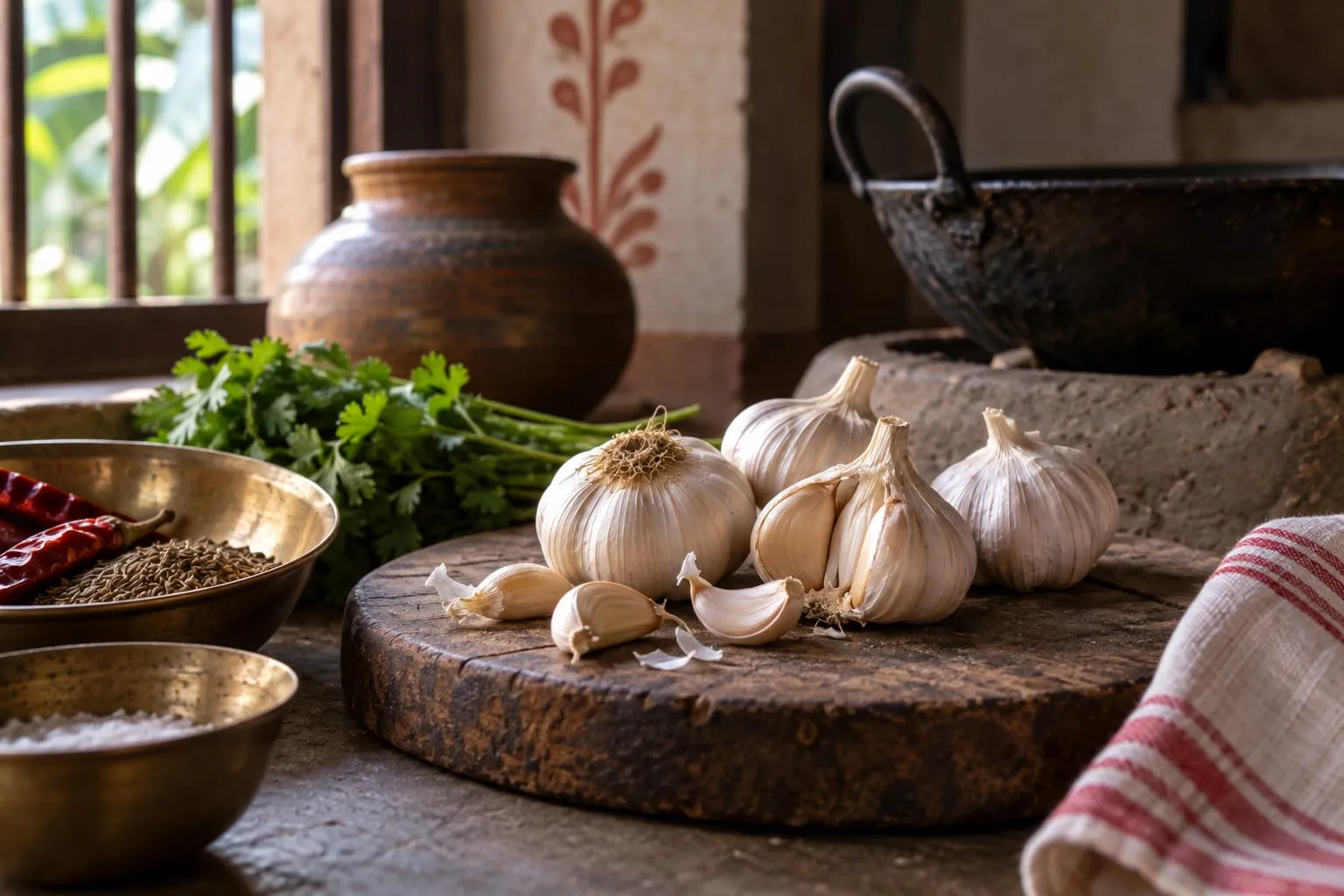
Garlic is so familiar in Bengali cooking today that it is easy to assume it has always been there. But the historical record tells a more complicated story.
Garlic (Allium sativum) is native to Central Asia, and its history stretches far beyond Bengal. It travelled widely through human networks and became an important food and medicinal plant in several cultures.
In South Asian traditions, garlic was not simply a cooking ingredient. It also had a long medicinal history. The Charaka Samhita, for example, contains a preparation known as Lasuna Ksheerpaka, demonstrating that garlic had a recognised place in classical Ayurvedic medicine.
A useful medicine, an unsuitable food
Manusmriti 5.5 lists garlic, onion and certain other foods as unfit for consumption by the dvija, or “twice-born”, groups. The text gives us an important historical clue:
Garlic could be valued in one intellectual tradition while being restricted within another social and religious framework.
That distinction matters when we look at Bengal.
The research behind this story suggests that early Bengali culinary traditions relied heavily on ingredients such as ginger, mustard and cumin, while onion and garlic were absent from some respectable Hindu culinary contexts. But absence from a particular textual tradition does not prove that nobody in Bengal consumed garlic. The evidence is uneven, and the distinction is important.
The cookbooks begin to tell a different story
The clearest evidence for change appears much later, in Bengali cookbooks.
| Year | Cookbook |
|---|---|
| 1831 | Pakrajeswar |
| 1858 | Byanjan-Ratnakar |
| 1879 | Pakprabandha |
| 1889 | Soukhin Khadya-Pak |
| 1900–1902 | Amish o Niramish Ahar |
Pakrajeswar, published in 1831, contained elaborate meat recipes influenced by Mughal culinary traditions, yet onion and garlic were largely absent. Utsa Ray notes that the book’s author explained that onion was hardly consumed by the intended readers. Byanjan-Ratnakar, published in 1858, followed a similar pattern.
By 1879, Pakprabandha was incorporating onion and garlic into Bengali recipes. A decade later, Bipradas Mukhopadhyay’s Soukhin Khadya-Pak became an important marker of changing middle-class food habits.
By the early twentieth century, cookbooks such as Pragyasundari Devi’s Amish o Niramish Ahar were documenting a much more varied Bengali culinary world. The book was published around 1900–1902, depending on the volume and edition.
The story of garlic in Bengal, then, is not simply a story of when an ingredient “arrived”.
It is a story of how a food can move between medicine, religion, social practice and the everyday kitchen—and how those boundaries can change over time.