
The Refugees Who Built a City Without Being Given One
When Partition divided Bengal in 1947, the people arriving in West Bengal did not arrive in a city waiting for them.
They arrived in waves.
Some came with money or relatives who could help them find somewhere to live. Many others arrived with very little. Over the following two decades, an estimated six million refugees from East Bengal entered West Bengal in successive waves, driven by communal violence, political uncertainty and the deteriorating conditions of life in East Pakistan.
Calcutta was already a crowded industrial city. Now it had to absorb a population for which neither the city nor the government had prepared adequately.
What happened next was not simply a story of rehabilitation.
It was a story of people making a city for themselves.
Bengal had a different refugee problem
The comparison with Punjab is revealing.
Partition produced a huge movement of people in both directions in Punjab. Muslims left areas that became part of India, while Hindu and Sikh refugees arrived from Pakistan. This created something that was largely absent in West Bengal: enormous quantities of evacuee property.
Land and urban property abandoned by departing Muslims could be taken into the rehabilitation system and redistributed to incoming refugees. The Indian government also invested heavily in planned settlements, housing and economic rehabilitation in Punjab.
Bengal’s situation was different.
The migration from East Bengal into West Bengal was largely one-way. There was no equivalent mass departure of Muslims from West Bengal leaving behind enough property to house and resettle millions of newcomers.
That difference had enormous consequences.
There was no vast pool of abandoned houses and agricultural land waiting to be reassigned.
There were simply too many people and too little space.
The city was not ready
The central government initially treated much of the eastern migration as a temporary problem. The expectation that refugees might eventually return influenced the scale and nature of rehabilitation offered to them. Assistance was also uneven, with official schemes distinguishing between people considered capable of becoming self-reliant and those treated as long-term dependants.
For families who had already lost homes, land and livelihoods, waiting for an ideal rehabilitation scheme was not an option.
They needed somewhere to live.
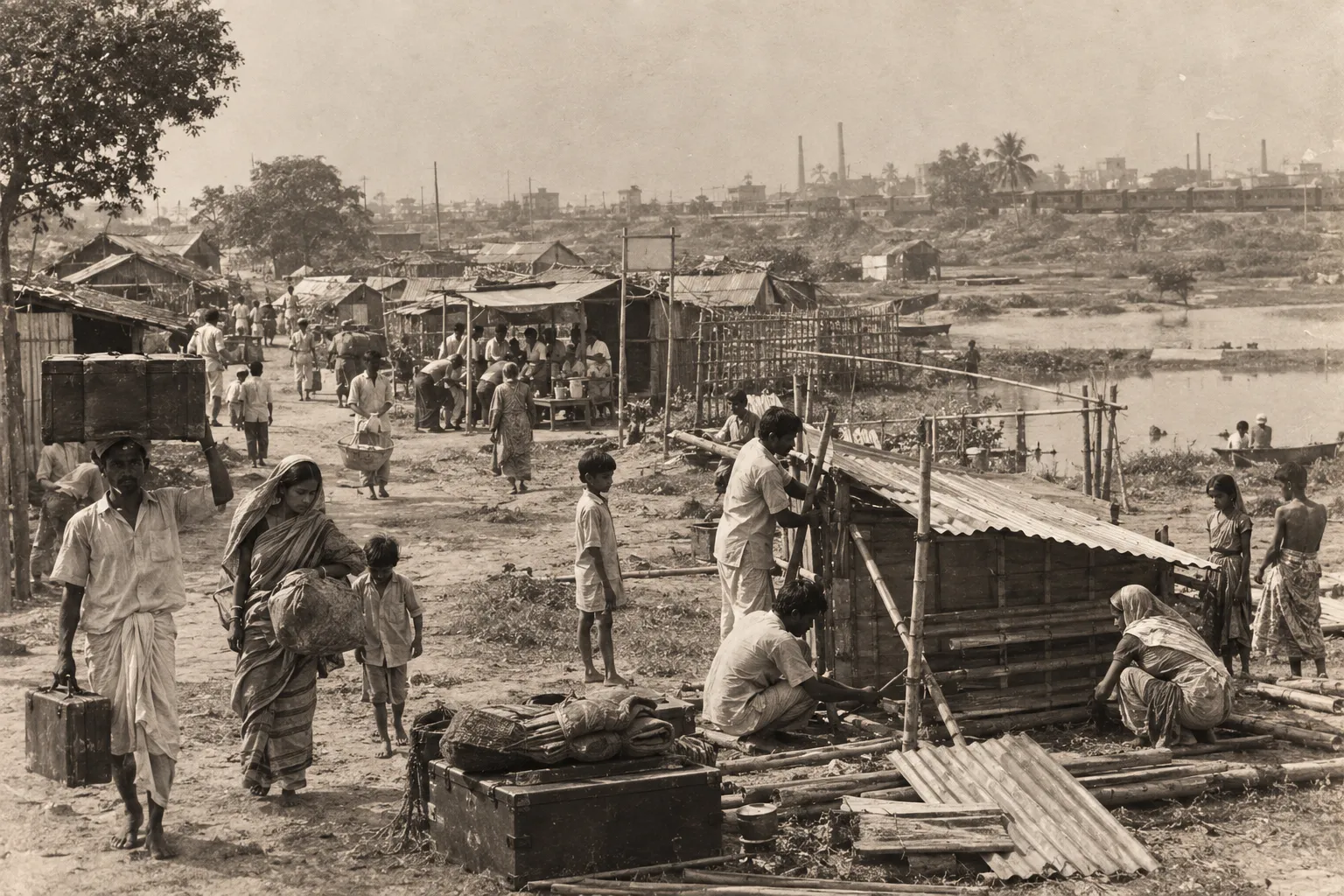
So people began occupying whatever land they could find.
Fallow land around Calcutta became settlement land. Informal occupations developed into squatter colonies. What began as an answer to immediate survival gradually became something more permanent: neighbourhoods, roads, schools, markets and community institutions built through collective effort rather than delivered as a finished urban plan.
The distinction matters.
These were not simply camps where refugees waited for the government to solve their lives.
Many settlements became attempts to establish ordinary urban life under extraordinary circumstances.
Building a neighbourhood before anyone called it a neighbourhood
A house was only the beginning.
A settlement needed a school for children, somewhere to buy food, places of worship, transport, drainage and roads. It needed committees, associations and systems for negotiating with authorities. It needed people willing to contribute labour and money even when neither was plentiful.
The refugee colonies therefore became a form of grass-roots urban development.
The state was present, but often not in the way a modern city planner would expect. Relief, policing and rehabilitation consumed enormous resources, while the scale of the crisis made comprehensive provision extremely difficult. West Bengal’s government was left carrying much of the immediate burden of provisioning and administration.
The refugees themselves filled the gaps.
Their settlements changed the physical geography of Calcutta and its surroundings.
They also changed its social geography.
People who had arrived as displaced families became teachers, clerks, traders, workers, students and professionals. A population that initially appeared in administrative language as a refugee problem gradually became part of the permanent life of the city.
Survival became institution-building
This is perhaps the most important part of the story.
Displacement is usually imagined as a process of loss: a house abandoned, a village left behind, a border crossed.
But migration can also produce something unexpected.
People who have lost a community begin reconstructing one.
The refugee colonies of West Bengal were born from insecurity, but they did not remain defined entirely by it. The same people who had arrived without secure homes created places in which their children could grow up, study and work. Over time, these settlements became part of the ordinary urban fabric of West Bengal.
That transformation was not effortless or equal. Refugees faced poverty, overcrowding, unemployment and discrimination, and many remained economically vulnerable for years. They were a marginalised population caught amid poverty and political conflict.
Yet the larger transformation is difficult to miss.
A city that had not been prepared to receive millions of people was partly rebuilt by the people it failed to accommodate.
The hidden history of post-Partition Calcutta
The story also complicates the way we usually remember Partition.
We tend to picture borders, trains, violence and the movement of people across maps.
But migration does not end when someone crosses a border.
It continues in the years spent finding work, securing land, sending children to school and turning a temporary shelter into a home.
In West Bengal, that process happened on an enormous scale.
The refugees did not simply enter Calcutta’s history.
They helped reshape the city around themselves.
Their greatest achievement was perhaps not surviving the journey from East Bengal. It was creating enough permanence after the journey that the word refugee eventually became inadequate to describe what they had become.
They had arrived without being given a city.
So, piece by piece, they built one.