
When Bengalis Stopped Wanting to Be Merchants
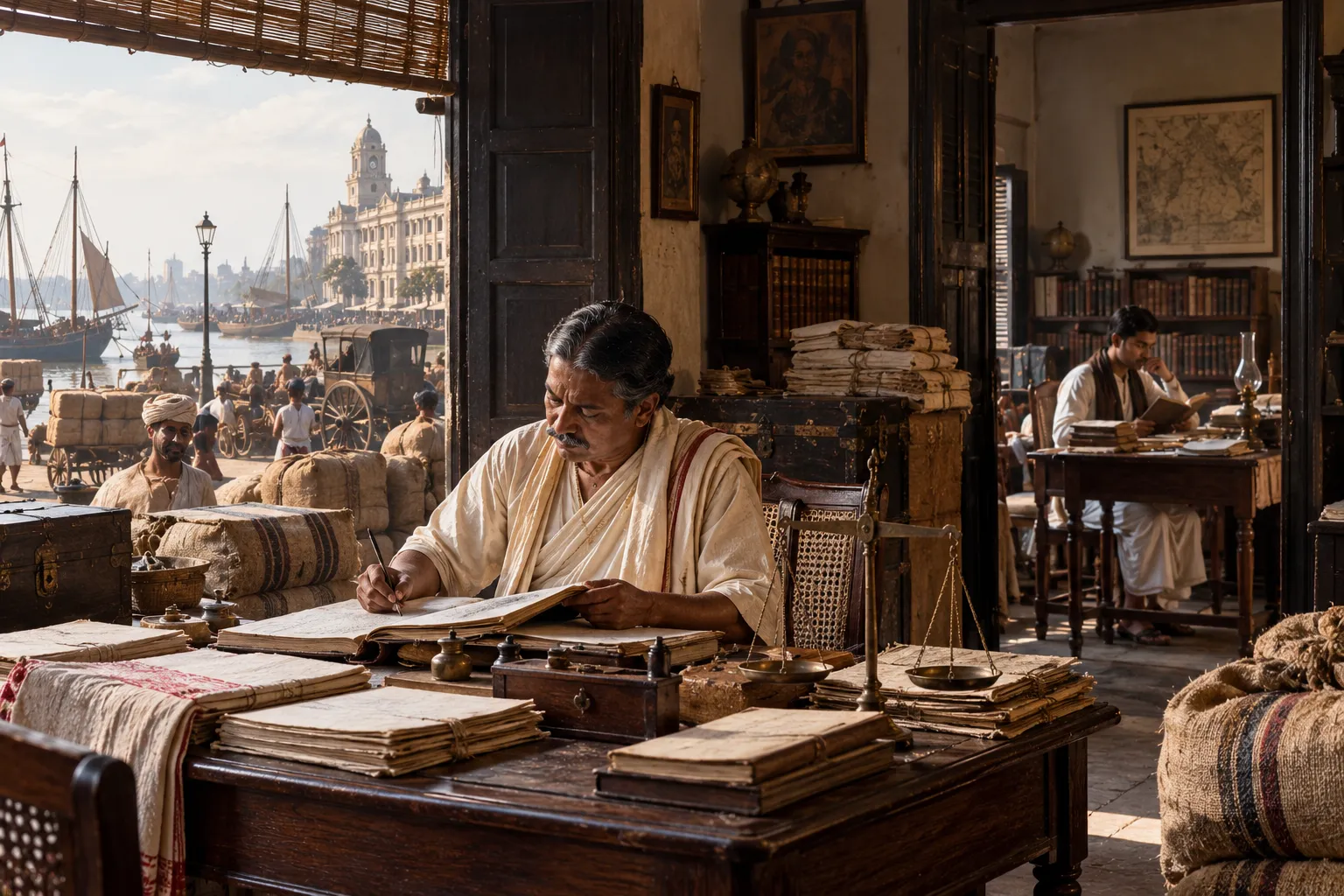
There was a time when a successful Bengali could imagine a future in commerce as naturally as in any profession. In early nineteenth-century Calcutta, men such as Dwarkanath Tagore, Ramdulal Sarkar and Mutty Lall Seal made fortunes through trade and went on to invest in shipping, banking, insurance and industry. Business was not yet something that had to be defended as a respectable career; for some of Bengal’s wealthy families, it was one of the most obvious routes to influence and prosperity.
Something changed over the course of the nineteenth century.
By the time a new Bengali middle class had taken shape, education, professional employment and the security of a salaried position had acquired a social prestige that commerce increasingly struggled to match. The change was gradual, and it certainly did not make Bengalis incapable of doing business. But it altered something deeper: what a respectable life was supposed to look like.
That change would eventually matter to Bengal’s economy. But first, it happened inside people’s ambitions.
When land became a different kind of wealth
One of the important beginnings lies in the Permanent Settlement of 1793, through which the East India Company established a new system of land revenue and recognised zamindars as proprietors of their estates.
For those who could acquire land, this created a powerful alternative to the uncertainties of commerce. Trade depended on markets, credit and changing fortunes; land could provide income, property and social standing across generations. Among sections of Bengal’s elite, landed wealth consequently became closely associated with respectability.
This did not eliminate commerce. Calcutta was already becoming an important centre of trade, and Bengali merchants continued to participate in its economy. But the social meaning of wealth was changing. Owning land could bring a kind of prestige that was not necessarily attached to making money in the marketplace.
That distinction became even more important when education began opening another route to status.
The rise of the bhadralok
Nineteenth-century Bengal experienced an extraordinary expansion of English education. Schools and colleges produced a growing class of educated Bengalis who entered law, teaching, medicine, administration and other professions associated with the colonial economy.
Out of this world emerged the bhadralok, a term usually translated as “respectable people”.
Respectability here meant more than simply being wealthy. Education, manners, literary knowledge, English proficiency and professional occupation all became markers of social standing. A person could acquire influence through learning and employment without owning a commercial enterprise or a large estate.
Education had therefore become a kind of cultural capital. It offered families a way to improve their position through the education of their children, and unlike a business venture, it did not require them to risk a fortune in the hope of making another.
This distinction gradually entered everyday ideas about a good career. A secure chakri, or salaried job, could be valued not merely because it paid a regular income, but because it carried social respect. Byabsa, or business, offered the possibility of greater wealth, but also involved uncertainty, debt, competition and the possibility of failure.
The two were never absolute opposites. Many Bengalis continued to trade, lend money, own businesses and invest in commerce. Yet the cultural preference in influential sections of society was increasingly clear: education was a respectable investment in a child’s future, while business was a risk that not every respectable family wanted its children to take.
When success became something you could study for
This was one of the peculiar achievements of colonial Bengal.
Education did not simply produce educated people. It created a new social route to advancement.
A young man with ability and access to education could enter the professions and build a respectable life without inheriting a commercial enterprise. His family could invest in his education rather than in a shop, trading partnership or industrial venture. The return on that investment was not necessarily a fortune; it could be a position in society.
The consequences were cultural as much as economic. The educated professional became an increasingly familiar figure in Bengali public life, while the merchant occupied a more complicated place in the imagination of the emerging middle class.
Literature and theatre participated in this wider culture of the bhadralok. Intellectual accomplishment, refinement and learning became important sources of prestige. The ability to speak and write well, to know literature, to debate ideas and to participate in the new institutions of colonial society could matter as much as, or sometimes more than, commercial success.
Over time, a particular social ideal emerged.
The respectable Bengali was increasingly imagined as someone who possessed education and culture, not necessarily someone who owned a business.
The irony of Dwarkanath Tagore
The life of Dwarkanath Tagore offers an interesting glimpse of the earlier world.
He was not simply a wealthy landholder who happened to invest in business. He actively pursued commercial opportunities and became involved in shipping, banking, coal mining and other enterprises. His career represented an ambitious form of nineteenth-century Bengali participation in the expanding commercial economy of Calcutta and the British Empire.
Yet the Tagore family would later become associated above all with literature, art, education and intellectual life, culminating in the extraordinary cultural influence of Rabindranath Tagore.
It would be misleading to turn this into a simple story of the family abandoning business. The Tagores’ history was much more complicated than that. But the contrast is revealing because it mirrors a larger transformation in Bengal: cultural achievement itself was becoming one of the highest forms of social distinction.
A family could be proud of wealth, but it could also be proud of producing a scholar, writer, lawyer or public intellectual.
That was a very different idea of success from the merchant’s world.
When the old industrial order began to disappear
The significance of this cultural history became clearer after Independence.
At the end of British rule, Bengal possessed a substantial industrial economy. British managing agencies had accumulated considerable influence over industries including jute, tea, coal and engineering, with Calcutta functioning as a major centre of corporate and financial activity.
After 1947, many British-owned enterprises and managing agencies began to withdraw or reduce their involvement.
This created a practical question that exposed the difference between professional expertise and ownership capital.
There were plenty of educated Bengalis capable of working as lawyers, accountants, engineers, managers and administrators. But taking over large industrial enterprises required something different: substantial capital, commercial networks and a willingness to assume considerable financial risk.
The Bengali middle class had accumulated considerable educational and professional capital over the previous century. It had not, to the same extent, accumulated the industrial ownership networks needed to replace the departing British business houses.
Other commercial communities were better positioned to do so. Marwari business families, whose trading and financial networks in Calcutta had developed over generations, became important owners and investors as industrial assets changed hands.
This was not simply a story of one community taking business away from another. Different groups had entered the modern economy with different histories of property, capital, education and commercial experience. When the economic structure changed, those differences became consequential.
Did Bengalis really stop doing business?
Not quite.
That is why the familiar claim that Bengalis are somehow naturally unsuited to business is so misleading. Bengal has produced merchants and entrepreneurs in many periods, and Bengali businesspeople continued to operate throughout the twentieth century.
The more interesting historical change was one of social preference.
For a significant section of Bengali society, education offered a route to advancement that felt safer, more respectable and more culturally rewarding than commercial risk. Families encouraged children towards professions that provided status and stability, and those expectations could reproduce themselves from one generation to the next.
The pattern also had extraordinary benefits.
The same culture that placed such value on education produced some of Bengal’s greatest writers, scientists, teachers, lawyers, artists and intellectuals. The intellectual life of modern Bengal cannot be separated from this transformation.
But the story has another side.
A society’s idea of success shapes the kind of economic life it is likely to build. If generations of families come to see education and professional security as the safest path upwards, fewer young people may be encouraged to acquire the habits, networks and tolerance for uncertainty that entrepreneurship demands.
That does not make the society less intelligent.
It makes it good at different things.
And perhaps that is the real story of Bengal’s changing relationship with business. The merchant did not suddenly disappear. Nor did Bengalis collectively decide to abandon commerce.
Instead, over the course of the nineteenth century, the meaning of ambition itself changed.
For one generation, success might have meant building a trading house.
For the next, it could mean owning land.
For another, it might mean earning a degree and entering a profession.
Those choices accumulated over time until they became part of the culture itself.
And culture can shape an economy long before anyone notices the connection.
Sometimes the most consequential economic decisions are made not in boardrooms or factories, but in the quiet expectations a family has for its children.