
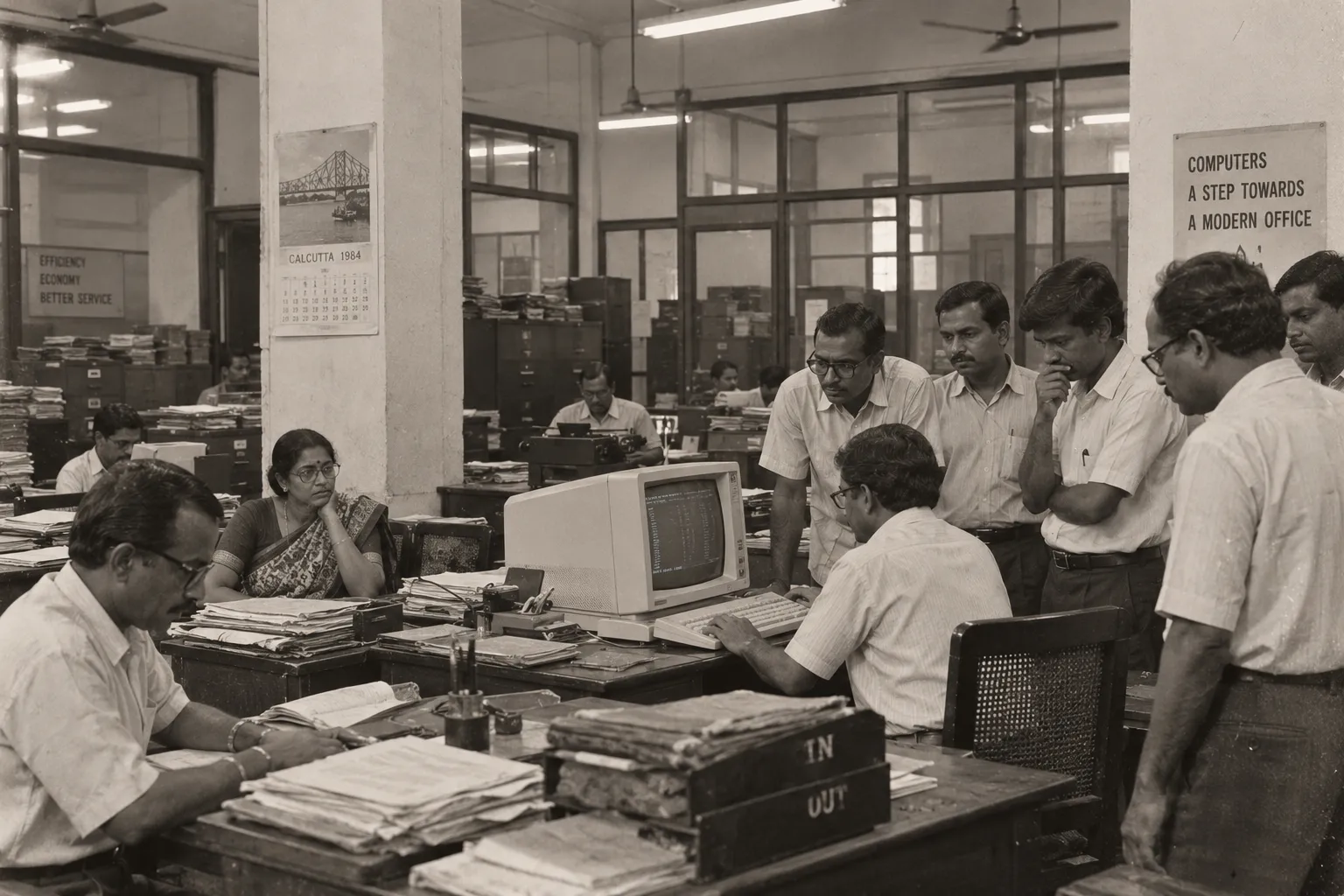
When Computers Became the Enemy
There was a time when a computer entering an office in Bengal could become a political event.
The machine itself was not particularly dramatic. It processed information, performed calculations and could complete certain tasks faster than a person. Yet during the 1980s, computerisation became entangled with a much larger argument about employment, technology and the future of work. To workers who already felt insecure about their livelihoods, automation could look less like progress than a warning.
This was not simply a story about people being afraid of machines. It was a question that societies repeatedly face when technology changes the workplace: who gets the benefits of greater efficiency, and what happens to the people whose work that efficiency makes less necessary?
Why computers became political
By the time computers were becoming a serious subject of debate in India, Bengal already had a strong political and industrial culture around employment. Trade unions had considerable influence, and questions of job security were deeply connected to the state’s wider political life.
In that environment, introducing computers was never just a technical decision. If a machine could perform tasks previously handled by several employees, workers had a reasonable question to ask: what would happen to those jobs?
The concern was particularly understandable in offices and industries where employment itself was often treated as a form of security. Computerisation threatened to turn technological efficiency into a very personal calculation. A faster machine might make a company more productive, but the worker had to wonder whether the company still needed him.
That is why resistance to computerisation should not be reduced to an irrational dislike of technology. It reflected a genuine conflict between two ideas of progress: the productivity of the enterprise and the security of the worker.
Bengal’s famous computer debate
The politics became particularly visible in West Bengal during the Left Front period. Trade unions and sections of the political movement expressed strong reservations about computerisation and automation, especially where they believed new technology could reduce employment.
Over time, however, the position was more complicated than the popular story that Bengal simply opposed computers. The state did not remain outside technological change. Computers entered government offices, banks, businesses, educational institutions and other workplaces, while debates continued over the pace and terms of adoption.
The question was gradually shifting from whether computers should exist to how technology should be introduced into working life.
That distinction matters because the history is often remembered through a convenient caricature: Bengal as the place where workers tried to stop the computer. The reality was less tidy. There was resistance, negotiation, adaptation and eventually widespread adoption.
The machine eventually became ordinary
The most revealing part of the story is what happened afterwards.
The computer that had once represented possible job loss became an ordinary instrument of work. The office changed around it. New occupations appeared, old tasks disappeared or changed, and people who had once worked without computers learned to work through them.
The transformation did not mean that every fear was misplaced. Technology really can eliminate particular tasks and reduce demand for particular forms of labour. But technological change also creates new forms of work, and societies that learn to use new tools can gain opportunities that were difficult to imagine when those tools first appeared.
For Bengal, there is a particularly interesting historical irony. A region that had once seen computerisation through the lens of threatened employment would eventually become home to a substantial information-technology and services sector.
The computer did not remain the enemy.
It became infrastructure.
What the computer debate actually tells us
It is tempting to look back and say that the critics were simply wrong. That would miss the more useful lesson.
Workers were right to ask what happened to employment when technology changed the workplace. Governments and employers were right to consider productivity and competitiveness. The difficult question was how to make those two concerns coexist.
The real mistake would be to imagine that a society has only two choices: reject new technology or accept it without question.
There is a third possibility: understand it.
Learn what it can do. Identify which jobs and skills it changes. Give people enough knowledge to adapt before the change becomes unavoidable. Technological transitions become less frightening when people understand not only what they might lose, but also what new possibilities are becoming available.
That is perhaps the most useful lesson Bengal’s computer debate leaves behind.
What Bengal Can Learn From This
The computer story belongs to another technological moment, and Bengal’s relationship with artificial intelligence today is different. There is no comparable mass movement treating AI itself as an enemy. If anything, the challenge may be quieter: many people know that AI exists without yet understanding how deeply it could change the way they study, work and build businesses.
That distinction matters. The lesson from the computer era is not that people should simply welcome every new technology. Technological change can redistribute opportunities as well as create them, and people have legitimate reasons to ask who benefits and who bears the cost.
But resisting, accepting and understanding a technology are three different things.
The computer eventually became ordinary because people learned to use it. The people who adapted their skills around it found new possibilities, while entire industries emerged around capabilities that had once seemed unfamiliar.
AI presents Bengal with a different moment. The question is less “Will this machine take our jobs?” than “Do we understand enough about this machine to decide what it can do for us?”
That is where the older story becomes relevant.
The most important lesson may not be to embrace AI blindly. It may be to avoid being late in learning it.