
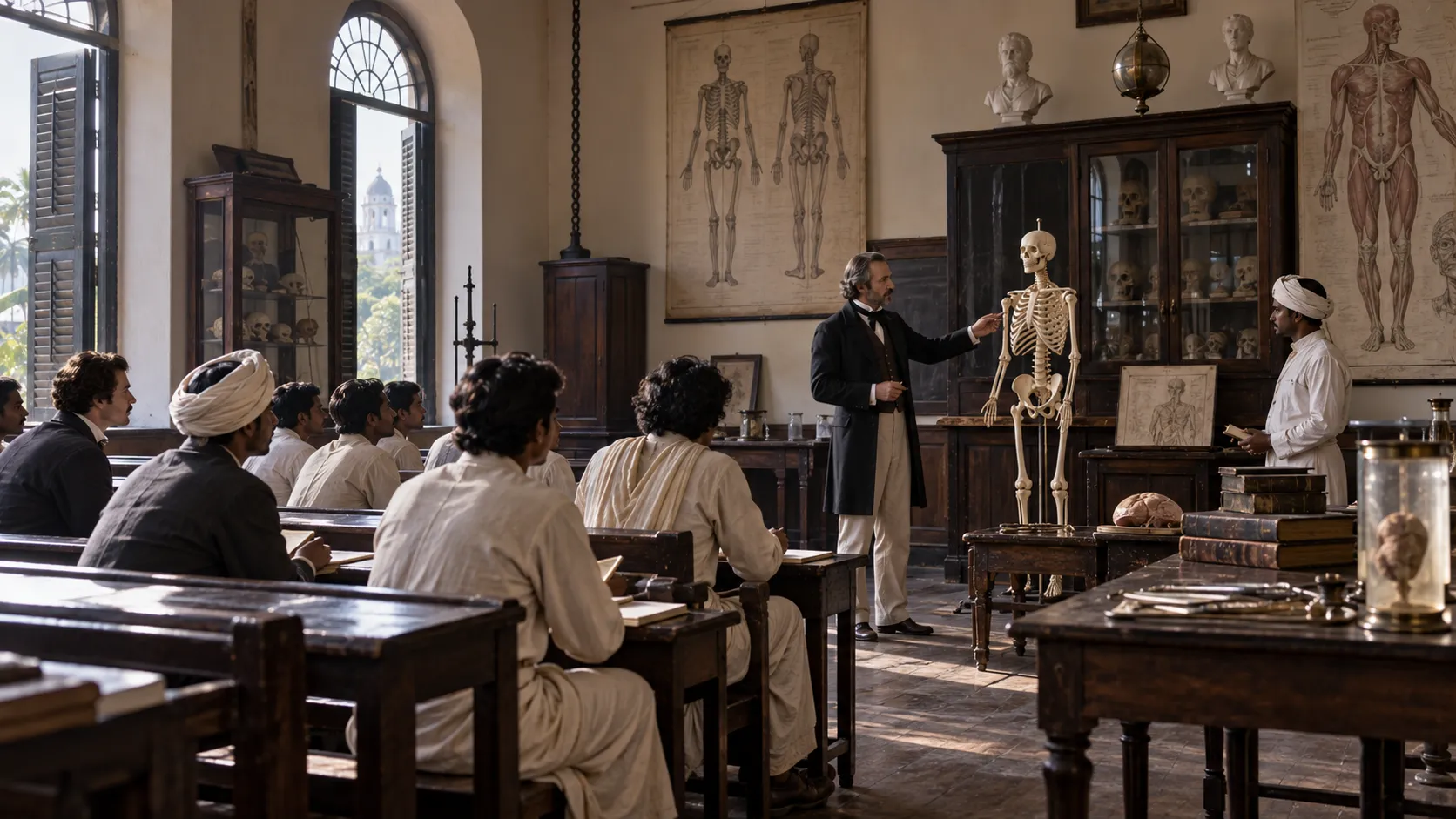
The Skeletons of Bengal That Taught the World Anatomy
A medical student in London, Boston or Tokyo might have learned the structure of the human body from a skeleton shipped halfway across the world. The bones could be carefully wired together, mounted on a stand and studied in a bright classroom. Their journey, however, began far from the medical school.
For much of the nineteenth and twentieth centuries, Calcutta became a major centre of the international trade in prepared human skeletons. The city’s workshops supplied anatomical specimens to medical and educational institutions abroad. A trade that joined medical demand to local labour also raised a difficult question: whose bodies became the raw material of scientific education, and under what circumstances?
A new demand for the human body
The expansion of modern medical education created a growing need for human remains. Anatomy students needed more than diagrams. They studied bones, joints and the relationships between different parts of the body through actual skeletal specimens.
Calcutta was already becoming an important centre of medical instruction. The Calcutta Medical College opened in 1835, and in 1836 Madhusudan Gupta and his associates performed a landmark human dissection there, challenging powerful social taboos surrounding the handling of corpses.
That moment belongs to the history of medical education. The commercial skeleton trade that developed around anatomy, however, was a different story—one that extended beyond the college and beyond India.
As demand grew, anatomical specimens became goods that could be prepared, bought, sold and shipped. Medical institutions and biological supply houses abroad formed part of the market. Calcutta’s role was not simply to teach anatomy locally, but to help supply the materials through which anatomy was taught elsewhere.
From the dead to the classroom
The production process described in historical accounts was painstaking. Bodies were obtained through different channels, including hospitals and morgues; the trade also became associated with illicit procurement. The preparation of bones involved separating and cleaning them, then assembling selected bones into articulated skeletons.
In Calcutta, workshops were concentrated in peripheral neighbourhoods, including Beniapukur and the Rameshwar Shaw Road area. The research paper identifies the firm Young Brothers, at 4A Rameshwar Shaw Road, as a major exporter.
A finished skeleton was not merely a collection of bones. It was a manufactured teaching object: cleaned, assembled, wired and prepared for transport. Articulated specimens could be packed in wooden cases; separate bones could be bundled for shipment.
The work required specialised knowledge and labour. Yet the people who performed it rarely appear in the familiar histories of medical progress, which tend to foreground doctors, colleges and scientific discoveries.
The workers behind the specimens
The paper identifies Dom and Hari workers among those involved in the preparation and handling of human remains. It describes workers retrieving bodies from river margins and cremation grounds, and undertaking the difficult work of cleaning and preparing bones.
These claims need to be handled with care. Caste communities were not uniform occupational groups, and the paper’s broad description should not be taken to mean that every Dom or Hari person performed this work, or that all specimens came through the same channel.
Still, the reported division of labour reveals an important social dimension of the trade. Work considered polluting or degrading by some sections of society could become economically valuable when medical institutions demanded its products. The market did not necessarily dissolve social hierarchy; it could depend upon it.
The people who made the specimens usable were essential to the supply chain, even as the finished objects travelled under the names of dealers and suppliers.
A global market—and an uncertain count
The scale of the trade is striking, but its numbers require careful treatment.
The research paper gives an estimate of up to 50,000 skeletons exported annually at the trade’s height. A 2024 scholarly article on the ethics and history of Indian skeletal collections cites estimates of up to 60,000 skeletons exported per year before the 1985 ban. These are estimates, not a complete count drawn from a surviving export ledger. The exact volume and its variation over time remain difficult to establish.
The international demand is more firmly visible in the legal record. In Mahamed Sayeed v. Union of India (Calcutta High Court, 1989), the petitioner was described as an exporter of human anatomical specimens to medical, research and educational institutions in the United States, Japan, Europe, Australia and the Far East. The case also records the government’s 19 August 1985 prohibition on exporting human skeletons and parts.
That court record offers a glimpse of the trade as a functioning business: exporters, licences, police certificates, foreign buyers and consignments already procured for shipment.
The ban, and the question it left behind
The export ban followed growing concern about the sourcing of human remains and allegations of body-snatching. The 1985 controversy brought the trade into public view, including reports concerning children’s bones. The Supreme Court later directed several state governments to investigate alleged offences connected with exports around the time of the ban.
The legal prohibition marked a turning point, but it did not erase the specimens already held in medical collections abroad. Skeletons prepared in India continued to be used in anatomy teaching and research, raising questions about consent, provenance and the responsibilities of institutions that inherited them.
The history of Calcutta’s skeleton trade is therefore not only a story about an unusual export commodity. It is also a story about the hidden labour behind scientific education, the unequal conditions under which bodies entered commerce, and the long journeys of objects whose origins were often left unrecorded.
A skeleton in a classroom can appear to be a universal model of the human body. Its history may be anything but universal: shaped by a particular city, a particular economy, and people whose work helped carry the material of medical knowledge across the world.