
The Wild Animals Calcutta Sold to the World
A wild animal captured in the forests of eastern India could end up thousands of miles away, displayed before curious crowds in a European menagerie. Between the forest and that distant spectacle lay a network of hunters, animal dealers, holding yards and ships. One of its important centres was Calcutta.
In the nineteenth century, the city became a commercial link between the wildlife of eastern India and an international market for exotic animals. Among the dealers associated with this trade was William Rutledge, whose operation in Entally connected forest capture with overseas buyers.
The journey of these animals reveals an unusual side of Calcutta’s commercial past: the city was not only a place where goods arrived from abroad, but also a place from which living creatures were sent out into the world.
The business began in the forest
The supply chain began far from Calcutta’s warehouses and docks.
Hunters, known as shikaris, operated in the Sundarbans and other forested regions of eastern India. Their work brought wild animals into a market that extended beyond the subcontinent.
The animals sought included tigers, leopards, elephants and rhinoceroses. Capturing large animals was dangerous and difficult. The historical account describes a particularly brutal practice: adult animals, including mothers, could be killed so that their young might be taken alive.
Young animals were valuable because they could be transported and raised in captivity. But capturing them meant separating them from their natural surroundings—and often from their mothers.
The trade therefore began not with a buyer choosing an animal from a catalogue, but with a dangerous and disruptive encounter in the forest.
William Rutledge’s animal yard in Entally
At the Calcutta end of this network stood William Rutledge, an animal dealer associated with a large menagerie and animal-clearing operation in Entally.
Animals arriving from the countryside could not simply be placed aboard a ship. They had to be held, fed and prepared for transport. The dealer’s premises became a temporary world of cages, enclosures and captive animals.
Entally was thus more than a location on the outskirts of the city. It was a commercial holding point between the forest and the market—a place where wild animals became consignments that could be bought, sold and shipped.
The animals’ journey had changed its character. In the forest, they were part of an ecosystem. In the holding yard, they were inventory.
From Calcutta to Europe
Rutledge’s operation was connected to European animal dealers, including Charles Jamrach of London and Carl Hagenbeck of Hamburg.
Such networks supplied animal businesses, private collections and zoological institutions. The trade linked people who captured animals in eastern India with buyers and audiences far beyond it.
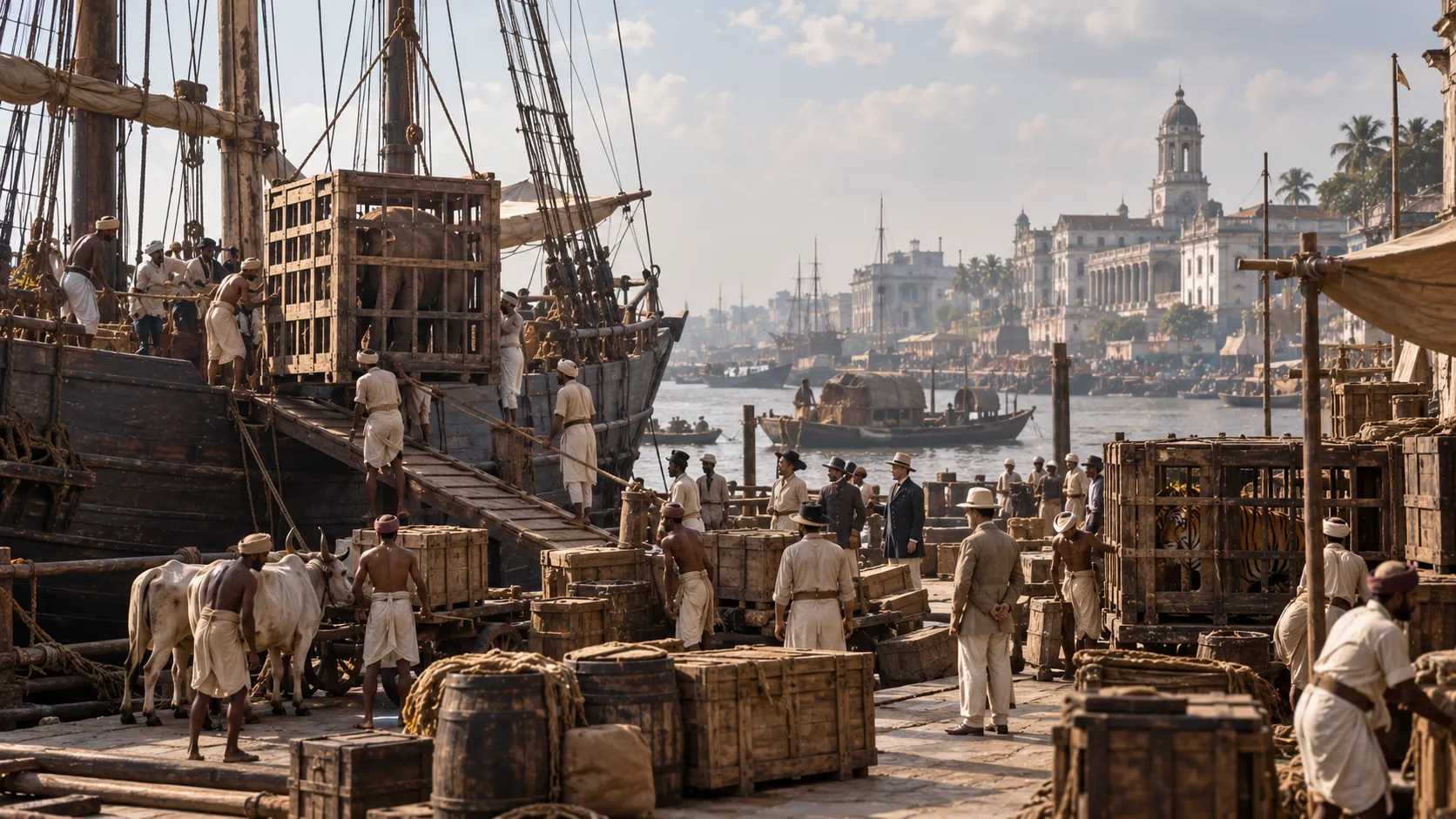
Kidderpore’s docks formed part of the export route described in the historical account. Animals could be loaded aboard ships and carried towards overseas markets, where their rarity and unfamiliarity made them attractions.
A tiger or rhinoceros captured in eastern India might eventually be seen by spectators who had never encountered such an animal in the wild. The spectacle began long before the animal reached its destination: it began with capture, confinement and a journey across the sea.
A king’s menagerie at Metiabruz
Not every animal passing through Calcutta was destined for Europe.
The city’s wildlife market also served local institutions and private collectors. Among the latter was Wajid Ali Shah, the deposed King of Oudh, who lived in exile at Metiabruz.
His menagerie formed part of the cultural world he maintained in exile. Animals could signify wealth, prestige and the continuation of royal practices of collecting and display.
The same commercial network could therefore serve very different customers: a European animal broker, a zoological institution, or an Indian ruler maintaining a private collection.
This is what makes Calcutta’s wildlife trade especially revealing. It was not a simple route from an Indian forest to a European zoo. It connected multiple markets and forms of collecting, each with its own reasons for wanting wild animals.
The cost of turning wildlife into cargo
The trade’s consequences extended beyond the animals kept in cages or shipped overseas.
The historical account links commercial capture to pressure on regional wildlife populations, including the disappearance of the Javan rhinoceros from the Sundarbans by the end of the nineteenth century. The extent to which the trade caused that decline requires careful examination against wildlife records and other historical evidence.
Still, the broader tension is unmistakable. A business built around supplying rare animals depended on repeatedly taking them from the wild. The more desirable an animal became in distant markets, the greater the incentive to capture it.
The commercial chain connected local hunters to faraway buyers, but the consequences were borne first by the animals and the landscapes from which they were taken.
The journey behind the spectacle
A Victorian menagerie promised its visitors a glimpse of distant worlds. Animals from unfamiliar landscapes were gathered together for public display, turning their difference into entertainment.
Behind that spectacle lay a chain of capture, confinement, transport and sale.
Calcutta stood at the centre of this story—not as the natural home of every animal, but as a commercial hub connecting eastern India’s forests with royal collections and overseas markets.
The history of William Rutledge’s animal trade shows how far the city’s business networks could reach. They moved not only textiles, foodstuffs or manufactured goods, but also living creatures whose journeys could take them from the Sundarbans to a cage on another continent.
The animals Calcutta sold to the world carried with them a history that the spectacle rarely revealed: the forest they left behind, the people who captured them, and the trade that made their captivity profitable.