
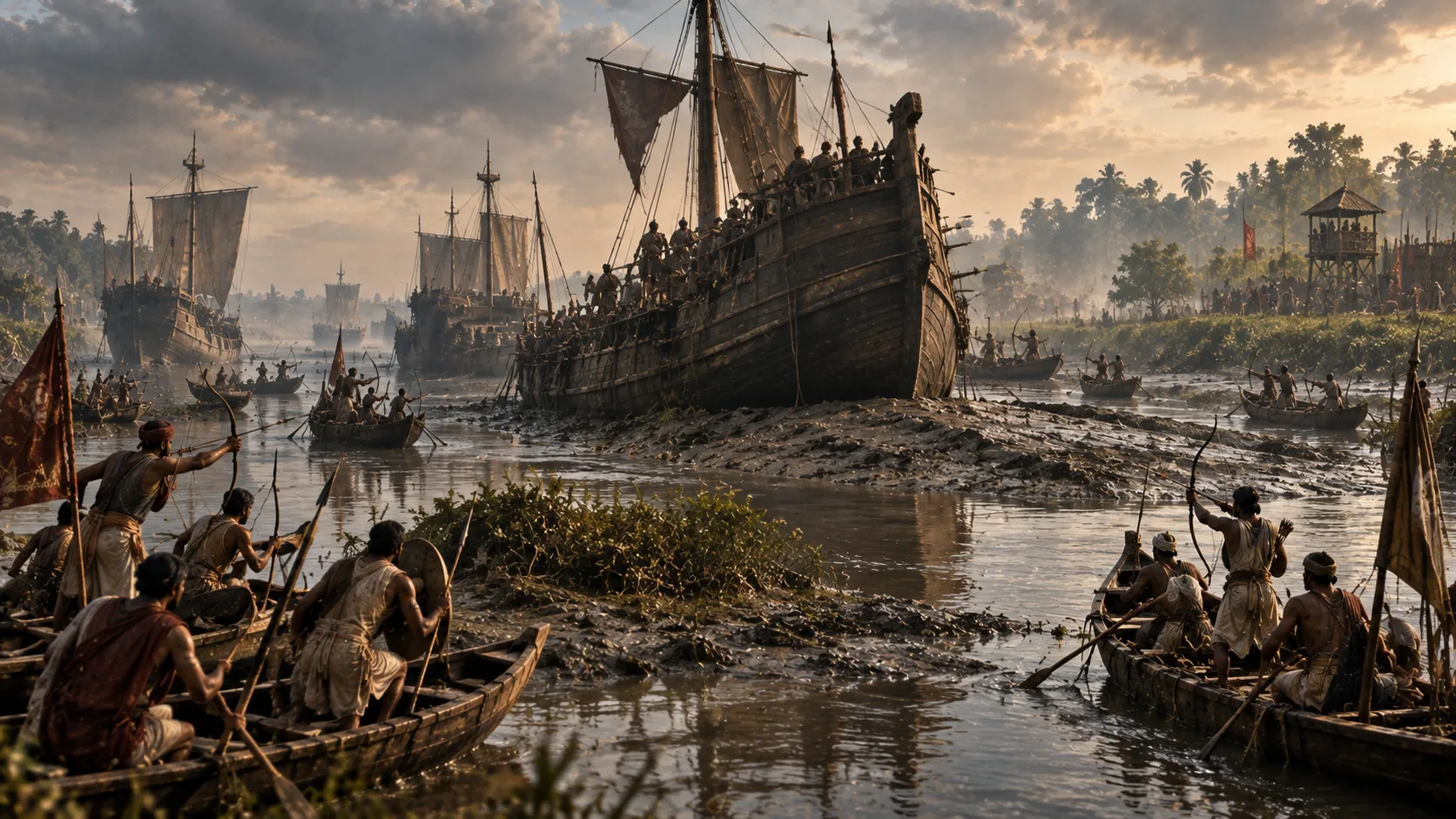
The War Bengal Fought With Mud and Tide
An invading fleet normally expects the water to be its advantage.
Ships move faster than armies marching along difficult roads. They can carry supplies, soldiers and weapons. A fleet can bypass obstacles that stop cavalry and infantry, and when the enemy has no comparable naval force, the water can become a highway into his territory.
But Bengal offered a different kind of battlefield.
Here, a river was rarely just a broad, predictable stretch of water. Channels divided and rejoined. Silt accumulated and shifted. Banks became soft and unstable. Tidal water could change the depth and character of a channel within hours. A vessel that moved easily in one stretch of water could find itself constrained somewhere else, particularly if its draft was poorly suited to the channel.
For a fleet accustomed to thinking of water as open space, this created a dangerous possibility: the water itself could become an instrument of confinement.
The research on Bengal’s naval warfare describes a tactical system built around precisely this environmental advantage. It calls the concept the “Mud & Tide” strategy, in which defenders used reconnaissance, narrow channels, tidal timing and smaller vessels to make an enemy’s superior size and numbers work against it.
The surviving evidence does not allow us to reconstruct a single battle and say, with certainty, that Bengal’s commanders followed every step of this sequence. But it does allow us to examine how such a strategy could have worked in the environment of the delta—and why a large invading fleet might have found itself fighting a battle it had not expected.
The Enemy Had to Enter the River
The first advantage belonged to the defender simply because the attacker had to come looking for him.
A fleet approaching Bengal could not fight effectively from a distance. It had to enter the waterways through which troops, supplies and ships could reach the interior. That meant the defenders had an opportunity to observe the approach and decide where the confrontation would take place.
The research reconstruction begins with river reconnaissance: identifying the enemy’s approach and understanding which channels, confluences and narrow passages could shape the movement of the fleet.
This is a very different concept from simply placing an army on a riverbank and waiting.
The defender is choosing the battlefield.
A broad channel might allow a large fleet to deploy its numbers. A narrow distributary could prevent several ships from manoeuvring together. A bend could obstruct visibility. A shallow stretch could restrict deeper vessels. A tidal channel could become significantly less navigable as the water receded.
The crucial decision was therefore not necessarily where the enemy would be attacked. It was where the enemy would be allowed to go.
Size Was Not Always Strength
Naval warfare usually rewards carrying capacity, firepower and numbers. A larger vessel can potentially carry more men and equipment; a larger fleet can concentrate greater force.
In a delta, however, size could become a liability.
The research contrasts the deep-water orientation attributed to the Chola fleet with a Pala naval force adapted to the distributaries and shifting shoals of the Bengal delta. It argues that heavier vessels could become increasingly vulnerable once drawn into narrower, silt-heavy waterways.
The underlying principle is straightforward.
A large ship needs sufficient depth and room to turn.
Take away either, and its advantages begin to disappear.
The defender’s smaller craft, by contrast, could operate in shallower water and move through channels where a larger vessel had difficulty manoeuvring. The result was not necessarily a spectacular naval battle in which one fleet destroyed the other in a single charge. It could instead become a battle of movement, positioning and patience.
The larger fleet was being made to fight under conditions for which its equipment was poorly suited.
The Tide Changes the Battlefield
The most distinctive element of the proposed strategy was the use of tidal movement.
The Bay of Bengal experiences regular tidal cycles, and the lower Bengal waterways are deeply connected with those movements. The research argues that commanders could exploit this environmental rhythm by timing operations around favourable tidal conditions.
Imagine the consequences for an invading vessel.
At one moment, a channel appears navigable. The fleet moves forward. The defenders withdraw, apparently giving ground. The pursuing ships continue into increasingly confined water.
Then the water begins to fall.
The same channel that permitted forward movement becomes progressively shallower. A vessel with a deeper draft has fewer options. Turning becomes difficult. Retreat becomes complicated. Ships can no longer maintain the formation that gave the larger fleet its strength.
The research describes precisely this possibility: heavier enemy ships could be drawn into winding distributaries and become grounded as the tide receded, while shallow-draft defending vessels retained greater freedom of movement.
This is the heart of the “Mud & Tide” concept.
The tide does not destroy the enemy. It changes what the enemy is capable of doing.
When the Fleet Could No Longer Manoeuvre
Once a large vessel became stuck in mud or severely restricted by shallow water, the character of the battle changed.
A fleet’s strength depends partly upon coordination. Ships need space to move, turn, support one another and bring weapons to bear. If the leading vessels become immobilized, the ships behind them can be trapped in their own formation.
The research proposes that Bengal’s smaller vessels could then harass the immobilized fleet, using their superior manoeuvrability to attack vulnerable points. It specifically describes archers and incendiary weapons being used against ships that could no longer move freely.
That particular sequence should be treated cautiously because the surviving evidence does not provide a complete contemporary battle report describing it step by step.
The broader military logic, however, is easier to understand.
A trapped ship cannot exploit its speed. A crowded fleet cannot easily bring all its weapons to bear. A large formation that has lost room to manoeuvre becomes a collection of individual targets.
The defender does not need to match the enemy vessel for vessel if the battlefield has already reduced the enemy’s ability to use its advantages.
The Attack Could Come From Everywhere
Riverine warfare also blurred the boundary between land and water.
A ship moving through a narrow channel could be attacked from another vessel, from the riverbank or from a fortified position controlling a strategic passage. The research describes the proposed Bengali system as an integrated operation involving river reconnaissance, fortified locations, light flotillas and land-based missile fire.
This matters because an invading fleet was not necessarily confronting a single line of ships.
It was entering an environment in which the threat could shift constantly.
A vessel might pass safely through one stretch of water and then come under attack around the next bend. The defenders’ smaller boats could appear, withdraw and reappear somewhere else. If the larger ships pursued them, they risked entering shallower water.
The fleet therefore faced a tactical dilemma. If it stayed together, it could become easier to restrict. If it separated, individual vessels could become vulnerable. And if it pursued the defenders too aggressively, it might enter exactly the water the defenders wanted it to enter.
The River Did Not Need to Be a Wall
This is where the strategy differs from a simple defensive idea.
Bengal did not need to block every river crossing.
It only needed to make movement expensive.
The research describes this broader objective as “denial through attrition”: rather than relying upon one decisive engagement, the defender could make the cost of advancing increasingly high through repeated harassment and environmental exploitation.
This makes sense in a landscape where an invading force had to depend upon waterways for movement and supply.
Every delay consumed provisions. Every damaged vessel reduced carrying capacity. Every grounded ship created a vulnerability. Every failed attempt to force a channel increased uncertainty about what lay ahead.
The defender’s objective was therefore not necessarily to sink the entire enemy fleet.
It was to make the campaign itself increasingly difficult to sustain.
Why Light Boats Mattered
A shallow-draft vessel might look unimpressive beside a large warship.
In the wrong water, however, the smaller vessel could have the advantage.
The research repeatedly emphasizes the role of light, manoeuvrable boats operating in shallow channels while larger vessels faced restrictions.
This is an important distinction from the popular image of naval warfare as a contest between large ships.
In Bengal’s waterways, the most useful vessel might not be the one capable of carrying the greatest number of soldiers. It might be the one that could turn quickly, enter a narrow channel, retreat through shallow water and return before the larger enemy could respond.
The river rewarded adaptability.
That made local knowledge a military resource.
The Chola Problem
The most important historical context for this reconstruction is the Chola invasion of Bengal in 1021–1023 CE.
Rajendra Chola I’s inscriptions celebrated the campaign and claimed that his forces reached the Ganges and carried away substantial wealth. The research materials interpret the campaign differently from the triumphal Chola account, arguing that the invasion achieved battlefield success without producing permanent conquest.
This does not prove that the Chola fleet was defeated by a documented “Mud & Tide” trap.
That would be too strong.
What the evidence does give us is a historical situation in which the contrast between an expanding Chola power and the riverine environment of Bengal becomes especially revealing. The Cholas could project military power over considerable distances, yet the absence of lasting occupation raises a different question from whether they won particular engagements.
How do you conquer a country whose waterways make sustained military control difficult?
That question is more interesting than simply asking who won a naval battle.
A Battle Where the Environment Fought Too
The deeper significance of the “Mud & Tide” idea is therefore not that Bengal possessed some secret weapon.
The weapon was the relationship between several ordinary things: shallow water, mud, tides, small vessels, reconnaissance and knowledge of the channels.
None of these was extraordinary on its own.
Together, they could transform the tactical equation.
The research’s proposed sequence begins with identifying the enemy’s approach, moves through the selection of strategic waterways and favourable tidal conditions, and ends with light vessels exploiting the restricted movement of heavier ships.
That is best understood as a model for how warfare could operate in the delta, rather than as a verbatim description of a documented Bengali battle.
The distinction is important because Bengal’s naval history contains relatively little surviving tactical documentation. The research itself acknowledges that Bengal-specific tactical treatises are less well documented.
But the absence of a surviving battle manual does not make the environment irrelevant.
It makes reconstruction necessary—and caution essential.
The Battlefield Had a Clock
Most armies choose when to attack.
A river governed by tides introduces another participant into that decision.
Water levels rise and fall whether an army is ready or not. A commander who understands the timing can plan around that rhythm. One who does not may discover that the battlefield has changed beneath his fleet.
That is why the proposed strategy is so striking.
The defenders did not have to control the tide.
They only had to understand it better than the people attacking them.
The same mud that was an inconvenience to a local boatman could become a serious obstacle to a deep-draft warship. The same narrowing channel that a smaller craft could navigate might become a trap for a larger vessel. The same receding water that merely changed the landscape for local inhabitants could determine whether an invading fleet could retreat.
The environment was not neutral.
What the Sources Can Actually Prove
There is a temptation to turn this reconstruction into a dramatic certainty: Bengali commanders deliberately lured enemy fleets into the Sundarbans, waited for the tide to fall, trapped the ships in mud and destroyed them with fire.
The surviving evidence does not justify stating that entire sequence as an established historical fact.
The research presents it as a synthesis of environmental conditions, naval tactics and historical interpretation. Its more specific descriptions of feigned retreats, deep-draft ships becoming trapped and swarm attacks should therefore remain clearly marked as reconstruction.
What is more securely defensible is the underlying principle: Bengal’s waterways could create major tactical differences between vessels adapted to shallow, shifting channels and vessels designed for deeper water.
The research also records more general naval practices such as boarding, ramming and setting enemy ships ablaze, alongside formations intended to concentrate missile coverage.
The exact combination used in any particular Bengali battle remains much harder to establish.
That uncertainty should not weaken the story.
It should make the story more honest.
The Real Battlefield Was the Water
The greatest advantage of Bengal’s riverine warfare was therefore not a particular ship, weapon or formation.
It was the ability to force an enemy to operate in an environment where familiar military advantages could become unreliable.
An invading commander might arrive with more ships, more soldiers and greater experience in conventional warfare. But those advantages mattered only if the fleet could move.
If the channel narrowed, numbers became difficult to deploy. If the tide fell, draft became a problem. If ships grounded, manoeuvrability disappeared. If the defenders knew the waterways better, pursuit became dangerous.
The battle could therefore be decided before the two fleets ever came properly alongside one another.
Mud and Tide
This is what makes Bengal’s proposed riverine tactics so different from the conventional image of naval warfare.
There was no need to imagine the delta as a giant fortress covered with walls and towers. The defenses could be dispersed through waterways, channels, crossings and settlements. A fleet entering the region would have to navigate a landscape that changed with water, season and tide.
The research describes this as a form of environmental attrition: a strategy designed to make invasion increasingly costly rather than necessarily seeking one spectacular victory.
Whether every element of the later reconstruction can be demonstrated is another question.
But the underlying military insight remains powerful.
A river can be defended without being blocked.
Sometimes the most effective way to stop an army is not to prevent it from entering.
It is to make it regret moving farther in.
When the Landscape Takes Sides
The history of warfare is usually written through armies and commanders. Bengal suggests another possibility: sometimes the most important participant in a battle is the landscape itself.
The delta did not choose sides. The mud did not belong to the defenders. The tide did not obey their commands.
But people who knew how those things behaved could use them to impose conditions on an opponent.
That was the deeper logic behind the “Mud & Tide” reconstruction. The defender’s strength came not from possessing a magical naval technology, but from combining local environmental knowledge with vessels and tactics suited to the waterways.
For an invading fleet, the river was a road.
For the people defending Bengal, it could become a trap.
And once the tide began to fall, the difference between those two ways of seeing the same water could become the difference between advancing and surviving.