
What Did a Bengali Warship Actually Look Like?
We know that Bengal had ships. We know that some were used for war. We know that medieval texts classified different kinds of vessels and that archaeological remains preserve fragments of how boats were represented.
But there is a frustrating problem.
The ships themselves are mostly gone.
Wood rarely survives for centuries in Bengal’s wet environment. What remain are descriptions, technical terms, artistic representations and scattered archaeological clues. Put together carefully, they allow us to sketch the outline of a vessel that would once have been an ordinary sight on Bengal’s waterways.
Not a single definitive “Bengali warship”, but a family of vessels designed for different kinds of water and different kinds of work.
A warship was not simply a merchant boat with weapons
The Yukti Kalpataru, a Sanskrit technical text traditionally associated with King Bhoja of Malwa, divides vessels broadly into Samanya, or ordinary vessels, and Visesa, or special vessels associated with sea travel. Within these traditions, vessel design could vary according to purpose, size and environment.
One particularly interesting distinction concerns the position of the mandira, or cabin.
The text describes Agramandira vessels with their cabins towards the front and associates them with warfare. By contrast, Madhyamandira vessels placed their cabins amidships and were associated with other forms of transport and command.
That does not give us a complete picture of a Pala-era Bengali warship. But it tells us something important: warship design was considered a distinct problem.
Start with the hull
The hull would have been the most important part of the vessel—and the part we know least directly.
The shipbuilding tradition described in the research used wooden planks joined through the sewn-plank method, with fibre cordage and wooden pegs rather than relying entirely on iron fasteners. The flexibility of such construction could help vessels tolerate the stresses produced by grounding and difficult water conditions.
The choice of timber mattered too. The research identifies several woods associated with Indian shipbuilding traditions and highlights sundari (Heritiera fomes) for its resistance to saline conditions.
So the imagined warship should not look like a European medieval galley made of rigidly fastened boards.
It should look like a wooden vessel shaped by the delta.
What would rise above the hull?
The evidence becomes more suggestive when we look upwards.
The Yukti Kalpataru preserves classifications based on the number of masts, with different mast arrangements associated with different vessels. The research also records a tradition in which single-, twin-, triple- and four-masted vessels were visually distinguished.
That gives us a useful clue about the variety of ships that could operate within the broader maritime world of the period.
But we should resist turning those descriptions into a claim that every Bengali warship carried a particular number of masts.
The evidence points to variation, not a single standard design.
And at the front was the fighting end
The prow was more than the point where the hull met the water.
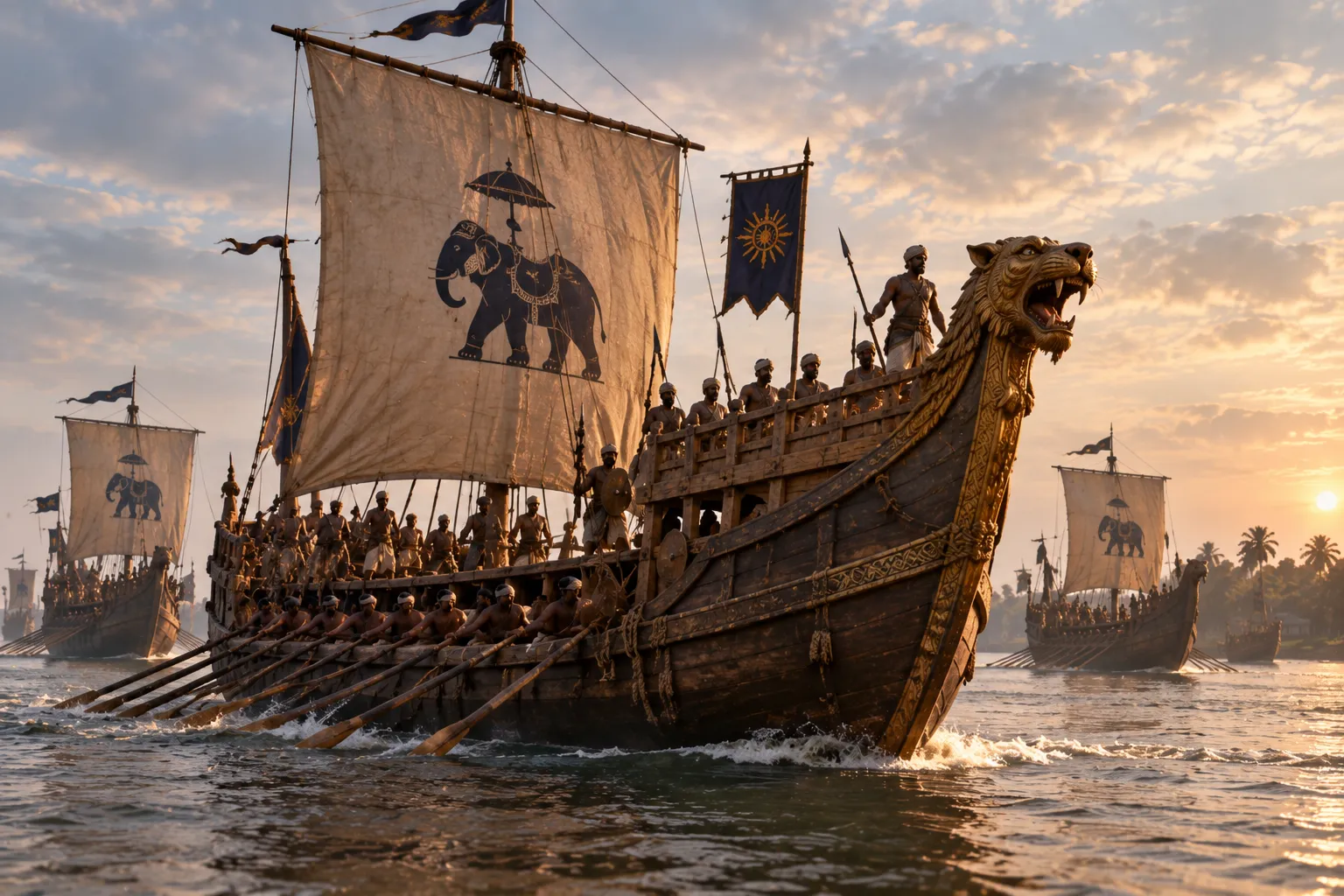
The research describes warship prows, or piringas, as being decorated with animal heads—including lions, tigers, serpents and birds. These decorations were associated with the projection of strength and naval identity.
Whether every warship actually carried such elaborate decoration is impossible to establish from the surviving evidence.
But as a visual tradition, it gives us something remarkable to imagine: a wooden vessel approaching through the river with an animal-headed prow rising above the water.
The warship did not have to be enormous to look formidable.
A deck made for movement
The surviving evidence also suggests that Bengal’s naval warfare depended upon combining vessels with fighting men on land and water.
That means a warship needed more than a beautiful hull.
There had to be room for sailors, oarsmen and armed men. Equipment had to be stored. Movement around the vessel had to remain possible. A fighting platform needed to be stable enough for archers or men engaged in close combat.
The precise arrangement is unknown.
This is one of the places where reconstruction must stop before imagination takes over.
We can infer the practical requirements of a fighting vessel. We cannot honestly draw a precise deck plan from the surviving evidence.
The clues in terracotta
Archaeology gives us another way to look at these lost vessels.
Excavations at Chandraketugarh have produced terracotta plaques and seals depicting boats and ships. These representations preserve details that written descriptions cannot easily convey: masts, sails, hull proportions and long oars.
They do not necessarily depict Pala-period warships—the major Chandraketugarh ship imagery is considerably earlier—but they demonstrate that vessels were important enough in Bengal’s visual culture to be represented in considerable detail.
That earlier evidence is valuable precisely because the later wooden ships have disappeared.
A terracotta image cannot tell us everything about a medieval warship. But it can remind us that Bengal’s shipbuilders worked within a long visual and technological tradition of vessel design.
So what did the warship look like?
Probably not the gigantic fantasy vessel that modern illustrations sometimes create.
The evidence points instead towards purpose-built wooden vessels of different sizes and configurations, adapted to riverine and maritime environments. Some would have been relatively light and manoeuvrable. Others were larger, with more substantial structures and carrying capacity.
A specialised war vessel could have a forward cabin arrangement, sails and oars, a decorated prow and a hull built to tolerate the stresses of difficult waters.
But the exact proportions of one particular Bengali warship remain unknown.
And that uncertainty is part of the story.
Reconstructing without pretending to know
Historical reconstruction becomes misleading when an artist fills every gap and then presents the result as fact.
Here, the gaps are unusually large.
We have technical classifications from a text associated with Bhoja, archaeological images from earlier Bengal, descriptions of naval activity and evidence for particular construction methods. These pieces belong to different places, periods and kinds of evidence.
They cannot simply be assembled into a perfect blueprint.
But they can establish the design logic of the vessels.
They were wooden. They came in different forms. Their construction could favour flexibility. Their rigs varied. Some designs were specifically associated with warfare. Their prows could carry striking animal imagery. And they were built for waterways that demanded something different from the ships of another environment.
The ship we can almost see
Perhaps that is the most honest way to imagine a Bengali warship.
Not as one perfectly reconstructed object, but as a silhouette emerging from fragments.
A wooden hull moves through brown river water. Fibre lashings hold its planks together. Oars rise and fall along the sides. A mast carries its sail above the deck. At the front, an animal-headed prow cuts through the current while armed men wait behind it.
We cannot know exactly how every such vessel looked.
But the surviving evidence tells us enough to understand the principle behind it: Bengal’s warships were not generic boats carrying weapons. They were vessels whose shape, materials and equipment reflected the waters in which they were meant to operate.
The ships are gone.
The clues remain.