
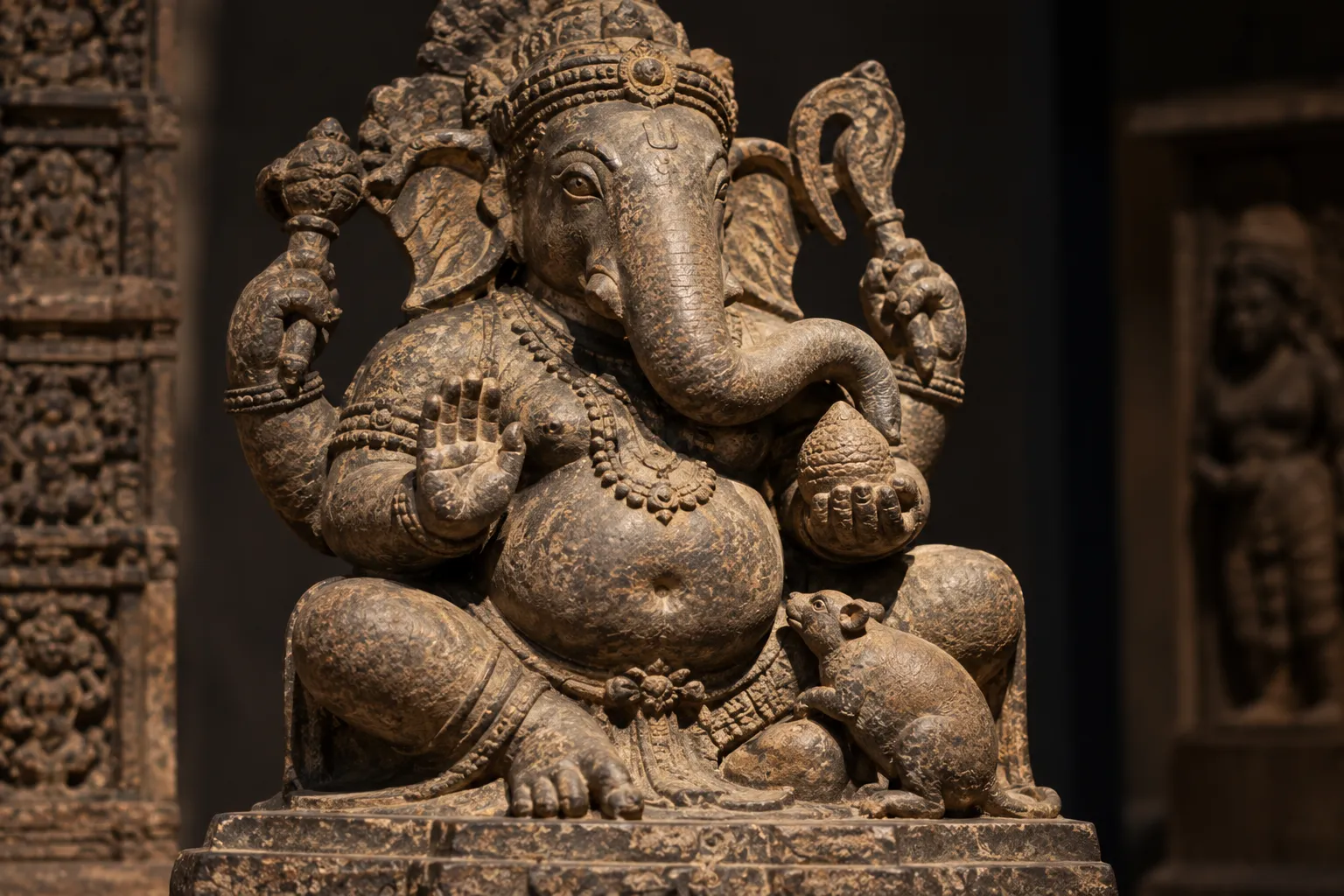
Why Is Ganesha’s Vehicle a Mouse?
Ganesha is one of the most recognisable figures in Indian religious art. The elephant head, the rounded belly, the broken tusk and the sweet modak are immediately familiar.
But look down at his feet.
There, beside—or sometimes underneath—the enormous god is a tiny mouse.
The pairing is so familiar that we rarely stop to ask how strange it is. Why should the deity associated with wisdom, prosperity and the removal of obstacles ride a creature associated with gnawing, stealing grain and slipping into the smallest corners?
The answer is not as simple as a single myth.
The mouse was not there from the beginning
One important clue comes from the history of Ganesha’s imagery itself.
The earliest surviving representations of Ganesha do not consistently show him with a mouse. The animal becomes an increasingly established part of his iconography in the early medieval period. Art-historical scholarship places the appearance of the mouse as Ganesha’s principal vehicle in central and western Indian sculpture around the seventh century, while later textual traditions give the relationship a fully developed mythological explanation.
That means the mouse was not simply an inseparable part of Ganesha from the moment the elephant-headed god appeared.
The relationship itself has a history.
A creature that steals grain
There is an intriguing clue in the Sanskrit word mūṣaka, commonly used for the mouse or rat associated with Ganesha. The word is related to the root muṣ, meaning to steal or rob.
That association opens an agricultural interpretation.
S. M. Michael, surveying earlier theories about the origins of the Ganapati cult, discusses a hypothesis that connects Ganesha with the harvest and the field rat. In this interpretation, the mouse represents a creature that threatens stored or growing crops, while Ganesha’s mastery over it symbolises the control or overcoming of a destructive force.
It is an attractive idea, but it should remain what the evidence allows it to be: an interpretation, not a proven explanation for the origin of Ganesha’s mouse.
The god who conquers the obstacle
This interpretation becomes particularly interesting because it fits Ganesha’s wider identity.
Ganesha is Vighneśvara, the lord of obstacles. A rat that gnaws through grain stores, disappears into walls and tunnels beneath the ground is, in a very literal agricultural sense, a small but persistent obstacle.
To place such a creature beneath the feet of the god creates a visual statement.
What causes trouble can be brought under control.
That may help explain why the mouse works so well as Ganesha’s companion. The vehicle does not need to be physically powerful. Its significance lies in what it represents and what the god is shown mastering.
But the mouse means more than one thing
Religious symbols rarely have only one meaning.
In later devotional interpretations, the mouse has been understood in relation to the restless mind, desire and the impulses that move unpredictably from one object to another. A government museum description of Ganesha riding the mouse, for example, interprets the animal as the wandering mind and Ganesha’s mastery of it as a metaphor for intellectual discrimination.
These interpretations belong to different layers of tradition. They should not be collapsed into a single ancient explanation.
The historical mouse and the theological mouse are not necessarily the same story.
One may have begun with a familiar animal in the agricultural world; later religious thinkers could give the same image deeper philosophical meanings.
An extraordinary contrast
There is also something visually clever about the pairing.
The elephant is enormous. The mouse is tiny.
The elephant suggests weight, strength and presence. The mouse is quick, elusive and capable of entering spaces far too small for a larger animal.
Ganesha sits above both worlds.
That contrast may be one reason the image became so enduring. Indian religious art frequently pairs a deity with an animal whose qualities illuminate something about the deity. Ganesha’s mouse creates an especially striking reversal: the greatest creature in the image depends upon one of the smallest.
It quietly unsettles the assumption that importance must correspond to size.
Bengal has its own evidence
The mouse became firmly established in Bengali Ganesha imagery as well. Archaeological and art-historical studies of Bengal’s medieval Ganesha sculptures note the frequent presence of the mouse as his vāhana. At Paharpur and in other Bengali examples, the development of Ganesha’s familiar iconography can be traced through sculpture and later textual traditions.
By the medieval period, therefore, the mouse was no longer an odd addition to Ganesha’s image. It had become part of the visual language through which Bengali viewers recognised the deity.
The little animal had acquired a permanent place beneath the god.
Why the mouse?
Perhaps the most honest answer is that we cannot reduce the pairing to one original meaning.
The mouse may have carried associations with agriculture, grain and destruction. Its Sanskrit name could evoke stealing. Its place beneath Ganesha could then be understood through his role as conqueror of obstacles. Later traditions could layer philosophical meanings onto the same image.
What matters is that the relationship accumulated meaning over time.
A tiny field animal became the vehicle of one of India’s most widely worshipped gods.
And every time Ganesha is shown riding the mouse, the image makes the same wonderfully unexpected point: greatness does not always need a great vehicle.