
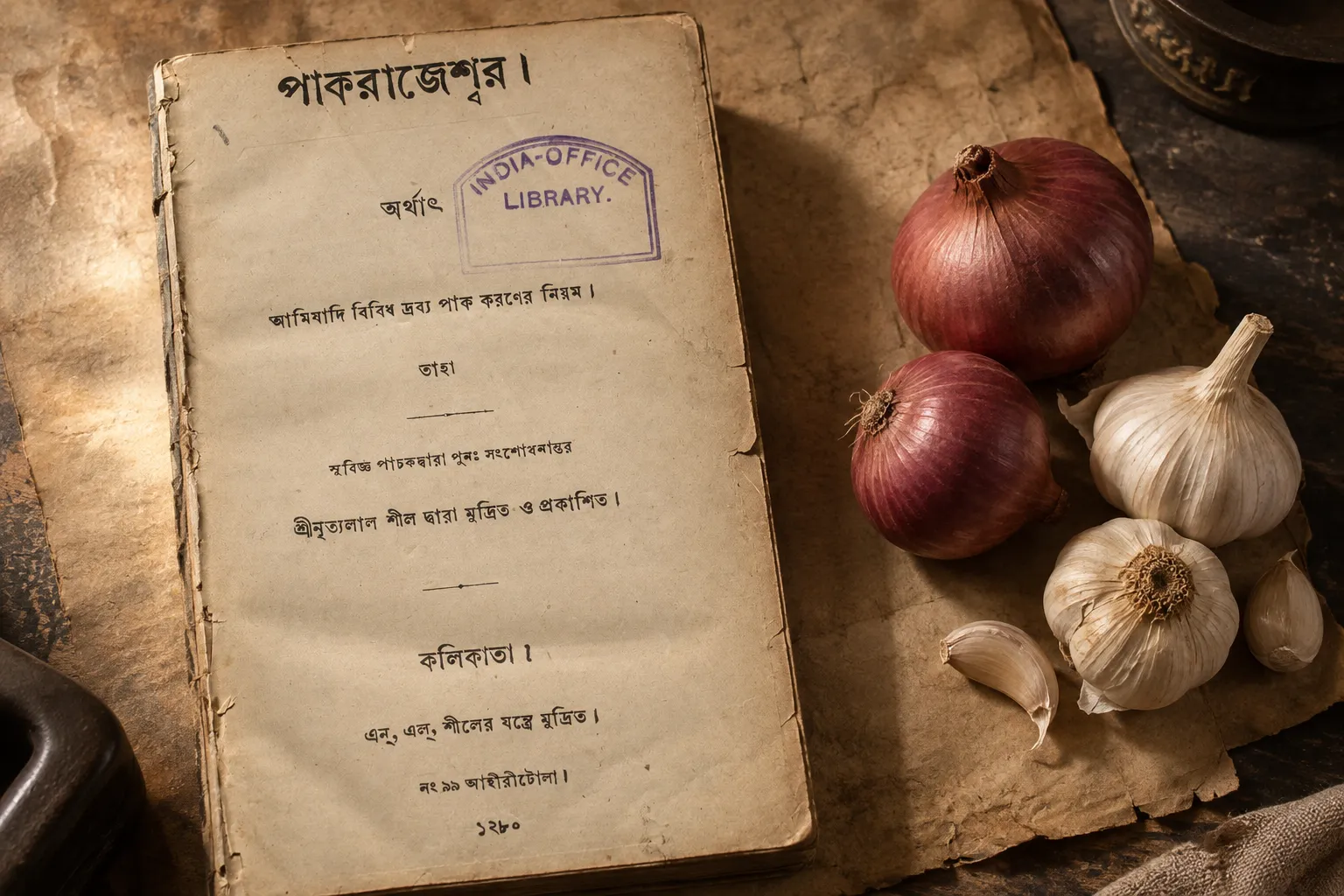
The Cookbook That Left Out Onion and Garlic
In 1831, a Bengali cookbook described elaborate meat dishes—but left out ingredients that many Bengali cooks today might expect to find in them.
The book was Pakrajeswar, published under the patronage of the Burdwan royal house. Its recipes included rich preparations associated with Mughal-influenced cooking. Yet onion and garlic, familiar foundations of many such dishes today, were largely absent.
The omission raises a question that reaches beyond ingredients: Who was a Bengali cookbook written for—and what did its author believe those readers would accept?
A cookbook that knew its audience
In Culinary Culture in Colonial India, historian Utsa Ray discusses the striking explanation offered in Pakrajeswar: because people in the region hardly consumed onion, the author had refrained from listing it as an essential ingredient.
That statement is revealing. The author was not simply recording a recipe in the abstract. The book was shaped by an understanding of its readers—their tastes, expectations and ideas about appropriate food.
But it is important not to mistake that explanation for a complete picture of Bengal. A cookbook could tell us what its author considered suitable to write down without representing every household or community.
The absence of onion and garlic, then, is not proof that nobody in Bengal used them. It is evidence of a particular culinary world being presented to a particular audience.
Meat dishes, but not the expected masala
The recipes make the omission more interesting.
Pakrajeswar included elaborate meat preparations, yet Ray notes the near absence of onion and garlic in these dishes. She connects this pattern to the book’s largely Hindu readership, which she argues was not yet accustomed to using these ingredients in its food.
This complicates the idea that culinary influences travel as complete packages. Mughal-influenced dishes could be adapted to local preferences rather than reproduced unchanged.
A recipe might carry the structure or ambition of a cooking tradition while leaving out ingredients that did not fit its audience’s expectations.
The dish travelled; its ingredients could be negotiated.
The silence was not permanent
The cookbook record did not remain fixed.
In 1858, Byanjan-Ratnakar also largely excluded onion and garlic. But in 1879, Pakprabandha incorporated both ingredients into its recipes. Ray notes that the latter was probably written by a woman who did not publish under her own name—an intriguing possibility, though not a settled identification.
These books offer a glimpse of change within Bengali recipe writing. Ingredients that were absent or marginal in some earlier works appeared in later ones.
That does not establish a single moment when Bengali cooking collectively accepted onion and garlic. Nor does it prove that every household followed the same path. It shows that the culinary world represented by these books was changing.
What a cookbook leaves out
A cookbook is not a census of kitchens. Its silences may reflect the author’s audience, the kind of food being described, or the assumptions behind the recipes.
The early books discussed by Ray were shaped by elite settings and royal patronage. They cannot automatically tell us what poorer households, Muslim families or cooks outside those circles prepared.
That limitation is precisely what makes Pakrajeswar worth reading closely. Its explanation for omitting onion tells us something about how the author imagined regional taste—and about the relationship between food writing and social expectations.
The book does not simply preserve recipes. It presents a version of Bengali cooking that its readers could recognize as appropriate.
A recipe is also a cultural decision
Today, onion and garlic may seem inseparable from many Bengali meat dishes. The cookbook record reminds us that familiar combinations have histories.
In nineteenth-century Bengali recipe writing, culinary influence was not simply copied from one tradition into another. It was filtered through audiences, preferences and ideas about food.
The most revealing detail is not merely that Pakrajeswar left onion and garlic out. It is that its author explained why.
That explanation turns a missing ingredient into historical evidence: a glimpse of how Bengali food was being described, negotiated and remade—one recipe book at a time.