
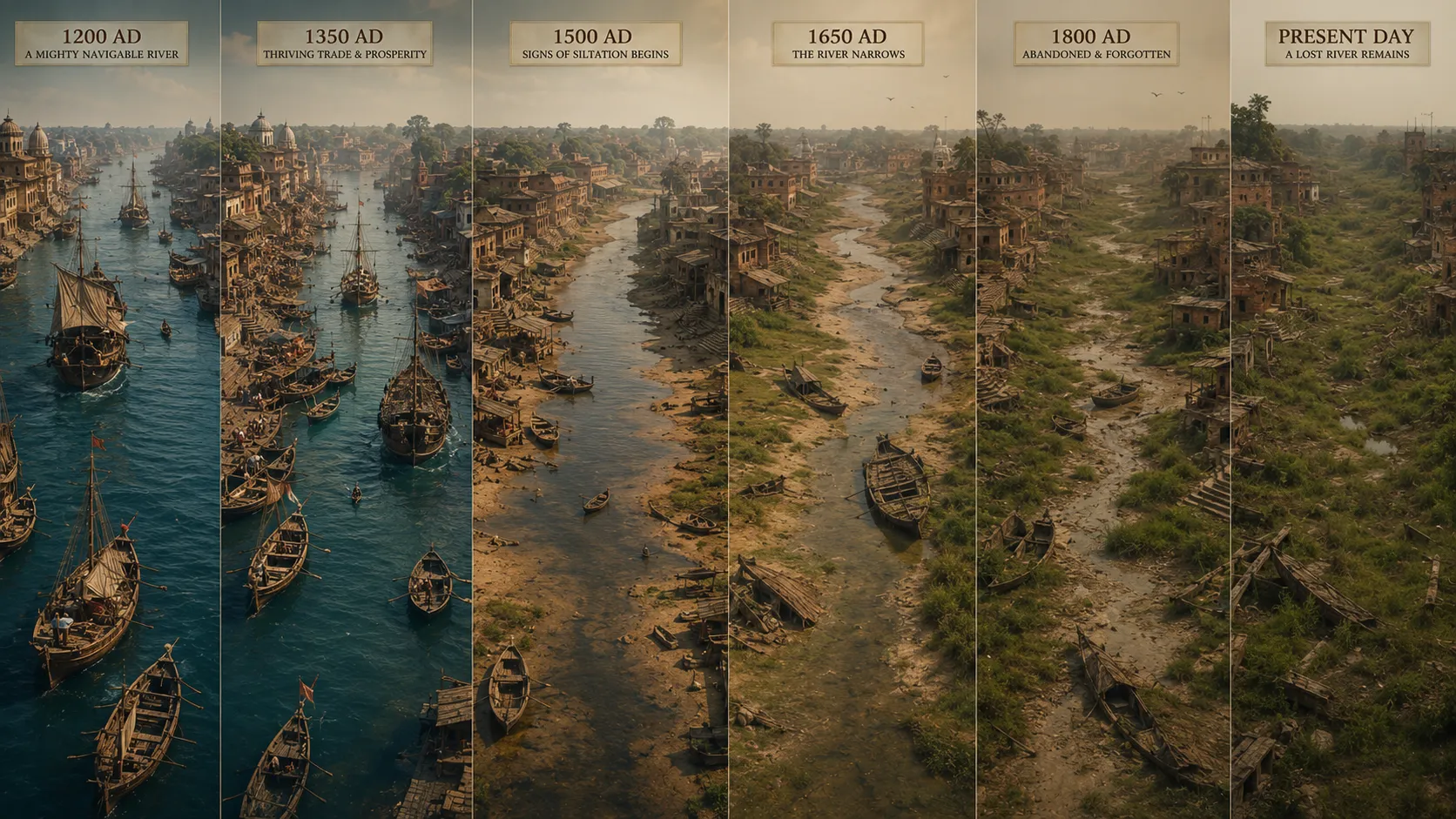
The Death of a River: Saraswati of Bengal
Rivers rarely disappear in a single moment.
They become shallower. Their channels fill with sediment. Water finds another route. A once-important branch is gradually reduced to a smaller stream, then a marsh, then a memory.
The Bengal Saraswati followed something like this long, uneven journey.
For centuries, it had been one of the important waterways of the lower Bhagirathi system, carrying boats through southern Bengal and helping connect places such as Saptagram with the wider world. Then its water began to diminish. Its channel silted. The main current of the river system moved elsewhere.
By the time later generations encountered the Saraswati, much of the great river was already gone.
But what actually killed it?
There are several answers. Some are well supported. Others remain debated. A few belong more to folklore than history.
The real story is less dramatic than a single catastrophe—but perhaps more revealing.
The Saraswati was not killed by one event. It was gradually abandoned by a changing delta.
A river slowly filling itself
The first part of the explanation lies in the very landscape that created the Saraswati.
Bengal is a sediment-rich delta. Rivers descending from the Himalayan system carry enormous quantities of material towards the Bay of Bengal. During the monsoon, powerful floods spread water and sediment across the floodplain.
A river does not simply carry this sediment away forever.
Some of it settles inside the channel.
Over centuries, the riverbed can rise. Natural levees build up along the banks. The channel becomes progressively less efficient at carrying water. Eventually, water begins to find another route.
This process is known as avulsion—a natural change in which a river abandons one channel for another.
The Saraswati appears to have been particularly vulnerable to this process. Its history was shaped by meandering, sediment deposition and repeated changes in the delta’s drainage network. Natural deltaic siltation and progradation provide the strongest underlying explanation for its decline.
Evidence from historical accounts also points towards gradual shallowing rather than sudden disappearance. Silting was already becoming significant by the 15th century, while later travellers described increasingly difficult navigation.
But there was another problem.
The Saraswati was losing water.
When the water chose another river
A distributary survives only as long as enough water continues to enter it.
The wider Bhagirathi system was changing.
One important part of that change involved the Damodar. Historical mapping and sedimentological evidence indicate that the Damodar had once contributed substantial flow to the Saraswati–Bhagirathi network. When the Damodar shifted its course, the Saraswati lost an important source of high-energy water.
That mattered enormously.
Fast-moving water helps a river transport sediment. Remove some of that discharge, and the sediment becomes harder to clear.
The Saraswati was therefore caught in a dangerous cycle:
less water → less flushing power → more sediment → a shallower channel → still less useful flow.
At roughly the same time, the main discharge of the Ganges system increasingly favoured the Padma, reducing the water available to the western Bhagirathi channels. Around the 16th century, the main flow of the Bhagirathi increasingly favoured what became the Hooghly channel.
The Saraswati was no longer the preferred route.
The Hooghly was.
And once the main current had shifted, the old distributary had little chance of returning to its former importance.
The ships noticed before historians did
The consequences were visible on the river itself.
At the beginning of the 16th century, Saptagram was still a major port. Tomé Pires described Satgaon as a good harbour and a prosperous city.
A few decades later, the situation looked very different.
By around 1570, Caesar Frederick reported that the river had become too shallow for large vessels. Ships could anchor downstream at Betore, where their cargo was transferred to smaller boats before continuing towards Saptagram.
That detail is more important than it might first appear.
It shows that the river had not suddenly vanished.
It had become inconvenient.
And for a port, inconvenience can be fatal.
As large vessels found it increasingly difficult to reach Saptagram, merchants began moving towards the deeper Hooghly. Around 1580, the Portuguese shifted their principal trading presence downstream to Hooghly.
The river was changing the commercial map before anyone formally declared that the old port was finished.
Was an earthquake responsible?
There is a more dramatic theory.
The great earthquake of 1505 has sometimes been connected with the Saraswati’s decline. F. C. Hirst proposed that tectonic movement might have altered the slope of the Bengal basin and affected the river’s connection with the main system.
The earthquake itself is historically recognised.
The problem is the next step.
There is no clear evidence demonstrating that the 1505 earthquake suddenly severed the Saraswati or caused its disappearance. The available geomorphological evidence fits gradual sedimentation and river avulsion better than a single catastrophic tectonic event.
That does not make tectonic influence impossible. The Bengal basin is a dynamic geological environment, and subtle changes in elevation can influence river gradients.
But the evidence is weaker.
The earthquake may have been a factor. It is not a convincing single explanation for the death of the Saraswati.
And no, the Portuguese did not kill it
Perhaps the most colourful explanation is also the least credible.
A popular story claims that Portuguese ships, with their deep drafts, damaged the river or otherwise caused it to silt up.
There is no scientific evidence for this.
The historical sequence actually suggests the opposite.
The Portuguese encountered a river that was already becoming difficult to navigate. They eventually moved downstream because the deeper Hooghly was more useful for maritime trade.
They did not destroy the river.
They followed the river’s decline.
The same caution applies to stories that blame the British for deliberately engineering the Saraswati out of existence. Colonial interventions certainly altered Bengal’s waterways, but the major decline of the Saraswati had begun centuries earlier.
Chronology matters.
Nature began it. Humans helped finish it.
This is where the story becomes more complicated.
The Saraswati’s initial decline appears to have been largely a natural consequence of deltaic change. But once the river was weakened, human intervention made recovery increasingly unlikely.
Later embankments restricted the movement of floodwater between rivers and floodplains. Canal construction altered drainage patterns. Land reclamation and urban expansion occupied former channels and wetlands.
In the 20th century, the Damodar Valley Project further changed the distribution of Damodar water. By then, the Saraswati was already severely degraded, but the reduction and regulation of flows helped push the old river towards its modern moribund condition.
Modern development added still more pressure: reclamation, brick kilns, barriers, bridges and pisciculture structures have obstructed sections of the old channel.
So human beings did not create the original disappearance.
But they helped make it permanent.
The river did not die on a day
This may be the most important thing to understand about the Saraswati.
There was no single morning when Bengal woke to discover that its river had vanished.
The decline unfolded across generations.
A channel became shallower.
Large ships stopped coming.
Trade moved downstream.
The Hooghly gained importance.
The old river received less water.
Maps continued to draw it even after its commercial life had faded.
Later, parts of the channel survived as wetlands, canals and residual waterways.
That is why the question “Who killed the Saraswati?” ultimately has no satisfying answer.
There was no single murderer.
There was a delta carrying too much sediment. There were rivers changing their courses. There was a loss of discharge. There were new channels offering water an easier path to the sea. And, much later, there were human interventions that reshaped what remained.
The Saraswati’s death was therefore not a murder mystery.
It was a story of geographical succession.
One river lost its advantage.
Another gained it.
And an entire landscape changed with the water.
The great Saraswati of southern Bengal is gone. But its disappearance still shapes the places around it—the old port of Saptagram, the changing Hooghly, the wetlands and settlements that occupy its former basin.
A river can disappear without leaving a monument to mark the moment.
Sometimes its death is written instead in stranded boats, abandoned ports, old maps and the shape of the land.
The Saraswati did not vanish because Bengal stopped needing a river. It vanished because the river system found another way to carry Bengal towards the sea.