
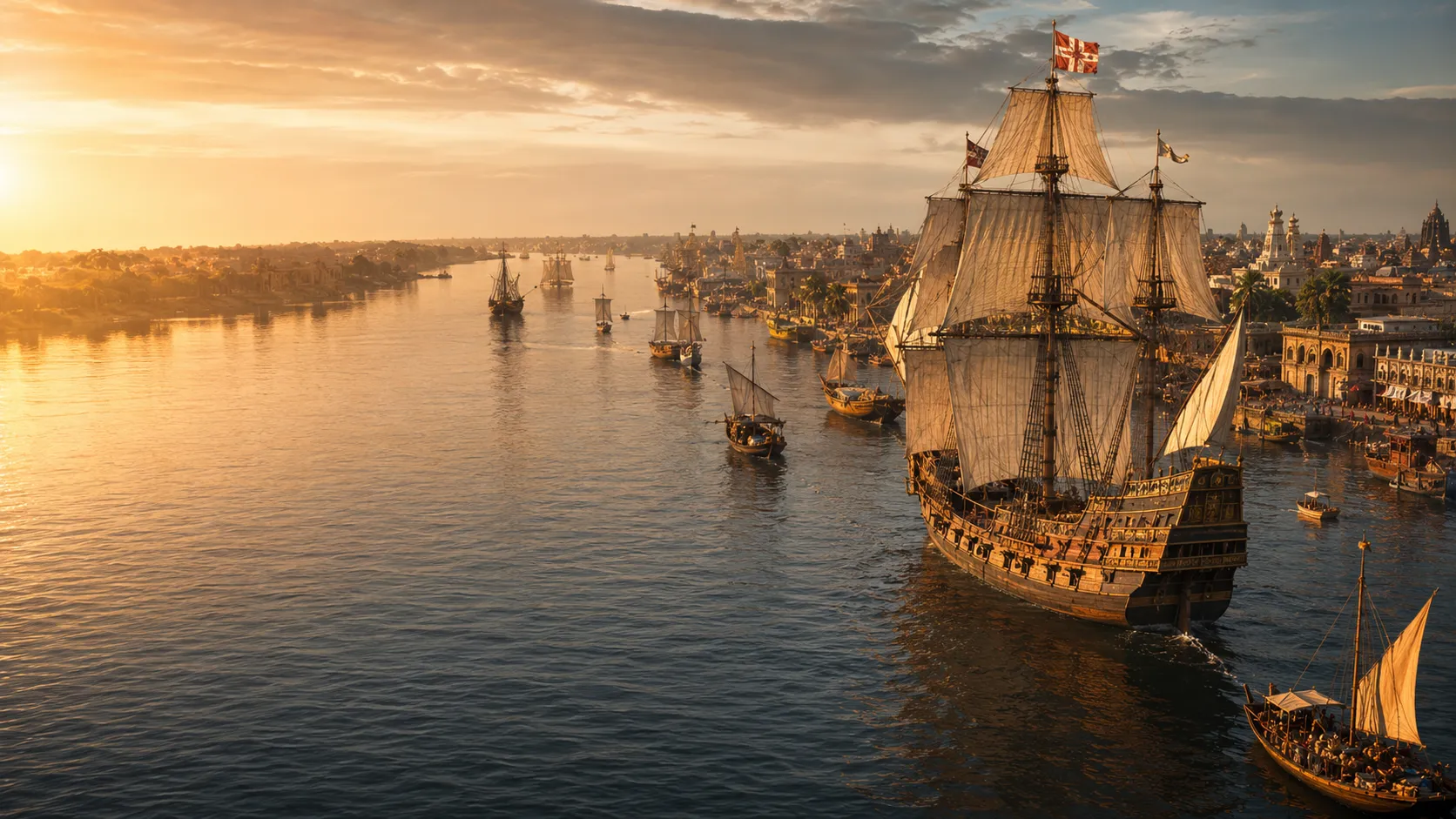
The River That Changed Bengal’s Capital
For a long time, Bengal’s most important cities were not fixed in place.
They moved.
Not because one dynasty simply replaced another, or because a conqueror chose a new capital. In the lower delta, the river itself could change the geography of power.
One of the clearest examples began with the decline of the Bengal Saraswati.
When the river was strong, Saptagram was one of Bengal’s great commercial centres. When its channel began to silt and lose water, trade gradually moved towards the Hooghly.
And, eventually, further south.
Towards Calcutta.
When the river carried the centre of Bengal
Saptagram’s importance rested on a simple geographical fact.
The Bengal Saraswati connected the rich agricultural interior with the Hooghly and the Bay of Bengal. Goods could move downriver; merchants and ships could move inland.
By the medieval period, this had made Saptagram an important centre of trade, administration and revenue.
Even after Bengal’s political capital shifted elsewhere in the 14th century, Saptagram retained considerable importance in southern Bengal. It became a mint and revenue centre, and later formed part of the Mughal administrative system.
The city’s fortunes therefore depended on something that governments did not entirely control:
the route taken by the water.
Then the river began to move
The Bengal delta is constantly rebuilding itself.
Rivers carry sediment from the Himalayas and deposit it across the floodplain. Channels become shallower. Water seeks other routes. Distributaries gain or lose importance.
The Saraswati was no exception.
Over centuries, sediment accumulated in its channel. At the same time, changes in the wider Bhagirathi system reduced the amount of water entering it. The Damodar, which had historically contributed substantial flow to the Saraswati–Bhagirathi network, shifted its course. By the sixteenth century, the main discharge of the Ganges system was also increasingly favouring the Padma, reducing the water available to the western Bhagirathi channels.
The result was not an overnight disappearance.
It was a change in the balance between rivers.
The Saraswati weakened.
The Hooghly strengthened.
And Bengal’s commercial geography began to change with them.
Trade follows the deeper channel
By the early 16th century, Saptagram was still a prosperous port.
Tomé Pires described Satgaon as a good harbour and a rich city with many merchants. But later European visitors saw a very different problem.
By around 1570, Caesar Frederick reported that the river had become too shallow for large ships. Merchants had to anchor downstream at Betore and transfer their goods to smaller vessels before continuing towards Saptagram.
That small logistical inconvenience carried a much larger historical consequence.
A port does not exist only because merchants want to use it.
It exists because ships can reach it.
Once the Saraswati became increasingly difficult for large vessels, the Hooghly offered an obvious alternative.
The commercial world began moving towards the waterway that could still carry it.
Hooghly takes the river’s place
By the later 16th century, European traders were increasingly drawn towards Hooghly.
The shift was not simply a story of European arrival replacing an older Bengali economy. The physical geography came first. The changing river system altered which places were most useful to merchants, administrators and governments.
Around 1580, the Portuguese moved their principal trading presence downstream from Satgaon to Hooghly, where the deeper Bhagirathi channel provided better access for maritime commerce.
The political system followed the commercial geography.
In 1632, the Mughals conquered Hooghly. Afterward, customs activity was transferred from Satgaon to Hooghly.
A revenue office had effectively followed the river.
The change mattered because customs were not merely bureaucratic machinery. They marked where trade was being concentrated—and where the state expected wealth to arrive.
Saptagram was losing its economic centre of gravity.
Hooghly was gaining it.
And then the centre moved again
But Hooghly was not the final destination.
As the lower Hooghly became increasingly important to maritime trade, commercial activity continued to spread southward. The old riverine world around Saptagram was giving way to a new geography of ports, settlements and trading stations.
Over time, Calcutta emerged within this changing landscape.
Its rise should not be reduced to the death of the Saraswati alone. Political decisions, European competition, warfare, administrative changes and commercial networks all mattered. The research points instead to a broader interaction between environmental change and human choices.
But the river had changed the possibilities.
A city that had once been ideally positioned could become inconvenient.
Another settlement, once less important, could suddenly become better placed.
That is how Bengal’s urban geography could move without the land itself moving.
A capital shaped by water
The story of Saptagram, Hooghly and Calcutta reveals something unusual about Bengal’s history.
Political power often appears to move because rulers make decisions.
Commercial power can move for a quieter reason.
The ships stop coming.
The Saraswati’s decline did not directly create Calcutta. But it helped dismantle the riverine geography in which Saptagram had flourished and shifted commercial advantage towards the Hooghly. From there, political and economic forces built a new urban landscape further downstream.
The capital of Bengal was never simply chosen.
In part, it was found by following the water.
And once the water changed course, the history of the cities changed with it.