
The Filmmaker Who Saw Bengal Differently
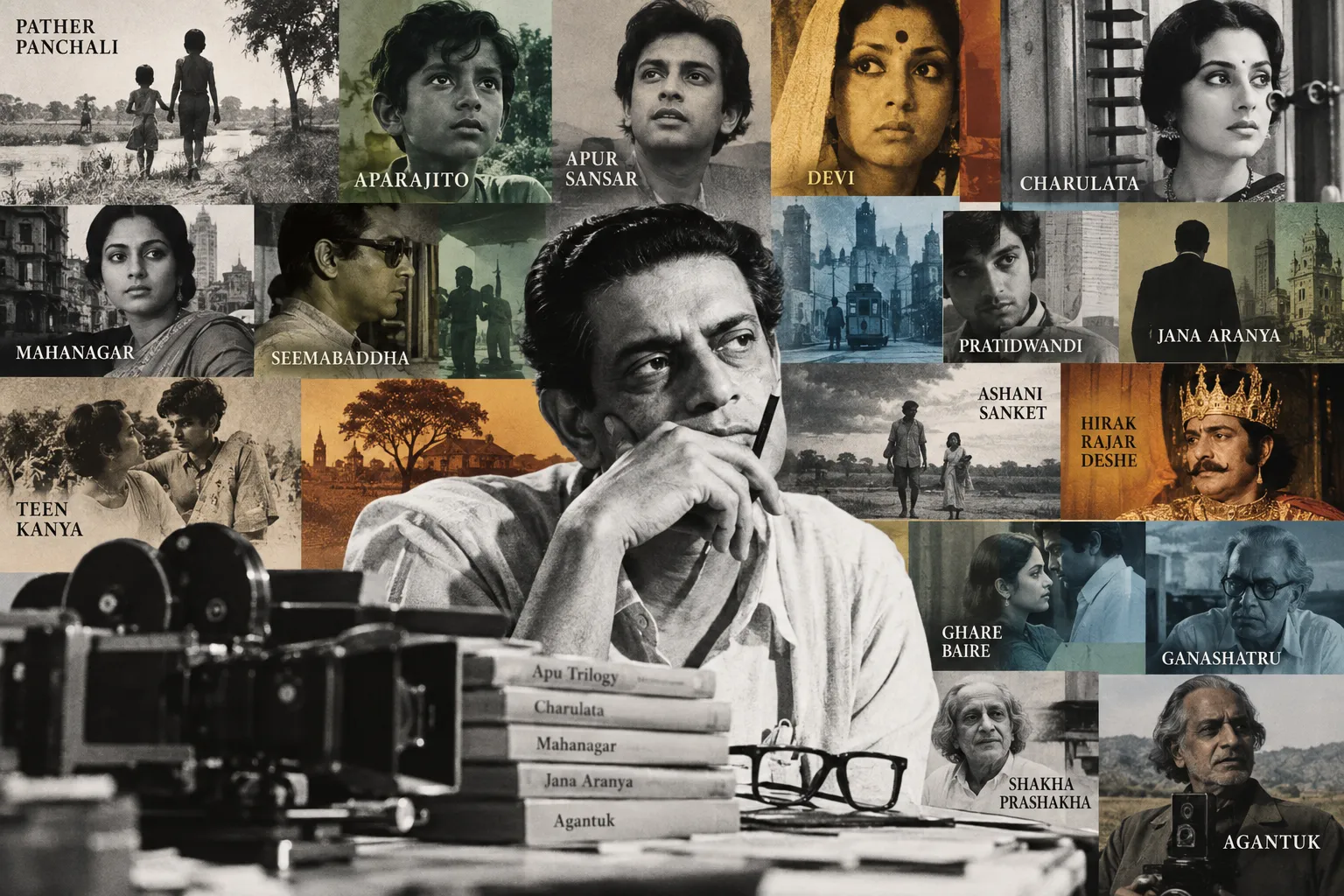
Satyajit Ray was a multi-talented master, and for Bengalis he remains an extraordinary part of our cultural imagination. Most of us know him deeply as a filmmaker and writer. But when we look across his films, something else becomes visible: a filmmaker who kept observing Bengal as it changed, finding stories not only in its villages and cities but in the anxieties, prejudices, ambitions and contradictions of the people who lived there.
Ray did not make the same kind of film throughout his career. He moved from rural Bengal to the modern city, from childhood to old age, from family relationships to politics, from literary adaptations to original stories. Yet beneath that variety was a remarkably consistent curiosity about people: how do we behave when the world we know begins to change?
He began with a village, but he did not remain there
Pather Panchali (1955) announced Ray’s arrival with a world that Indian cinema had rarely presented in quite this way. Adapted from Bibhutibhushan Bandyopadhyay, the film follows Apu and his family through the ordinary difficulties and discoveries of rural Bengal. Poverty is central to the story, but Ray does not reduce his characters to poverty; childhood curiosity, family affection, jealousy, humour, beauty and loss exist alongside it.
The film’s visual language is inseparable from that approach. Ray observes rather than constantly explains, allowing landscape, gesture, sound and silence to carry meaning. Ravi Shankar’s music became another important element of the film’s emotional world. The result was a Bengali story that remained intensely local while becoming understandable to audiences far beyond Bengal.
Pather Panchali was followed by Aparajito (1956) and Apur Sansar (1959), completing the Apu Trilogy. Together, the three films trace not merely the life of one character but the movement from village to city, childhood to adulthood and inherited world to modern aspiration.
The trilogy established one of Ray’s enduring strengths: he could make a small personal life feel historically significant without turning it into a grand historical spectacle.
Ray kept returning to literature
Literature was one of the great sources of Ray’s cinema. Bibhutibhushan gave him the Apu world, while Rabindranath Tagore became another major presence. Teen Kanya (1961) brought three Tagore stories to the screen, while Charulata (1964), based on Nastanirh, became one of his most accomplished examinations of loneliness, marriage and the emotional restrictions placed on an educated Bengali woman.
Devi (1960) took another literary and social question into the realm of belief. The film examines what happens when a young woman is treated as a goddess, exposing the destructive possibilities of faith when belief turns into unquestioned authority. Ray was interested not simply in condemning belief, but in examining what happens to individuals when a society stops questioning its own assumptions.
His literary adaptations were therefore never simply illustrations of famous Bengali stories. He used literature as a way into questions about society, psychology and changing values.
His Bengal was also becoming modern
Ray’s cinema gradually moved from rural landscapes into more recognisable urban and middle-class worlds.
Kanchenjungha (1962), his first original screenplay, unfolds over a single afternoon in Darjeeling and examines family relationships, class expectations and the pressures surrounding marriage. Mahanagar (1963) moves into Calcutta and follows Arati, a housewife who takes a job during a period of financial pressure. The film became a subtle study of women’s changing role, work, marriage and urban modernity.
In Charulata, Ray looked backwards into the late nineteenth century, but the questions were surprisingly contemporary: what does an educated woman do with an intellectual life that her social world does not fully allow her to pursue? What happens to a marriage when emotional and intellectual needs remain unspoken?
This was one of Ray’s distinctive qualities. He could make a film about another period without making it feel like a museum piece. The historical setting was important, but the human question came first.
Then came the city of anxiety
By the 1970s, Bengal itself was changing rapidly, and Ray’s cinema changed with it.
Pratidwandi (1970), Seemabaddha (1971) and Jana Aranya (1975) formed a powerful portrait of urban Bengal under pressure. Their worlds included unemployment, competition, political instability, ambition and moral compromise. Rather than turning these subjects into straightforward political statements, Ray placed individuals inside them and allowed the contradictions to emerge through their choices.
The three films also show how differently Ray could approach the same city. In Pratidwandi, the educated young man encounters a world in which academic qualifications no longer guarantee a future. Seemabaddha examines corporate ambition and the compromises of professional success. Jana Aranya follows a young man’s entry into a harsher commercial world where survival increasingly demands moral concessions.
Ray was not making three versions of the same film. He was watching different layers of the same society begin to change.
Even his political films trusted the audience
Ray’s political imagination is perhaps clearest in Hirak Rajar Deshe (1980). On the surface it is a children’s fantasy about a whimsical king and his kingdom. Beneath that surface lies a much darker world of propaganda, censorship, enforced conformity and political control.
The timing mattered. The film came after the Emergency of 1975–77, and its allegorical quality allowed Ray to address political power without making a conventional political drama.
This was another characteristic of his cinema: he rarely needed to tell the audience exactly what to think. He created a situation, populated it with recognisable human beings and allowed the implications to emerge.
The same quality can be found in his later films. Ghare Baire (1984), based on Tagore, returned to questions of nationalism, gender, politics and personal freedom. Ganashatru (1990) examined institutional resistance to inconvenient truth. Shakha Prashakha (1990) turned towards family, corruption and moral compromise.
A filmography that kept changing
Ray’s career cannot easily be reduced to one style because his subjects kept changing.
| Film | Year | What makes it distinctive |
|---|---|---|
| Pather Panchali | 1955 | Rural Bengal, childhood, poverty and everyday life |
| Aparajito | 1956 | Education, migration and the movement from village to city |
| Apur Sansar | 1959 | Adulthood, marriage, fatherhood and loss |
| Devi | 1960 | Faith, superstition and the destructive power of belief |
| Teen Kanya | 1961 | Three Tagore stories and three different portraits of womanhood |
| Kanchenjungha | 1962 | Class, family expectations and modern relationships |
| Mahanagar | 1963 | Working women, marriage and changing Calcutta |
| Charulata | 1964 | Loneliness, marriage, intellect and nineteenth-century Bengal |
| Kapurush / Mahapurush | 1965 | Two sharply different studies of relationships and belief |
| Pratidwandi | 1970 | Youth, unemployment and political uncertainty |
| Seemabaddha | 1971 | Corporate ambition and moral compromise |
| Ashani Sanket | 1973 | The Bengal Famine of 1943 and the destruction of rural life |
| Jana Aranya | 1975 | Unemployment, business and moral compromise |
| Hirak Rajar Deshe | 1980 | Political allegory, authoritarianism and propaganda |
| Ghare Baire | 1984 | Nationalism, gender and political idealism |
| Ganashatru | 1990 | Truth, institutions and public responsibility |
| Shakha Prashakha | 1990 | Family, corruption and moral inheritance |
| Agantuk | 1991 | Civilization, identity, belonging and the meaning of being “modern” |
The list itself reveals something about Ray. He did not spend his career trying to repeat the success of Pather Panchali. He moved from villages to cities, from childhood to old age, from family relationships to politics, from nineteenth-century Bengal to contemporary Calcutta, and from realism to allegory.
His final film asked his biggest questions
Then came Agantuk (1991), Ray’s final film. On the surface, it is about a man who returns to a family claiming to be a long-lost relative. But the stranger, Manomohan Mitra, gradually becomes something more than a character in a family mystery. Through him, Ray begins questioning the assumptions by which modern society defines civilization, education, progress, culture and even trust.
Mitra has travelled widely and lived outside the familiar structures of respectable middle-class life. He refuses to accept conventional definitions simply because everyone around him accepts them. The conversations in the film therefore feel different from the social observations of Ray’s earlier cinema. They feel almost like a filmmaker who has spent a lifetime watching people and has finally decided to ask them, directly: What exactly have we learned?
There is something particularly moving about that question coming at the end of Ray’s career. After decades of making films about childhood, family, women, cities, poverty, ambition, politics and social change, he ended by asking some of the largest questions of all. What do we really mean by civilization? Does education make us wiser? Does modernity make us better? And are we certain that the way we live makes us more civilized?
Agantuk does not offer comfortable answers. It leaves us with Ray’s doubts, observations and provocations, almost as if he were passing a conversation on to the next generation.
What did we carry forward?
This is where Ray’s legacy becomes more complicated.
Bengalis have preserved his films, celebrated his awards, quoted his characters and kept his literary creations alive. We continue to discuss Pather Panchali, Charulata, Mahanagar, Hirak Rajar Deshe and Agantuk as works that helped define modern Bengali culture.
But perhaps the more difficult question is what we have done with the ideas inside them.
Ray repeatedly asked his audience to look more carefully at society: at blind belief, social prejudice, empty respectability, political certainty, professional ambition, gender expectations and our assumptions about what constitutes a good life. His films rarely behaved like lectures because he trusted viewers to recognise the questions for themselves.
That makes Agantuk especially powerful today. The film does not merely leave us with a set of philosophical observations; it leaves us with the responsibility of deciding whether those observations have changed anything in us.
We remember Ray as a genius. We remember the filmmaker who took Bengal to the world and the writer who gave Bengali readers Feluda and Professor Shanku. But perhaps the more meaningful way to remember him is to return to the questions he kept asking.
Ray spent a lifetime teaching us how to look. The question is whether we are still carrying what he taught us when we look at ourselves.