
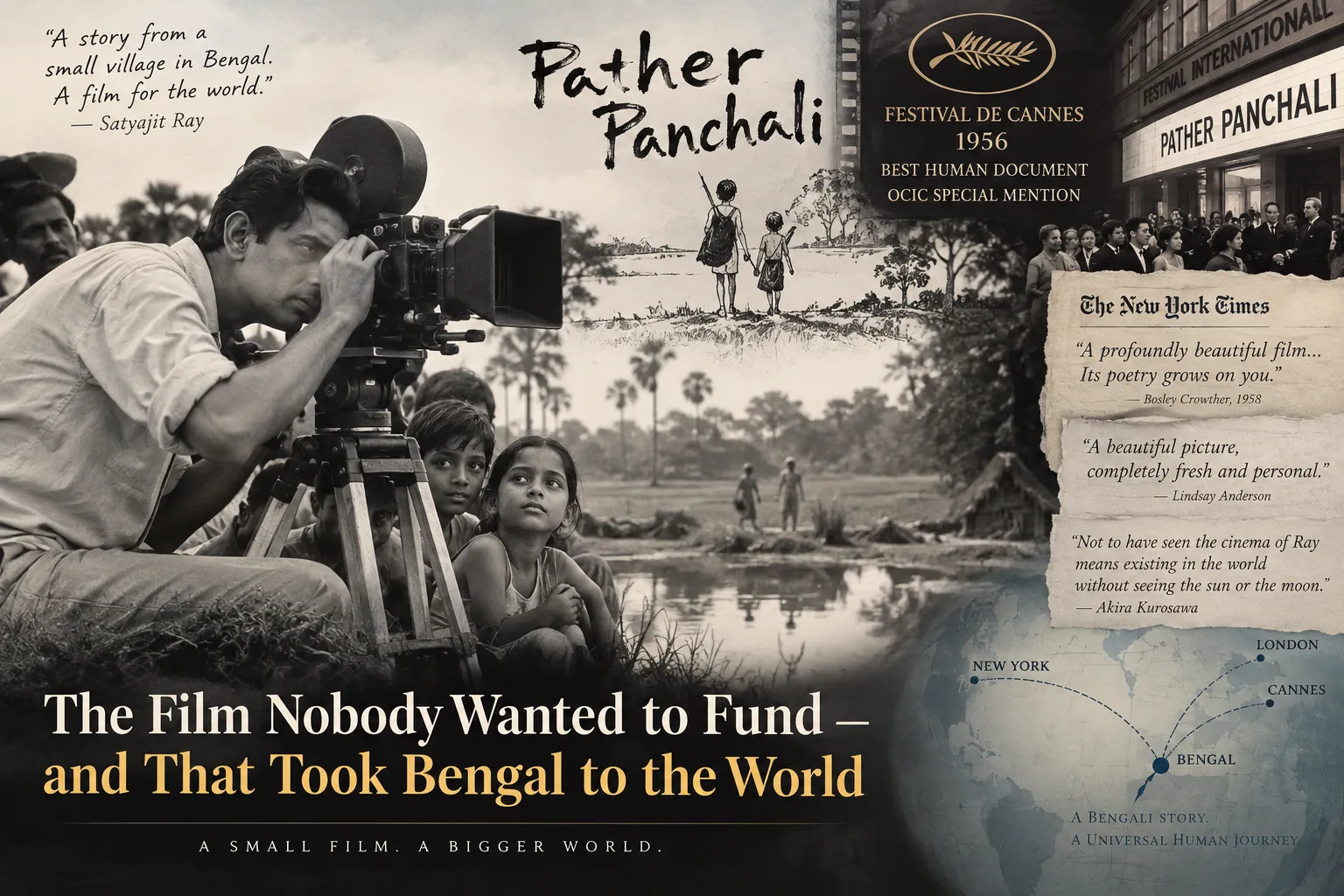
The Film Nobody Wanted to Fund — and That Took Bengal to the World
Today, Pather Panchali is so deeply embedded in Bengali cultural memory that it is easy to forget how uncertain its beginning was. Satyajit Ray’s first film is now regarded as one of the landmarks of Indian and world cinema, and its images of rural Bengal have travelled across languages and generations. But when Ray began making it, he was an inexperienced filmmaker with no established production house behind him, trying to turn a Bengali novel into a film that few people were willing to finance.
The story of Pather Panchali is therefore not simply the story of a great film. It is the story of how a project that struggled to exist eventually became one of the films through which the world discovered a different possibility in Indian cinema.
A film that was difficult to finance
Ray’s connection with Pather Panchali began before he became a filmmaker. While working as a designer at Signet Press, he had illustrated and designed books connected with Bibhutibhushan Bandyopadhyay’s novel. The story stayed with him, and he began imagining how its characters and landscape might work on screen.
The idea was far from an obvious commercial proposition. Ray had never directed a feature film, and the story centred on a poor Bengali family living in a rural environment rather than the glamorous stars and conventional entertainment associated with mainstream Indian cinema. There was little reason for a commercial producer to assume that such a film would succeed.
Ray began shooting in 1952 while continuing his professional work, and the production moved slowly because money repeatedly ran short. The supplied script records the extraordinary measures taken to keep the project alive: Ray borrowed against his life-insurance policy, while his wife Bijoya Ray pawned her jewellery, and Ray also sold books to raise money for the production.
At several points, the film was in danger of simply stopping.
The government that helped finish it
Eventually, the West Bengal government became involved. After officials saw footage from the unfinished film, the government provided financial assistance that allowed Ray’s team to continue. The production could finally move towards completion, and the film that had begun as an uncertain private project became a government-supported production.
That intervention mattered because Pather Panchali needed more than artistic conviction. It needed time. Ray’s approach depended on observing everyday life rather than forcing the story into a conventional commercial structure, and the production’s interruptions were already making the process unusually long.
The film finally reached the screen in 1955.
Even then, its future was uncertain.
Bengal had to learn to see it first
The first response in Calcutta was not the instant triumph that later histories sometimes suggest. The film’s early reception was cautious before word of mouth helped bring larger audiences and wider appreciation.
What audiences were encountering was different from much of the popular cinema around them. Ray did not treat poverty as a backdrop for a conventional melodrama. He spent time with a family, its relationships and its surroundings. Children ran through fields, watched trains, explored the world around them and experienced the ordinary pleasures and anxieties of childhood. Poverty was present everywhere, but so were curiosity, humour, affection, jealousy and wonder.
The film’s achievement lay partly in refusing to separate these things.
Then the film left Bengal
The decisive transformation came when Pather Panchali began travelling beyond India. It reached the Cannes Film Festival in 1956 and received the Best Human Document award, along with an OCIC Special Mention.
The recognition did not stop at Cannes. Over the following years, the film received awards or major recognition in Rome, Manila, Edinburgh, Berlin, San Francisco, Vancouver, Stratford, New York and elsewhere. Its international reception established Ray as a filmmaker whose work could command serious attention far beyond India.
Its American journey was particularly striking. When Pather Panchali opened at New York’s Fifth Avenue Playhouse in 1958, it reportedly ran there for eight months. A film made in rural Bengal by a first-time director had found an audience in one of the world’s major cultural capitals.
The film had crossed a boundary that mattered enormously: it was no longer simply a successful Bengali film being appreciated abroad. It had become part of the international conversation about what cinema itself could do.
The people who saw something extraordinary
The praise that followed was not merely a collection of festival prizes. Important filmmakers and critics began describing something distinctive in Ray’s work.
British filmmaker Lindsay Anderson praised the film’s freshness and personal quality, while critics such as Pauline Kael and Jack Kroll emphasised its unusual humanity and cinematic power. The admiration continued across generations. Akira Kurosawa, one of Ray’s most celebrated peers in world cinema, later spoke of the profound emotional effect of Ray’s films, and the reputation of Pather Panchali continued to grow as later filmmakers and critics encountered it.
These responses reveal something important about the film’s international appeal. Its subject was intensely local, but its emotional language did not depend upon the audience already knowing Bengal.
The more specifically Ray observed his world, the more widely that world seemed to travel.
But the world did not agree about the film
The international story becomes more interesting when we stop treating Pather Panchali as a universally acclaimed masterpiece from the moment it appeared.
Some influential viewers simply did not respond to it. François Truffaut is famously reported to have walked out, objecting to watching a film about peasants eating with their hands. The anecdote has become part of the mythology surrounding the film, but it captures a real divide in the way Ray’s cinema was received: not everyone accepted its deliberate pace, poverty-stricken setting or rejection of conventional plot structures.
The influential New York Times critic Bosley Crowther was also far from convinced. Reviewing the film in 1958, he criticised what he saw as its loose structure and slow tempo, even while acknowledging the poignancy and poetic quality that gradually emerged. Later critics similarly debated whether the film’s fragmentary structure could make it diffuse or demanding to watch.
That disagreement is revealing. What one critic experienced as patience and observation, another could experience as slowness. What one audience saw as an honest portrayal of ordinary life, another could regard as an overly romantic treatment of poverty.
The criticism followed Ray home
The question of poverty became especially controversial.
Ray was later criticised in India, most famously by actress and parliamentarian Nargis Dutt, for what she described as “exporting poverty.” The accusation suggested that films like Pather Panchali presented India’s hardship to Western audiences in ways that could reinforce an outsider’s image of the country. Later scholars and critics have continued to debate whether the Apu films romanticise poverty or transform it into an aesthetic experience.
This criticism deserves to be taken seriously, but it does not settle the question.
Ray was not filming poverty simply to display it. His interest was in the texture of ordinary life: how people behave within difficult circumstances, how children experience the world, how families absorb loss and how beauty exists alongside deprivation. The poverty in Pather Panchali is neither erased nor presented as the whole identity of its characters.
That ambiguity is part of what has kept the film alive as an object of discussion.
What actually travelled from Bengal?
The most remarkable thing about Pather Panchali is that Ray never had to make Bengal less Bengali in order to make it intelligible to the world.
The film remained deeply rooted in Bibhutibhushan’s literary world, in the landscape of rural Bengal and in the rhythms of Bengali family life. Yet audiences who had never visited Bengal could understand Apu’s curiosity, Durga’s restlessness, Sarbajaya’s anxieties and the family’s grief.
The local did not have to become generic before it could become universal.
That was a powerful lesson for Bengali cinema. A film could be made in Bengali, draw on Bengali literature, inhabit a specifically Bengali landscape and still enter the world’s largest conversations about cinema.
One film was not the whole story
It would be wrong to suggest that Pather Panchali single-handedly put all of Bengali cinema on the world map. Bengal already had a rich film culture, and other Indian filmmakers had received international recognition before Ray. Nor did the film’s success mean that every Bengali film suddenly acquired a global audience.
What Pather Panchali did was different and perhaps more lasting. It gave the international film world a filmmaker whose work was unmistakably rooted in Bengal and demonstrated that this local perspective could sustain a major cinematic career.
Ray followed it with Aparajito and Apur Sansar, and the Apu story became a trilogy. His subsequent films moved far beyond rural Bengal into the worlds of women, families, cities, politics, class, modernity and moral conflict. The international audience that had discovered Pather Panchali now had an entire Bengali filmmaker to discover.
The first door had been opened.
The film nobody wanted to fund
There is a strange symmetry in the history of Pather Panchali.
At the beginning, Ray was trying to persuade people that a poor Bengali family, played largely without established stars, could carry a feature film. Money repeatedly threatened to stop the production. He had to risk his own security, his family had to make sacrifices, and the state eventually had to help finish what the commercial system had been reluctant to support.
A few years later, critics and filmmakers around the world were debating the film’s meaning, its form and its portrayal of India.
Some saw poetry where others saw slowness. Some saw human universality where others saw poverty being packaged for foreign audiences. But even the criticism confirmed that the film had entered a much larger conversation.
That may be the most important part of its legacy.
Pather Panchali did not take Bengal to the world by making Bengal look like somewhere else. It took Bengal to the world by trusting that Bengal, seen truthfully, was already worth looking at.