
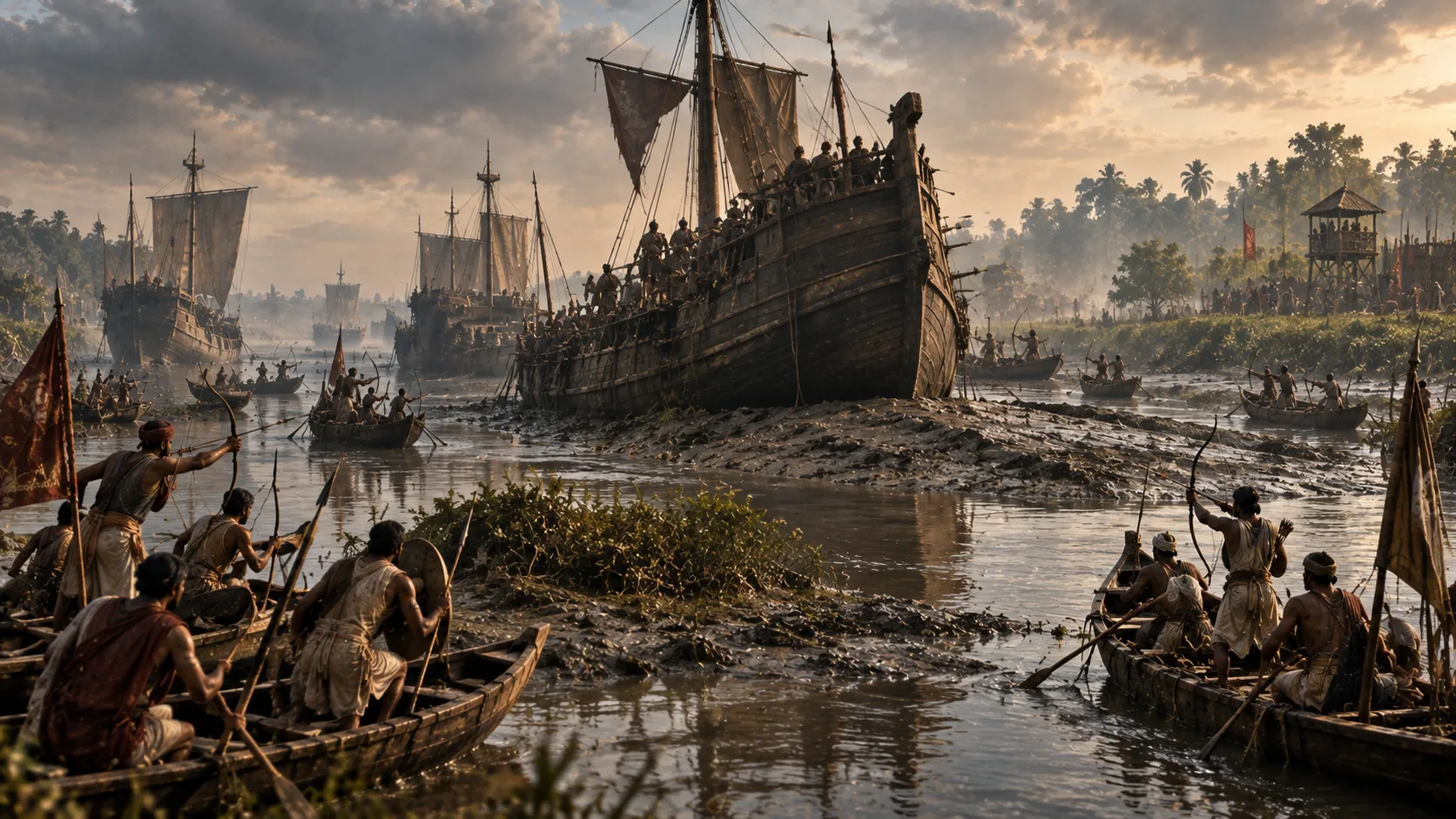
The Chola Army Won. So Why Didn’t Bengal Fall?
When the armies of Rajendra Chola I marched north towards the Ganges in the early eleventh century, they were not entering an unknown political world. Bengal was ruled by the Palas, whose power had already shaped much of eastern India for centuries. The Cholas, meanwhile, had built one of the most formidable imperial states in southern India, and Rajendra had demonstrated the extraordinary reach of Chola military power across the Bay of Bengal.
The Chola account of the expedition leaves little doubt about how the campaign was meant to be remembered. The inscriptions celebrate the defeat of rulers in the north, the reaching of the Ganges and the seizure of valuable booty. Mahipala I, the Pala ruler, appears in this triumphant narrative as one of the kings overcome by Rajendra’s expedition. From the perspective of an imperial inscription, the story is straightforward: the Chola army came north, defeated its enemies and returned victorious.
Yet there is a problem with the usual way this story is understood. Bengal did not become a Chola province.
The Pala political order survived. Chola rule was not established across Bengal, and the region continued to follow its own political trajectory. The campaign was therefore clearly significant, but its significance cannot simply be equated with permanent conquest. The more interesting historical question is not whether the Cholas won. It is what kind of victory they actually achieved.
The inscription that celebrates a victory
The Chola inscriptions are important because they preserve the voice of the victorious power. Rajendra’s campaign was not presented as a minor raid. It was incorporated into the larger story of Chola imperial expansion, a demonstration that the reach of the southern empire extended far beyond its immediate homeland.
The expedition also needs to be understood within the wider military history of Rajendra’s reign. The Cholas had developed enormous experience in projecting power by sea, and their campaigns had carried Chola influence across the Indian Ocean world. An expedition into Bengal demonstrated something equally important: the ability to move a large military force over extraordinary distances and strike at one of the great political centres of eastern India.
The research material used for this story therefore treats the Chola campaign as a genuine military achievement rather than dismissing the inscriptional claims simply because Bengal survived. That distinction matters. Historical revision becomes weak when it merely replaces one exaggerated triumphal story with an exaggerated story of resistance.
The Cholas had won something. The question is what they had won.
A victory is not the same as a conquest
An army can defeat another army without acquiring permanent control of the country it has entered. It can capture a ruler’s possessions, force a retreat, collect tribute or booty, demonstrate its military superiority and then withdraw. All of those outcomes can constitute victory without producing a new political order.
This distinction is especially important when reading imperial inscriptions. Such texts were not neutral campaign reports. Their purpose was to record royal achievement, commemorate victories and establish the prestige of the ruler. The language naturally emphasizes the extent of success rather than the limitations of the expedition.
The Bengal campaign becomes more complicated when that triumphant inscriptional account is placed beside what happened afterwards. The research material notes the continued survival of Pala territorial control in eastern Bengal and the later recovery of Pala power. That does not erase the Chola victory; instead, it places a boundary around what that victory accomplished.
Rajendra could defeat a Pala force and still fail to establish lasting Chola sovereignty over Bengal.
Those two statements are not contradictory.
The country the Cholas entered was far from home
Distance was not merely a line on a map. It was a military problem.
The Chola heartland lay in the far south of the subcontinent. Bengal was separated from it by enormous geographical distance and by several political and environmental zones. An expeditionary force could reach Bengal; maintaining permanent control over Bengal was another matter altogether.
Every additional stage of a campaign created logistical demands. Soldiers needed food and supplies. Horses and elephants required care. Ships required crews and maintenance. Communications had to cross territories that were not necessarily under Chola authority. A force that had travelled thousands of kilometres from its political centre could win a spectacular campaign and still find occupation disproportionately expensive.
The research describes the Chola forces as operating in an environment very different from the open waters in which their maritime power was most effective. Once the campaign moved into the Ganges and its tributary systems, the geography became unfamiliar and increasingly complex.
This does not prove that Bengal’s rivers single-handedly defeated the Cholas. It does, however, remind us that military power is always dependent on the environment in which it operates.
Bengal’s survival was not the same as a battlefield victory
There is a temptation to turn the story around and say that the Cholas were somehow defeated by Bengal’s navy. The surviving evidence does not justify such a simple reversal.
The research describes the Pala naval force as having survived the campaign and argues that this survival was important because control of Bengal’s river networks could not be secured merely by defeating a field army.
But the same research also acknowledges the Chola victory. Its own formulation is revealing: the Chola forces may have achieved tactical success while failing to convert that success into lasting strategic control.
That distinction gives us a much more useful way to understand the campaign.
The Cholas did not need to be secretly defeated for Bengal to remain outside the Chola Empire. Their expedition could be militarily successful while the political consequences remained limited.
The problem of holding what you have reached
Capturing territory and governing it are different military tasks.
A raiding force can move rapidly, defeat an opponent and return before the political landscape has time to change. An occupying power has to do almost the opposite. It must remain. It needs garrisons, administrators, supply lines, political allies and reliable communications. It must collect revenue and enforce authority after the original army has gone.
The Chola campaign is striking precisely because the evidence points towards the first kind of success rather than the second.
The army reached Bengal. The campaign damaged Pala power and produced the kind of booty that Chola inscriptions celebrated. Yet there was no enduring Chola administrative transformation of Bengal comparable to the establishment of a new provincial order.
The absence of permanent occupation is therefore not an insignificant footnote. It is central to understanding the limits of the campaign.
Bengal was still politically alive
The strongest evidence against interpreting the expedition as total conquest is what happened to the Pala political tradition afterwards.
The research notes the continued presence of Pala authority in eastern Bengal and the later recovery of Pala power, particularly under Ramapala. The subsequent emergence of Sena power also demonstrates that the political history of Bengal continued on its own trajectory rather than being absorbed into the Chola imperial system.
This is why the phrase “the Cholas conquered Bengal” can be misleading if it is used without qualification.
It compresses a complicated campaign into a permanent political outcome that the evidence does not establish.
A more careful formulation would be that the Cholas mounted a successful expedition into Bengal, defeated Pala forces and extracted substantial political and material gains, but did not establish lasting Chola rule over the region.
That may sound less dramatic than the language of conquest. Historically, it is far more revealing.
The river made occupation harder
There was another problem waiting for any power that wanted to turn military reach into permanent control: Bengal’s landscape.
Bengal’s waterways were not simply obstacles that an army crossed once and then left behind. The Ganges and its distributaries formed a connected environment through which people, goods, troops and information moved. The research emphasizes the difficulty that unfamiliar river systems, shifting channels, tidal conditions and waterlogged terrain could create for forces accustomed to other forms of warfare.
This is where the argument developed in the earlier stories of this cluster becomes relevant without needing to repeat them.
A-1 examined how Bengal’s landscape could become a source of military power. A-3 reconstructed the tactical possibilities of mud, tides and narrow waterways. This story asks a different question: what happens after the battle is over?
The answer may be that the same landscape that complicated military movement also complicated permanent occupation.
A conquering army could enter a river system. To rule it, however, required continuing access to that system.
The Cholas had proved they could reach Bengal
That achievement should not be minimized.
For an empire based in southern India, the ability to project military power into Bengal was remarkable. The campaign demonstrated the geographical reach of Chola imperial ambition and the effectiveness of a military system capable of operating far from its centre.
The Chola inscriptions were therefore not inventing the importance of the campaign. Their emphasis lies in the natural tendency of imperial records to present military achievement as complete political triumph.
Rajendra had shown that the Cholas could reach the Ganges.
He had not shown that the Cholas could permanently rule everything they reached.
That difference is the key to the story.
So, did Bengal win?
Only if we use the word win carefully.
There is no good reason to transform the campaign into a Bengali victory in which the Cholas were secretly annihilated or driven out after a decisive defeat. The available research does not support that version. Chola inscriptions preserve a genuine record of military success, and that success deserves to be taken seriously.
But neither should we accept the opposite extreme: that because Rajendra’s inscriptions proclaimed victory, Bengal must therefore have been conquered in any lasting political sense.
The outcome was more complicated.
The Cholas achieved an extraordinary expeditionary victory. The Palas survived as a political power. Bengal was not incorporated into the Chola state. The campaign demonstrated the reach of Chola military power without producing permanent Chola rule over Bengal.
In other words, the Cholas won the campaign, but they did not inherit the country.
The difference between a campaign and an empire
This distinction tells us something larger about medieval warfare.
Empires are often remembered through their most spectacular campaigns: the city captured, the king defeated, the river reached, the treasure seized. But imperial power is ultimately measured by what remains after the army has gone.
A successful expedition can make a ruler famous. A durable empire requires institutions capable of staying behind.
The Chola expedition into Bengal is therefore valuable precisely because it exposes the gap between those two things. Rajendra’s army could travel an extraordinary distance and defeat a powerful opponent. Yet distance, logistics, geography and the resilience of the existing political order prevented that moment of military superiority from becoming permanent Chola sovereignty.
The campaign was real. The victory was real. Its limits were real as well.
The Chola victory Bengal remembers differently
For centuries, histories of warfare have tended to follow the language of the victor. A king claims victory, an inscription records conquest, and later histories inherit the vocabulary.
But the history of Bengal asks us to look beyond the inscription.
Rajendra Chola’s army reached the Ganges. It defeated Pala forces and returned with the spoils of a successful campaign. Those achievements belong to the history of the Chola Empire and should not be diminished.
Yet Bengal remained Bengal.
The Pala political tradition survived, recovered and continued to shape the region. The Chola Empire did not replace it with a permanent southern administration. What looked like a conquest from the perspective of an imperial inscription turned out, from the longer perspective of Bengal’s history, to be an extraordinary incursion whose political consequences were much more limited.
That is perhaps the most revealing part of the story. Military power can determine who wins a campaign without determining who owns the future.
And in Bengal, the future remained open.