
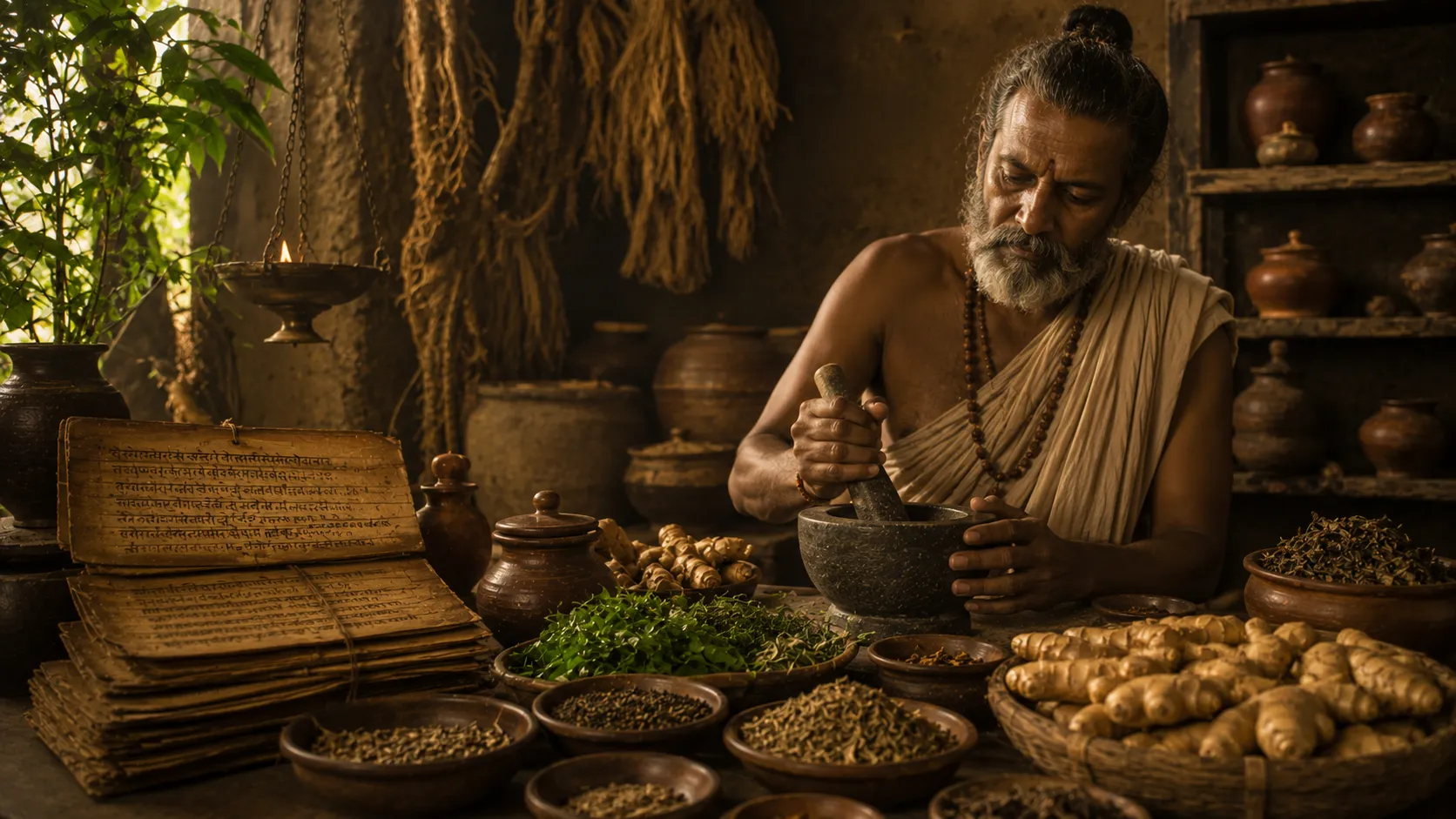
The Spice That Left Garlic and Onion Behind
In a Bengali kitchen, ginger, garlic and onion often arrive together. They are the familiar trio behind countless curries, lending warmth, depth and fragrance to the food.
But outside the kitchen, they do not always travel together.
Ginger can cross a boundary that garlic and onion often cannot: it has a place in certain ritual and devotional settings, where food is governed by rules of purity and suitability. The same ingredient that flavours a curry can also appear in a world of offerings and sacred observances.
Why did ginger acquire this different standing? And what does its unusual position reveal about the relationship between Bengali food, religious practice and the meanings attached to plants?
Three ingredients, different reputations
Modern cooking encourages us to think of ginger, garlic and onion as a set. They are commonly chopped, ground or fried together, forming the aromatic foundation of a dish.
Yet culinary companionship does not necessarily mean ritual equivalence.
In many Hindu food traditions, onion and garlic are avoided in particular contexts—especially when preparing food for worship, fasting or certain forms of devotional observance. The rules are not identical across all communities or households, but the distinction is familiar: ingredients welcomed in everyday cooking may be excluded from food prepared for sacred occasions.
Ginger occupies a more complicated position. It is widely used in cooking, but it also has a place in some ritual practices and traditions of sacred offering. Its presence in these settings complicates any simple division between ingredients that are “ordinary” and those considered suitable for religious use.
Ginger, in other words, did not have to leave the kitchen to enter the sacred world.
A plant with more than one life
Part of ginger’s distinctive position lies in the fact that it is not merely a flavouring.
In South Asian traditions, ginger has long been associated with medicinal use. Sanskrit medical vocabulary distinguishes forms of the plant, including ārdraka for fresh ginger and śuṇṭhī for dried ginger. These terms belong to a wider medical and culinary history in which a plant could be valued for its practical properties as well as its taste.
But medicinal importance alone does not explain ritual acceptance. Nor does the fact that ginger is used in worship mean that it is treated as sacred in every Bengali tradition.
The important distinction is between a plant’s cultural reputation and the specific rules governing its use. A substance may be considered useful, auspicious or appropriate in one setting without acquiring the same status everywhere.
That is why ginger’s ritual role needs to be understood through particular practices and sources, rather than through a single claim about what all Bengali Hindus believe.
Why ginger, but not always garlic and onion?
The contrast invites a tempting explanation: perhaps ginger was accepted because it was regarded as pure, while garlic and onion were not.
But that answer is too neat.
Food restrictions have developed through overlapping traditions of religious observance, ideas about bodily and spiritual discipline, regional custom and household practice. The categories are not simply botanical. Ginger, garlic and onion may be grouped together in recipes because they perform similar culinary work, while being separated in ritual contexts because those contexts follow different rules.
And those rules are not universal. Practices vary between communities, religious traditions and occasions. Even within a single household, the ingredients used for everyday cooking may differ from those chosen for an offering or a fasting meal.
So ginger’s “edge” is not necessarily a story of one ingredient being universally declared holy and two others universally rejected. It is a story of different kinds of value: culinary, medicinal and ritual, each shaped by its own history.
The kitchen is not the whole story
The familiar trio of ginger, garlic and onion makes sense when we think like cooks. Together, they build flavour. But history asks us to look beyond what ingredients do in a pan.
Ginger’s place in ritual life reminds us that plants carry meanings beyond their taste. Their status can change with the setting, the purpose of a meal and the tradition observing it. An ingredient may be ordinary in one moment and appropriate for a sacred act in another.
That does not make ginger’s history a simple tale of purity, nor does it establish a single moment when it became holy. It shows something more revealing: Bengali food culture cannot be understood through recipes alone.
The three ingredients may share a place in the masala bata—the ground spice mixture—but they do not necessarily share the same place in the world beyond it.
And that is where ginger’s story begins to separate from the others.