
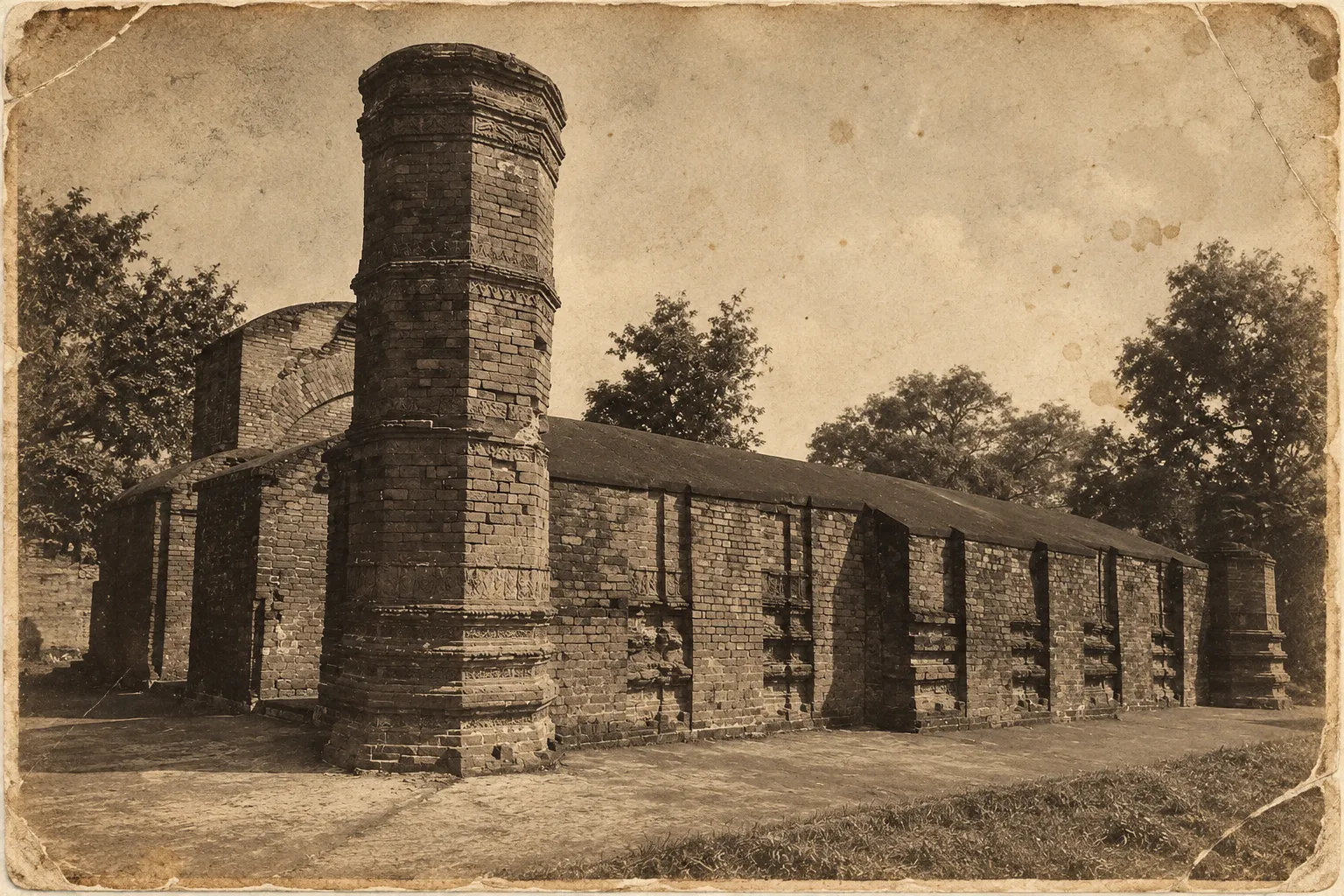
The Stones That Remembered Bengal
At Tribeni, not far from where the Saraswati once branched away from the Bhagirathi, stands a monument with a strange kind of memory.
Its walls belong to the early history of Islam in Bengal.
But some of the stones are older.
They carry traces of another Bengal—Hindu, Jain and Buddhist traditions that existed before the monument was built. Sanskrit inscriptions survive on some of the reused blocks. Defaced images and fragments of earlier architectural decoration remain embedded in the later structure.
The result is not simply a mosque or a tomb.
It is a palimpsest: one historical landscape written over another without completely erasing what came before.
This is the Zafar Khan Ghazi Dargah and Mosque at Tribeni, dated to 1298 CE.
And its stones tell a story that is larger than the monument itself.
A monument beside a changing river
The location matters.
Tribeni was not an arbitrary settlement. It was a major point in the river system from which the Saraswati emerged as one of the channels of the Bhagirathi.
In the medieval landscape, rivers determined far more than where boats travelled. They influenced settlement, agriculture, commerce and political power.
A settlement beside a major river could become a meeting point between different communities and traditions.
Tribeni was one such place.
By the late 13th century, the political landscape of Bengal was changing. Muslim rule had expanded into parts of the region, while older religious and cultural institutions remained deeply rooted in the landscape.
The monument associated with Zafar Khan Ghazi belongs to this period of transition.
Its date—1298 CE—makes it one of the earliest surviving Muslim monuments in Bengal.
But the building itself contains evidence that its story did not begin in 1298.
The stones that came from somewhere else
Look closely at the material of the monument and another history begins to emerge.
Some of the basalt and sandstone blocks were reused from earlier religious structures.
Among them are architectural fragments associated with Hindu, Jain and Buddhist traditions. Some bear Sanskrit inscriptions. Others preserve traces of figures and decorative elements whose original religious meanings belonged to an earlier architectural world.
The stones therefore have two lives.
First, they belonged to earlier structures.
Then they were incorporated into a new monument.
That physical reuse is important because medieval buildings were not constructed in an empty landscape. Builders worked with the materials available around them. Earlier structures could be dismantled, quarried, transported and rebuilt.
What survives today is therefore not simply evidence of destruction or replacement.
It is evidence of reuse.
And reuse creates an unusual historical record.
A stone can outlive the building for which it was originally carved.
What does a Sanskrit inscription do on a mosque?
This is perhaps the most intriguing question the monument raises.
A Sanskrit inscription embedded in a Muslim monument is a reminder that Bengal’s religious landscapes did not change overnight.
The language of the older stone belonged to an earlier intellectual and religious world. The building in which it was eventually placed belonged to a new political and religious order.
Both histories remain visible.
This is why the monument is so valuable to historians.
Written records can describe political change.
Chronicles can name rulers.
But a reused stone can show that different historical layers physically occupied the same place.
The past has not merely been recorded.
It has been built into the wall.
Beyond a simple story of conquest
It is tempting to look at reused temple material and tell a simple story: one religion arrived, another disappeared, and its buildings were destroyed.
The evidence allows a more careful interpretation.
The monument certainly belongs to the period of Islamic political expansion in Bengal, and the reused religious imagery and inscriptions demonstrate that earlier sacred architecture was incorporated into the new structure. But the stones themselves cannot tell us exactly why each piece was reused, how the earlier structures disappeared, or what happened to the communities associated with them.
Those questions require other evidence.
What the monument can tell us with greater confidence is something subtler.
Bengal’s architectural landscape was being transformed, but the older landscape did not simply vanish.
Parts of it were carried forward—literally, stone by stone.
The river helps explain the meeting
The Saraswati makes the story even more interesting.
Tribeni’s importance was closely tied to its position within the river network. The river connected settlements and made movement possible across the delta.
People, goods, ideas and religious traditions travelled through these same landscapes.
That means the reused stones at Zafar Khan Ghazi are not isolated archaeological curiosities.
They belong to a place where different phases of Bengal’s history accumulated around a changing river system.
The river brought movement.
The monument preserved the layers left behind.
And both remind us that medieval Bengal was not a collection of sealed communities living in separate historical worlds.
It was a landscape of encounter, transition and reuse.
A stone can have a longer memory than a city
There is something almost poetic about the survival of these fragments.
The Saraswati that once flowed past this landscape has largely disappeared.
The settlements around it have changed.
The political powers that shaped medieval Bengal have vanished.
But a carved stone remains.
It may have begun its life in a temple or another earlier religious structure. Centuries later, it became part of a mosque and dargah. Today, it is evidence for historians trying to understand a Bengal that no longer exists in the same form.
The stone has outlived all the worlds that gave it meaning.
And that is why the Zafar Khan Ghazi monument deserves to be read not merely as an early Muslim building, but as a historical archive in stone.
Its walls contain a conversation between different Bengals: the Bengal that existed before the Islamic conquest, the Bengal being transformed in the 13th century, and the Bengal that emerged afterwards.
The river at Tribeni changed course.
Political power changed hands.
Religious landscapes changed.
But the stones remembered.
Sometimes the most complicated history of a place is not written in a book. It is built into its walls.