
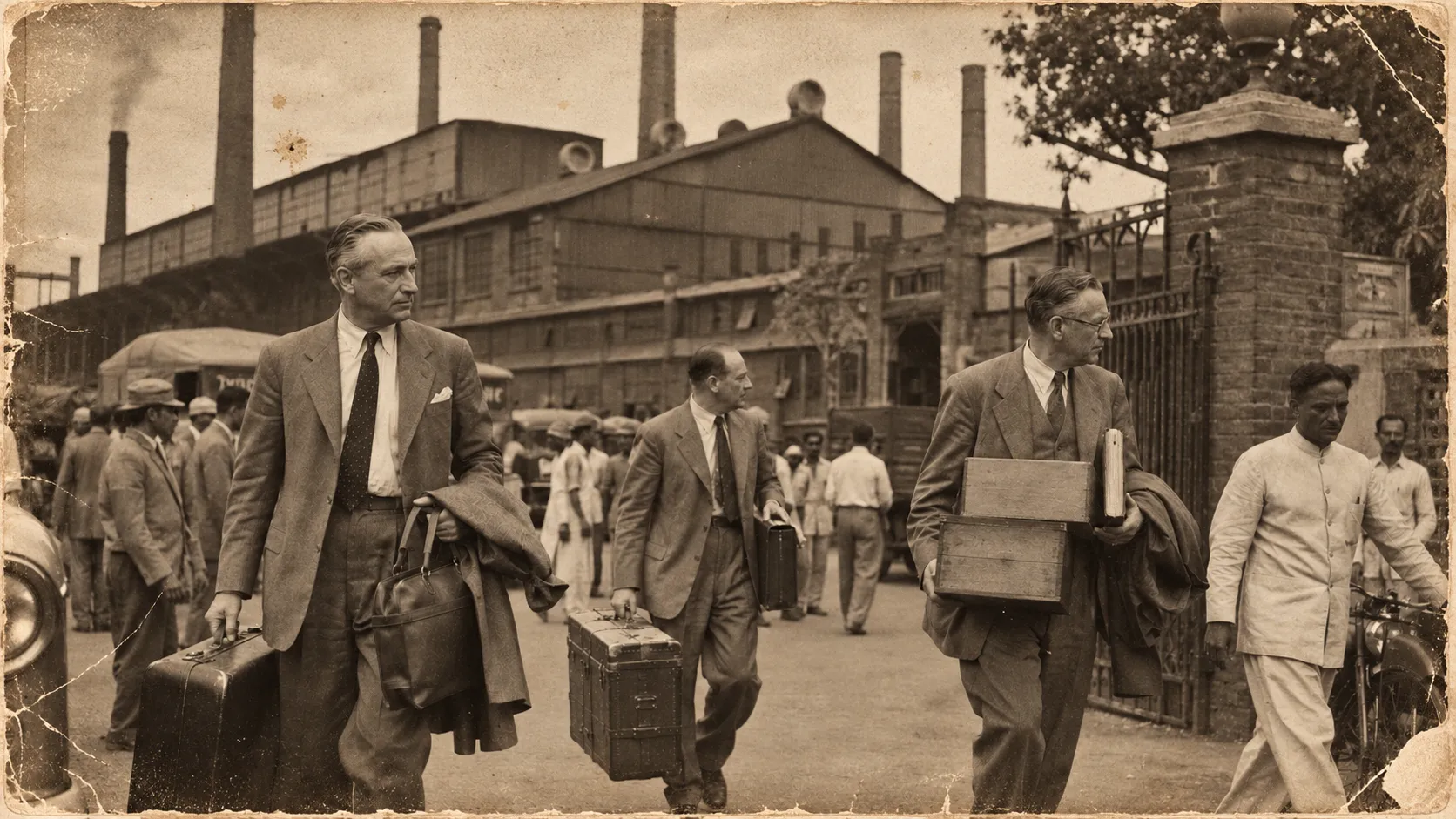
The Factory Was There. The Owners Were Not
By the time India became independent, Calcutta was already surrounded by factories.
Jute mills lined the Hooghly. Coal, engineering, chemicals and other industries had made Bengal one of the major industrial regions of British India. The city had banks, insurance companies, trading houses, accountants, lawyers, engineers and managers who understood how a modern industrial economy worked.
And yet, within a few decades, something curious had happened.
The factories had not disappeared.
But many of the people who owned them had.
The story of Bengal’s industrial decline is often told as a story of factories becoming inefficient, labour unrest, political instability or government policy. All of these mattered. But there was another transformation taking place at the same time: the ownership of Bengal’s industrial economy was changing hands.
An industrial economy built by someone else
Colonial Calcutta’s industrial landscape had been shaped to a considerable extent by British capital and British managing agencies.
These agencies were more than ordinary companies. They could control groups of enterprises across industries, arranging finance, management and commercial connections from the same corporate base. Jute, tea, coal and engineering all became part of this wider industrial system.
Bengalis were certainly present within it.
They worked as lawyers, accountants, engineers, managers and intermediaries. Bengali entrepreneurs also built successful businesses of their own.
But professional participation and industrial ownership were not the same thing.
A person could understand how a factory worked without possessing the capital and commercial network required to buy one.
That distinction would become critical after 1947.
Independence changed the ownership question
British rule did not simply end political authority. It also began to unsettle an economic structure that had depended heavily on British business houses.
After Independence, many British-owned enterprises and managing agencies began to withdraw from India or reduce their role. Industrial assets that had once been controlled by British interests increasingly became available for Indian ownership.
On paper, this looked like an opportunity.
But buying and running a large industrial enterprise required enormous resources.
It required capital.
It required banking relationships and suppliers.
It required knowledge of markets and distribution.
And, perhaps most importantly, it required a willingness to put substantial wealth at risk.
Bengal had plenty of educated professionals.
It had fewer people with the combination of industrial capital, commercial networks and accumulated business experience needed to take over the departing British interests on the same scale.
That gap mattered.
The rise of a different business network
This is where the history of Marwari business families in Calcutta becomes important.
Marwari merchants had established themselves in Bengal’s commercial economy over generations. Their networks connected trading, finance, credit and investment. These networks were not created after Independence; they already existed when the colonial industrial structure began to change.
As British owners withdrew, Marwari business houses were therefore among the groups well positioned to expand their ownership of industrial enterprises.
It would be easy—and misleading—to turn this into a story of one community being naturally better at business than another.
The deeper difference was historical.
Different communities had accumulated different forms of economic capital.
One section of Bengal’s middle class had invested heavily in education and professional advancement. Other business communities had developed dense networks around trade, credit, family firms and commercial investment.
When the ownership structure of Indian industry changed, those accumulated advantages suddenly mattered.
The paradox of the educated middle class
There is an irony here.
The same Bengali society that had produced generations of highly educated professionals also found itself relatively weak in large-scale industrial ownership.
A Bengali engineer could manage a factory.
A Bengali accountant could audit its books.
A Bengali lawyer could represent the company.
A Bengali executive could run its operations.
But none of those roles automatically made him the owner.
This was one of the long-term consequences of the changing Bengali ideal of success.
For much of the nineteenth and early twentieth centuries, education had become one of the safest routes to social mobility. A professional career offered status without requiring a family to risk its accumulated wealth in uncertain commercial ventures.
That preference did not make professional expertise less valuable.
It simply meant that expertise and ownership were increasingly separated.
When ownership matters
Factories do not exist in isolation.
An industrial economy depends on people willing to keep investing in machinery, expand production, find new markets and survive periods when profits disappear. Ownership determines who makes those long-term decisions and, crucially, who has the incentive and capacity to keep putting capital into the enterprise.
This is why the transfer of ownership mattered beyond the names written on company documents.
Bengal’s industrial decline was not caused by a single factor, and it would be wrong to suggest that a change in ownership alone explains what happened to the region. Labour conflict, policy choices, infrastructure, political uncertainty, partition and wider changes in India’s economy all played roles.
But ownership was part of the story.
When a region loses not just factories but the local accumulation of industrial capital, rebuilding becomes harder.
The factory remained, but the ecosystem changed
This helps explain one of the strange impressions of post-Independence Bengal.
The industrial landscape did not vanish overnight.
The chimneys were still there. The mills still employed workers. Engineers and managers still went to work. Goods continued to be produced.
But beneath the visible factory floor, the economic structure was changing.
The people making decisions about capital increasingly belonged to business networks whose roots lay outside the Bengali professional middle class.
Meanwhile, many Bengali families continued to steer their children towards education, government service and professional careers.
The two developments reinforced each other.
One side accumulated ownership.
The other accumulated expertise.
And expertise, however valuable, does not automatically become capital.
A different way of understanding Bengal’s industrial decline
The familiar question is: Why did Bengal lose its industries?
A better question may be: Who owned Bengal’s industries, and who was prepared to own them when the old owners left?
That question does not produce a simple answer.
It does, however, reveal something easily missed when industrial history is reduced to strikes, politics or factory closures.
Economic decline can begin with an absence that is harder to see than a closed mill: the absence of a new generation of owners willing and able to replace the old one.
Bengal had educated people.
It had industrial experience.
It had factories.
What it increasingly lacked was the same depth of locally rooted industrial ownership capital.
And once that ownership moved elsewhere, bringing it back was far more difficult than producing another generation of graduates.
The factory was there.
The owners were not.