
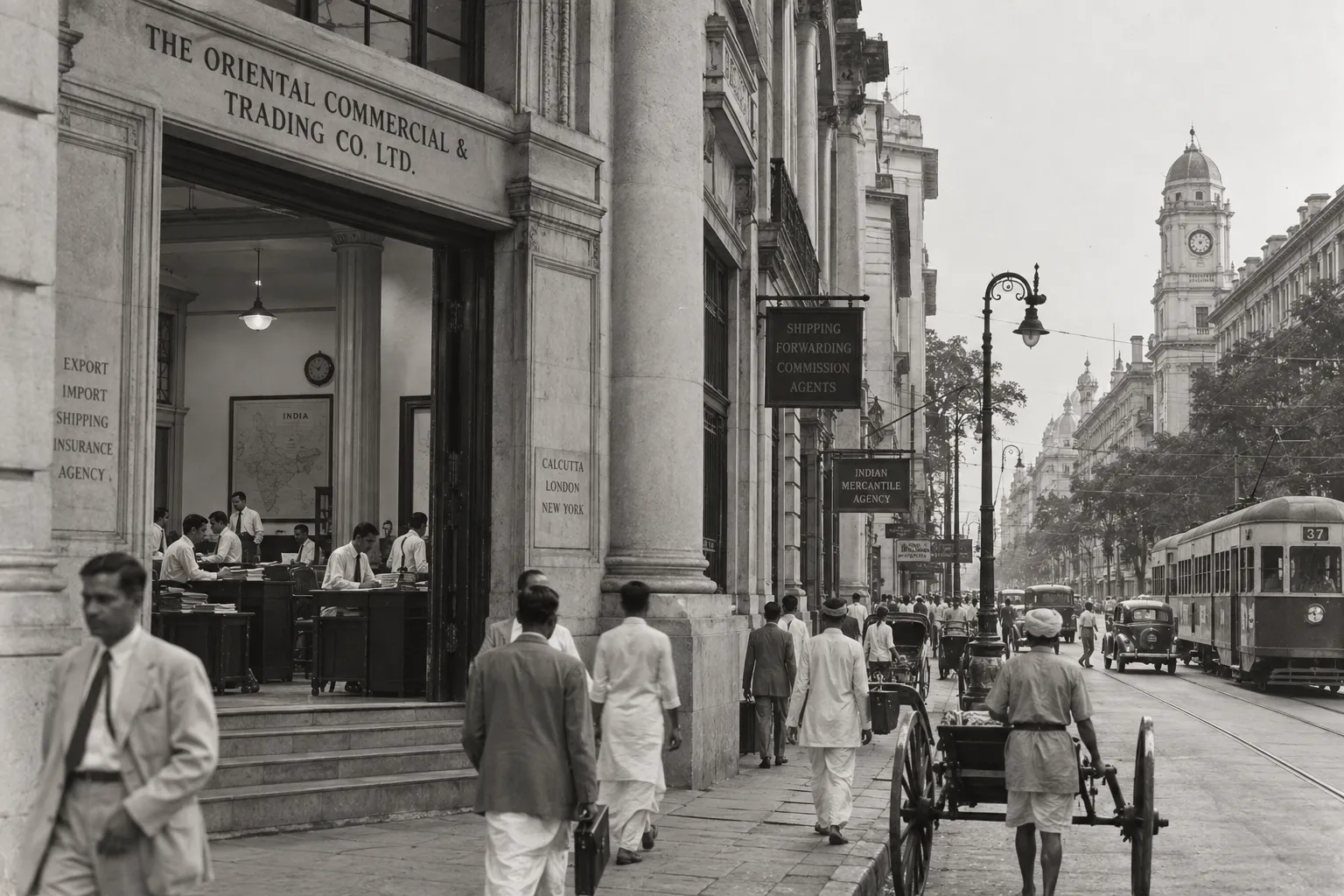
When Calcutta Lost Its Companies
For much of the nineteenth and early twentieth centuries, Calcutta was not merely a city where business happened. It was one of the places from which a remarkable amount of business was directed. A company might own a tea garden in Assam, a coal mine in eastern India, a jute mill beside the Hooghly or a shipping operation reaching across the Bay of Bengal, yet the people arranging its finance, negotiating contracts and making major decisions could be sitting in an office in Calcutta.
That made the city more than an industrial centre. It made Calcutta a corporate command centre.
By the later twentieth century, that position had weakened considerably. The factories did not all disappear, and neither did business itself. What changed was the concentration of companies, capital and decision-making that had once given Calcutta an importance far beyond the physical size of its industrial economy.
The city behind the factory
Calcutta’s business power rested on a system that was unusually concentrated. British managing agencies played a major role in organising and controlling enterprises across industries, connecting manufacturing and extraction with finance, trade and management. Jute, tea, coal, engineering, shipping and other businesses could therefore be linked through corporate networks based in the city.
The significance of this arrangement went well beyond the companies themselves. A large business headquarters required banks and insurers, lawyers and accountants, brokers, engineers, shipping agents and other specialists. People carrying information about commodities, credit and overseas markets moved through the same commercial world. The city accumulated not only factories and warehouses, but knowledge about how large businesses were financed and run.
That concentration helped make Calcutta one of British India’s major business centres. Its industrial importance was therefore partly geographical—the mills and mines of the eastern region—and partly institutional: so many of the people making economic decisions were connected to the city.
Then the old corporate order began to change
Independence altered the environment in which this system had operated. British business houses now faced an Indian state with new priorities, new regulations and a different political relationship with foreign capital. Over the years that followed, some British enterprises reduced their presence, transferred ownership or changed their corporate arrangements, while Indian business groups expanded their role in the economy.
This was not a single moment of departure. The transfer of economic power in Calcutta unfolded over decades and was shaped by corporate law, taxation, capital controls, government policy and the particular circumstances of individual firms. Nor did every British company simply leave, or every Indian company move its operations elsewhere.
But the overall corporate landscape was changing.
The people who owned and controlled major enterprises were increasingly Indian, while the relationship between those enterprises and Calcutta itself was becoming less certain.
A factory could stay while the company changed
This distinction is crucial.
When ownership changed, the factory did not have to move. A jute mill could continue operating beside the Hooghly under a different owner. A coal company could retain its mines in eastern India. Workers could continue arriving at the same gates each morning, while the financial and strategic decisions governing the enterprise were increasingly connected to a different business network.
This meant that industrial geography and corporate geography could begin to diverge.
A city can manufacture something without controlling the company that manufactures it. It can have engineers and managers without being the place where the most important investment decisions are made. And it can retain an impressive industrial landscape even after some of the corporate ecosystem that once sustained that landscape has begun to thin out.
Calcutta’s transformation becomes much easier to understand once those distinctions are made.
The rise of new Indian business power
One of the most important parts of this transition was the expansion of Indian business groups. Marwari merchants and financiers had been part of Calcutta’s commercial economy long before Independence, and some business families expanded from trading and finance into industrial ownership as the colonial corporate structure changed.
It would be too simple to describe this as one community replacing another. Tirthankar Roy’s work on corporate Calcutta shows that the transfer of economic power involved a much wider set of institutional and economic forces. The important point is that Indian ownership expanded within a changing corporate system, and the new owners did not necessarily reproduce the exact relationship between company, city and business network that had existed under the managing agencies.
Calcutta could therefore become more Indian-owned without automatically becoming more powerful as the headquarters of Indian industry.
That is one of the less obvious ironies of the transition.
When economic power moves, cities feel it
A corporate headquarters may look insignificant compared with a factory. One is a building full of offices; the other occupies acres of land and employs hundreds or thousands of people. Yet the headquarters can have an outsized effect on a city’s economic life because it concentrates decisions about investment, finance, expansion and strategy.
Around those decisions grows another layer of urban activity: professional services, banking, legal work, accounting, management and business information. The city becomes a place where people not only work in industry but also decide what industry should do next.
When enough of those functions move elsewhere, the consequences accumulate gradually. There may be no dramatic closing ceremony, no single day when the city ceases to be a business capital. Instead, a little more corporate power is exercised somewhere else each year, until the old concentration is no longer what it once was.
This is one reason Calcutta’s economic history cannot be measured only by counting factories.
The geography of production and the geography of decision-making are not the same thing.
A city can remain industrial and still lose influence
By the second half of the twentieth century, Calcutta remained an important industrial and commercial centre. Its port, engineering industries, jute mills, coal connections and professional institutions continued to matter, and the city remained deeply connected to eastern India’s economy.
But India was developing several powerful centres of corporate and industrial activity. Manufacturing investment was spreading into regions that had previously possessed fewer natural-resource advantages, while major Indian companies were building business networks that were increasingly national in scale.
Calcutta was no longer the only place where India’s industrial future was being decided.
That change is easy to miss because the physical city remained recognisable. The Hooghly was still there. The old industrial districts were still there. Offices still opened every morning and trains still carried workers towards factories.
But economic power is not always visible from the street.
A company can disappear from a city’s economic life long before its factory disappears from its skyline.
What Calcutta really lost
The most useful question, then, is not simply how many companies left Calcutta? It is what happened to the network that made Calcutta a place from which companies were run?
The answer lies in a long transition rather than a single collapse. British corporate dominance gave way to Indian ownership; managing agencies lost their earlier role; new business groups expanded; industrial investment became more geographically dispersed; and the concentration of corporate decision-making that had once distinguished Calcutta gradually weakened.
That does not mean Calcutta stopped producing, trading or doing business. It means that the city increasingly had to share a role it had once occupied with unusual prominence.
And that may be the more revealing way to understand its economic decline.
A closed factory is easy to see. A company headquarters moving elsewhere is harder to notice. But when enough decisions about capital, investment and expansion begin being made somewhere else, a city can lose something more fundamental than a building.
It can lose its place in the chain of command.