
Bengal’s Durga Puja Begins With His Voice. Some Said He Had No Right to It.
For most Bengalis, Durga Puja does not begin with the pandal or the dhak. It begins in the dark on Mahalaya, with one man’s voice coming out of the radio.
When you hear Ya Chandi that morning, you are not thinking about caste.
You are thinking about the dark outside, and the conch, and then that voice. Nobody in the para stops to ask what surname the man has.
In the 1930s, some people did ask.
A clerk with a bad voice
Birendrakrishna Bhadra was a Kolkata radio man, actor and playwright, born in 1905 in north Calcutta, and the voice that has recited the Chandi on All India Radio’s Mahishasuramardini almost every Mahalaya since the 1930s.
He did not start out sounding like a god’s messenger. He was a clerk in the Railways, with an office at Fairlie Place. A short walk away, at 1 Garstin Place, was the Indian Broadcasting Company. In his lunch hour he went there to do radio plays.
His voice in those days, according to people who knew him, was hoarse and grating. He failed the audition for comperes. For a while he wrote and produced plays instead, until one play needed an unusual voice and he got the part.
So the first thing to know about the most famous voice in Bengal is that the radio station once turned it down.
The objection
The second thing is that, when the Chandi programme began, some people did not want that voice anywhere near it.
Bhadra was a Kayastha. Reciting the Chandi was, for the orthodox, a Brahmin’s job. Mihir Bandyopadhyay, who worked under him at AIR, remembered that in those early days the conservative Brahmins of Bengal objected to Bhadra doing the Chandipath. Pradip Kumar Mitra, a later station director of AIR Kolkata, put it in the blunt terms of the time: they objected because he belonged to the “Shudra” caste.
Nobody, as far as I can find, wrote down the names of the men who complained. Their argument survives. They don’t.
What happened next is the part I like.
Banikumar, who wrote the script, was born Baidyanath Bhattacharya, a Brahmin name. He did not argue theology. According to Mitra, he simply said that if Bhadra was removed because of his caste, he would call off the whole production.
That was the end of it.
“Ami path kori na”
Bhadra gave his own answer too. The historian Indira Biswas, writing about the early Calcutta radio station, records a short statement he made to his critics:
“Ami path kori na, ami pujo kori.”
I don’t recite. I worship.
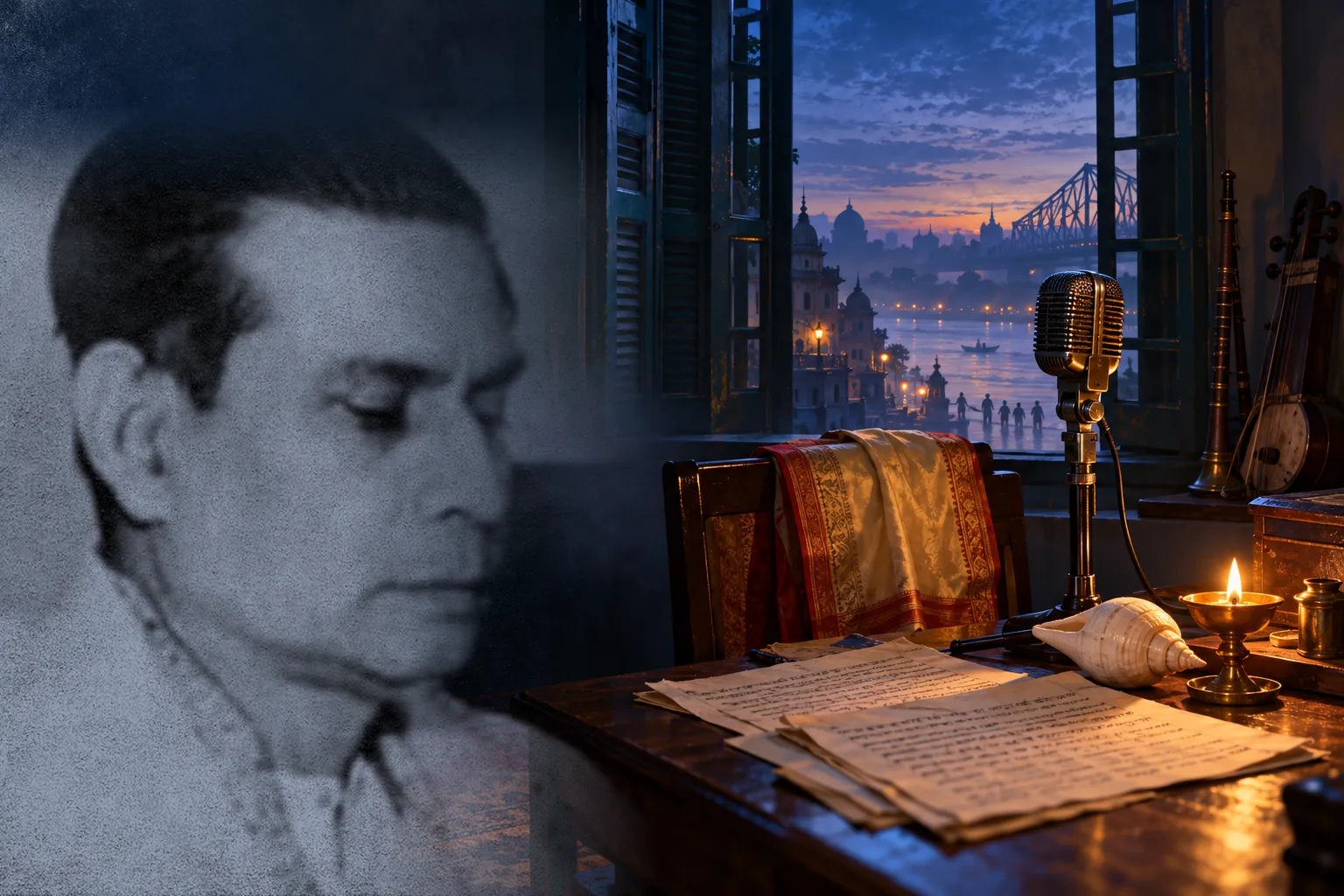
You could read that as a clever line to calm people down. The way he went about it suggests he meant it. Banikumar later wrote that on the morning of the broadcast Bhadra would get up before dawn, bathe, put on a golden garad silk, and come to the studio alone. He told them it was his offering, not a performance. In the years it was live, a car came for him after midnight and took him to the AIR office at Eden Gardens.
His daughter Sujata remembered something that complicates the picture a little, which is why I trust it. At home, she said, he was not especially religious. “We never saw him offering puja or even light an incense stick.”
And yet he cried at the microphone. Her mother, Romarani Devi, once asked him why. He told her that every time he sat down to recite, he saw Ma Chandi.
Listen to the “Jago… jago Ma” passage again this year and you can hear where it happens.
He also worked at it. Bandyopadhyay said he spent hours on his Sanskrit pronunciation. The Sanskrit scholar Nrisingha Prasad Bhaduri said what makes his Chandipath stand out is the feeling. You may not follow every word, but you know it is a prayer.
The room he recited in
The other people in that studio were not all Brahmins either. Some weren’t Hindu.
In the early orchestra, the sarangi was played by Munshi Ahmed Hussein and the harmonium by Khushi Ahmed. The shehnai players were Muslim ustads. Once, they started playing over Bhadra’s recitation by mistake. Pankaj Mullick’s music and Bhadra’s voice ran over each other, and the team kept it.
So on the most Hindu morning of the Bengali year, a Kayastha called the goddess, a man with a Brahmin name had refused to drop him, and Muslim musicians were playing behind him. Several of them, at least. Nobody in 1930s Calcutta thought to write down everyone’s religion, and I am not going to guess.
After the microphone
Away from Mahalaya, Bhadra was busy. He acted in and directed plays, adapted Bankim, did running commentary on football matches without knowing much about the game, and described the funeral processions of Tagore and Bidhan Chandra Roy for radio listeners. People who worked with him remembered a khadi kurta, dhoti and wrap all year, an umbrella in one hand, a jhola full of scripts in the other, snuff, and the last tram home at about ten.
He was a contract artiste, so when he retired in 1970 there was no pension. Sujata said AIR sometimes called him for a fifteen-minute Mahabharata reading, for Rs 75. Para pujas asked him to do the Chandipath. A neighbour said they paid him peanuts.
There is a story, told by one writer, that late in life a guard at the radio building asked him for an entry pass. “Ami radio-r jonmo diyechhi,” he is said to have replied. I gave birth to radio, and you want my pass?
He died in November 1991 at 86, in the four-poster bed in the family house at Shyampukur. The man who had described the last journeys of Bengal’s great names went, the Telegraph wrote, almost unnoticed.
Who decided
So who did get to decide whose voice was holy enough?
Not the men who objected. They lost so completely that their side of it is now only a line in a few articles. Banikumar decided once, in a studio. After that it was decided every year, in the dark, by people who turned the radio on and did not turn it off.
There is a marble plaque on the house at Shyampukur now. It says he lived there all his life.
It does not mention his caste. Nobody thought it needed to.
This Mahalaya, like every Mahalaya, Bengal’s Puja began with his voice again.