
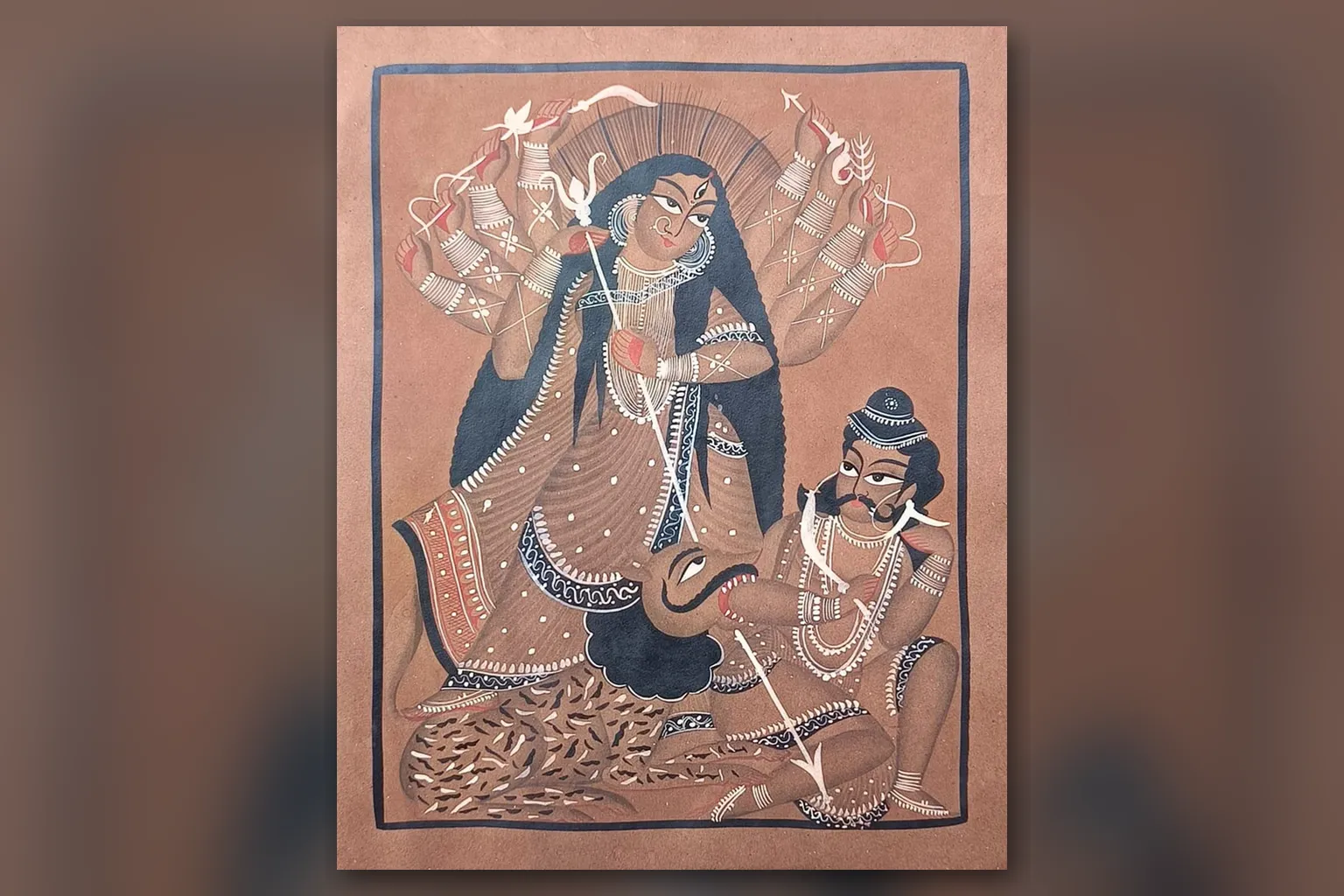
Durga Has a History. Does Mahishasura?
Walk into any Kolkata pandal this week and you will see the same scene.
A ten-armed goddess on a lion. Below her, a muscular man with a sword, half out of the neck of a buffalo she has just beheaded, her trident in his chest. That is Durga Puja, Bengal’s biggest festival, and that man is the reason for it. Mahishasura is the buffalo demon whom the goddess Durga kills, and his defeat is what Bengalis celebrate every autumn.
We know her story well. Scholars have spent a century tracing it. When I first wrote about this for a video, the question that kept nagging me was the obvious one:
Just because he is an asura, is he not allowed a history?
He is. And it turns out you can date it.
A buffalo, and a bored lion
Go back about two thousand years, to Nagar in Rajasthan.
Small terracotta plaques found there, dated to around the 1st century, show the goddess fighting her enemy. The enemy is a buffalo. Just a buffalo. In one, she is pulling its tongue. Her lion, as the writer Monidipa Dey puts it, drawing on the archaeologist V.S. Agrawala, “sits quietly below her and seems quite uninvolved in the tussle”.
Two thousand years later, that lion is still the most relatable figure in the scene.
These finds came out of the 1940s and 50s, and they upset an old belief. In 1941 the scholar J.N. Banerjea had written that there were no images of this goddess before the Gupta age. The Nagar plaques pushed her back by centuries.
Then come the Kushan sculptures of Mathura, around 1,800 years old, and Gupta ones after that. The goddess changes. She gains arms, the poses shift. Her enemy stays an animal. I put it bluntly back then: there is a buffalo, but no asura.

Durga slaying the buffalo, terracotta, Mathura, Kushan period. Los Angeles County Museum of Art (M.88.213.10). Public domain, via Wikimedia Commons.
There is one odd exception. Agrawala noted a Kushan plaque from Mathura in which the enemy is a human asura, with no buffalo at all. So the man was not missing from people’s minds. He just hadn’t found his way into the buffalo yet.
The demon who carried an umbrella
The next big change is in the south, at Mahabalipuram near Chennai, in the late 7th century.
Inside a Pallava cave temple there is a huge relief of the battle. Mahisha has a buffalo’s head now, but a man’s body. And he does not look like a loser. The art historian C. Sivaramamurti described the goddess as “normal in size, her opponent colossal and with dignified royal bearing, an umbrella raised over his head”.

The Mahishasuramardini relief, Mahishasuramardini Cave Temple, Mahabalipuram, late 7th century. Photo: Rainer Halama, CC BY-SA 4.0, via Wikimedia Commons.
An umbrella, in old India, meant a king.
It is one of the earliest images of the half-human Mahisha, and possibly the most beautiful. Here he is a rival worth fighting.
The man in the neck
Around the 8th and 9th centuries, the form Bengal knows settles in. The goddess has cut off the buffalo’s head, and out of the neck climbs the asura in human form, still fighting. You see it in Pala-period sculpture from Bengal and Bihar, and in images from as far as Chhattisgarh and Indonesia.

Pala-period Mahishasuramardini, Bengal, 12th century, phyllite. Dallas Museum of Art. Photo: Daderot, public domain, via Wikimedia Commons.
This is roughly the time the Devi Mahatmya, the text recited at Puja (and the source of the Chandi that Birendrakrishna Bhadra reads on Mahalaya morning), had already become well known. Most scholars date it to around the 5th or 6th century. The story was written; the stone caught up.
Every thakur a Kumartuli artisan shapes this month still follows the pose those Pala sculptors carved.
Older than the goddess?
I’d go further. I think the buffalo’s story is older than Durga’s.
Some of it is guesswork, but it is interesting guesswork. There is a famous seal from the Indus Valley, more than 4,000 years old, showing a seated figure with large horns. Archaeologists long called it a “proto-Shiva”. In a 1978 paper in the journal Anthropos, the scholar Alf Hiltebeitel argued that the horns are a buffalo’s, and that the figure may have more to do with the buffalo than with Shiva. “A ‘proto-Siva’ with buffalo’s horns,” he wrote, “would take too much explaining to retain credibility.”

Impression of the “Pashupati” seal, Mohenjo-daro, Indus Valley Civilization, c. 2500-2000 BCE. From E.J.H. Mackay’s excavations, published 1930s. Public domain, via Wikimedia Commons.
Other scholars, notably the Finnish Indologist Asko Parpola, have also linked a Harappan buffalo cult to the later Durga story. Nobody has proved it.
The word itself has a history too. In the Rigveda, the oldest Hindu text, asura could mean a mighty lord, and it was even used for gods. The sense of “demon” came later. In the Puranas, the gods and the asuras are half-brothers, sons of the same sage, Kashyapa, by different mothers.
Some writers go a step further and suggest that a buffalo-worshipping people were defeated by goddess worshippers, and the myth remembers it. It is a tidy theory. There is no direct evidence for it, and I’d treat it with the same caution.
Not everyone in India sees him as a villain, either. The Asur community of Jharkhand counts Mahishasura as an ancestor, which is a story for another day.
The same buffalo
So what was Mahishasura before he was a man? A buffalo, mostly. An animal that people across India have revered, feared and offered to the mother goddess for a very long time.
I wrote a line about that continuity that I keep coming back to: the same buffalo, struck by the same trident, in the same pose. The Nagar goddess and the one in your neighbourhood pandal are doing the same thing, two thousand years apart.
What changed is what we needed the buffalo to be. For centuries a beast, then for a while a king, and in Bengal a man who will not stay down.
I like to read Mahishasura as whatever stands in your way, the fear or the bad year you cannot shake. That may be why he needed a human body in the end. A buffalo is easy to kill. The thing climbing out of its neck, still holding a sword, looks a lot more like the problems we actually have.
This year, when the dhak starts and you stand in front of the goddess, look down for a second.
He has been in that pose for a long time, and he has earned his place in the frame.