
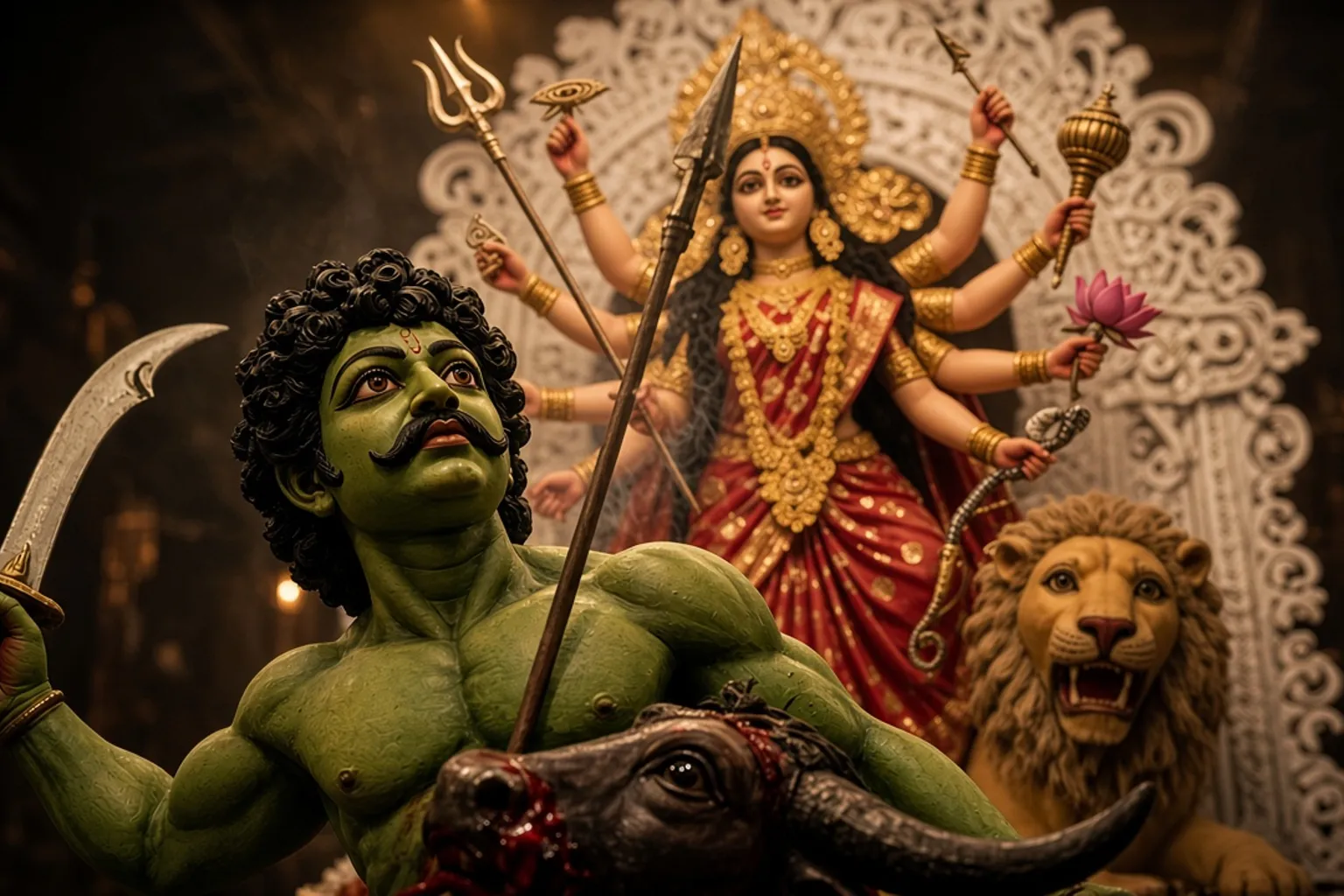
In India, Hindus Worship Durga. Some Worship the Asura Too.
At every pandal in Kolkata this week, the same man will be lying at the goddess’s feet.
Most of us never look at his face for long. He is the reason for the festival, but he is not the point of it.
A few hundred kilometres west of my city, in the hills of Gumla in Jharkhand, there are people who look at him differently. They share his name.
The Asurs are a small Adivasi community of iron-smelters turned farmers, living mostly in Jharkhand, who believe Mahishasura was their king and ancestor. India classes them as a particularly vulnerable tribal group. The 2011 Census counted 22,459 of them in Jharkhand and 4,129 in Bihar, with smaller pockets in West Bengal.
In my last story I followed Mahishasura through two thousand years of stone. This one is about the people who still call him family.
Nine quiet days
“It’s true that we have never celebrated Durga Puja,” Chamru Asur told the Indian Express in 2016. He was 70, living in Sakhuapani, a village half a kilometre from a bauxite mine. “It is also true that we remain inactive during those nine days and, at the end of it, make offerings to our ancestors so that we are all safe.”
He remembered the zamindari days, when the Asurs would carry wood and leaves to the landlord’s house in Bishunpur for the puja, hand them over, and walk home before the celebrations began. Then they prayed to their own ancestors for protection.
He said all this without anger. When pressed, he shrugged it off as “just beliefs”. “I have heard we are descendants of Mahishasur. That’s all I can tell you.”
His neighbour Anil Asur had a sharper memory. As a boy he loved going to the pandal at Jobhi Path, ten km away. One year his father stopped him and explained who had been killed that day. If your brother or sister were killed, his father asked, would you celebrate?
Then someone says, no, it isn’t like that
Here is where the newspaper version usually ends: the Asurs lock themselves in and mourn.
Sushma Asur, a cultural activist and the first published Asur poet, has heard that version many times. “We do believe that Mahishasur was our ancestor, but there’s no special mourning ritual conducted during Navratri,” she told Scroll in 2024. “Instead, people celebrate Navakhani as it falls around the same time.”
Navakhani is a harvest festival, the eating of the first new rice. So in some Asur homes, while Kolkata is pandal-hopping, people are simply eating the year’s first paddy.
The rites for their ancestor, whom they also call Bhainsasur (buffalo-asura), come later, around Diwali. Sushma once described one to the Indian Express. At Sohrai, people rub karanj oil on the navel, chest and nose, where Mahishasura is said to have bled, and eat a cucumber, which stands for the liver of his killer.
I find that detail oddly moving. It is grief, and also a joke with an edge, and it is done with a vegetable.
Sushma’s bigger frustration is that outsiders come for the myth and leave the village as it is. Scroll’s reporter found Asurs near Bishunpur living without diagnosis for cancer and TB, their fields turned into mine craters. “Many people come to me for their work,” she said, “but in so many years nothing much has changed for us.”
I am aware that I am one more of those people.
Hudur Durga
The Asurs are not the only ones.
The Santhals, one of India’s largest tribal communities, spread across Jharkhand and West Bengal, have a dance called Dasai that falls in the same month as Durga Puja. Vandana Tete, who works to revive Adivasi literature in Ranchi, described it to the Indian Express: “When others celebrate Navratri, the Santhals look for their missing chief, whom they call Hudur Durga. When they cannot find him, they pretend to dismantle a clay model.”
The men go village to village dressed in women’s saris, playing the bhuang, a gourd instrument that cracks like a gunshot, and singing a refrain of hai re, hai re.
Who Hudur Durga was depends on whom you ask. Many Santhals now say he is Mahishasura. Others tie the dance to a lost spiritual guru, or to an older story of missing brothers and sisters. The Daricha Foundation, which documents Bengal’s folk traditions, notes that folklorists once recorded Dasai as a kind of graduation for young students of herbal medicine, taught by the village ojha.
The steps have stayed the same. The meaning has moved.
Purulia’s own day
In Purulia, in Bengal’s western edge, some Santhals have turned that memory into a public day.
Ajit Prasad Hembram, a Kherwal Santhal activist, told the Indian Express in 2013 that the nine days “have never been a time of celebration for the Kherwal tribes but that of mourning”. That year his group marked a Mahishasur Martyrdom Day with Dasai dance and a play about Hudur Durga, and he said similar meetings were happening in about 20 places in West Bengal. He told the site GroundXero in 2018 that he believed the first such observance was held in his village, Falaora, in 2011.
His version of the story is a war of Aryans against natives. Not everyone who studies these communities agrees. Krishnopriyo Bhattacharya, who has worked with the tribal people of north Bengal for decades, told the Indian Express there is “no evidence” that the Asurs descend from Mahishasura, and that young Asurs care more about jobs than myth.
The idea reached Parliament in 2016, when a minister read from a pamphlet said to be from JNU and called it “depraved”. That is where most Indians first heard of it.
In the tea garden
The voice that stays with me is Bargi Asur’s.
He was 83 when the Indian Express met him at the Carron tea estate in Jalpaiguri, in north Bengal, where his father came to pick tea in 1914. As a child, his mother would not let him leave the hut during the nine days. “I would be bored to death,” he said. He sneaked out anyway. Only when friends teased him about his surname did he work out why.
“For centuries, we have been afraid to talk about them openly,” he said of their beliefs. “Now we carry out our rituals almost apologetically.”
Most of the Asur families on that estate have since become Christian. Some have quietly changed their surnames. Etwari Asur, 75, still kept an Asur puja twice a year, once in Phagun and once at Dussehra.
A king who is allowed to come home
India already has a well-loved asura, of course. In Kerala, Onam welcomes back Mahabali, the generous asura king sent to the underworld by Vishnu and allowed to return once a year to see his people. Nobody there thinks it odd to put out flowers for him.
The Asurs have no such day in the national calendar. Their story lives in smaller places, like a boy stopped at a door by his father, or oil rubbed on the navel at Diwali.
On Dashami, when the immersion trucks roll down to the Ganga and the dhak beats faster, the figure at the goddess’s feet goes into the river with her.
Somewhere in Gumla, I like to think, an old man is setting out an offering of his own, so that everyone stays safe.