
The Sugar Drop That Let the Poor Feed the Gods
Somebody always throws them too early.
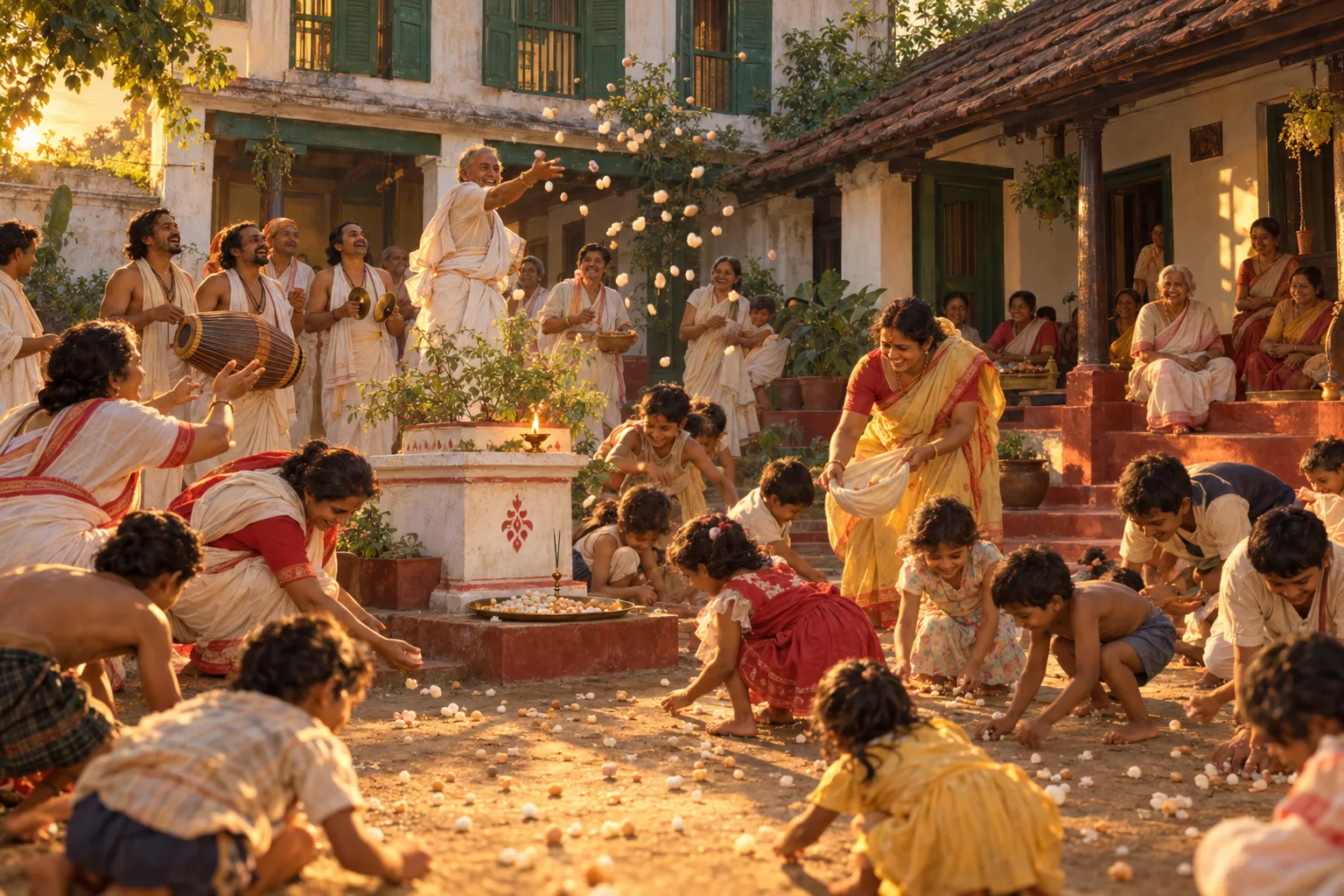
The kirtan is still going, the khol hasn’t stopped, and a handful of batasa is already flying over the heads. Then another. Children dive. Grown men forget themselves. A mashima in the back holds out the end of her sari like a net. Harir lut! Somebody gets one on the forehead and laughs.
You know this scene. Most of us do. And you know the taste, too. A batasa breaks with a little dry crack and then just goes, melting on the tongue before you can decide whether you liked it. White ones, the pale brown gur ones. Nakuldana rolling around in a steel bowl beside them, small and hard as gravel.
Nobody ever thinks of them as the important sweet. They sit at the edge of the thala, next to the fruit, while the sandesh gets the middle.
I want to make a small case for them.
A sweet for the poorest house
Ask yourself who can afford to feed a god.
Put it in money. A proper offering of milk sweets means milk, a lot of it, fuel, a confectioner, and it has to be eaten the same day or it turns. In a Bengal summer, “the same day” can mean before lunch. For a landless family, or a widow living on someone else’s charity, that is not a small spend. It may be impossible.
A batasa asks for sugar or gur, water and fire. That’s it. Boil the syrup down until it’s thick, drop it in little spoonfuls onto a flat surface, let it set. The air caught inside is what makes it crisp and light. Because almost no water is left in it, it keeps. Put a packet in a tin and it will still be there at the next purnima, and the one after.
So a poor household could buy a few paise worth at the haat and keep them by the thakur-ghor. Every evening, a lamp, a few drops of sugar, a bell. The god is fed. Nobody has to apologise.
That, to me, is the quiet power of it. Bengal’s grand sweets came later. Chhena and the whole roshogolla-sandesh world grew up much nearer our own time. But for a very long while, and still in thousands of village homes today, the everyday offering was this little drop of sugar. Gods of the poor, and the gods of the rich on ordinary days too, ate batasa.
The gods who never asked for more
Look at the folk gods especially. In the worship of Dharmaraj in rural western Bengal, of Lokenath, of all the village deities who sit under trees and on the edges of ponds, batasa is simply the thing you bring. Nobody expects kheer. A paper cone of batasa, a few bananas, some flowers. Done.
And at Tarakeswar, one of the busiest shrines in Bengal, the prasad pilgrims carry home is nakuldana. Those hard white pearls survive a crowded train, a bus, a long walk, a week in a cloth bag. A dairy sweet would be ruined by the first station. The sugar drop gets home to a village in perfect shape, and the whole family gets a share of the blessing.
Throwing it
Here is the part I love most.
You cannot throw sandesh. Well, you can, once. Then someone has to wash a sari.
You can throw batasa all day. It’s light, it doesn’t stick, and if it falls in the dust you blow on it and eat it anyway. So it became the sweet you scatter. At kirtan gatherings, at Janmashtami, the Harir lut sends handfuls out over the crowd. In some Dharmaraj festivals, the priest throws fistfuls of batasa to the people after the rites, and the whole place rushes for it.
Think about what that means. Food from the god’s own plate, and nobody is checking who you are before it lands. The child of the house and the boy who came in from the road are both on their knees in the same dirt, grabbing. Whoever catches it, eats it.
The memoirist Chitrita Banerji remembers exactly this in her Bengal childhood, batasa raining into the kirtan crowd for whoever could catch it. We the nineties kids, brought up in joint families where everyone lived together around one uthan with a tulsi-mancha in the middle, we saw Harir lut in those days. Prasad offered to Hari, thrown up into the air, and whatever fell, everybody picked up. And in that picking up, rich and poor, high and low, it all got wiped out for a moment. The movement Chaitanyadeb brought, we used to say, right there in our courtyard.
The name
People in Bengal will tell you batasa comes from batas, the wind. It’s a lovely explanation. A sweet made of air, named for air. Whether or not the word really travelled that way, you can see why the story stuck. Hold one up to the light and it does look like a little puff of breath that somebody froze.
What’s left on the plate
These days the batasa packet comes from the corner shop, and nobody makes a fuss over it. It still turns up at every puja in the house, at every Lokkhi evening, in the dodhikarma bowl at Saraswati Puja, mixed in with chire, khoi, curd and banana. We eat it absent-mindedly when the plate comes round.
Next time, maybe, don’t.
Somewhere behind that dry little crack is every family that never had milk to spare and fed their god anyway, and every hand that reached up out of a crowd for a falling sweet and got one.