
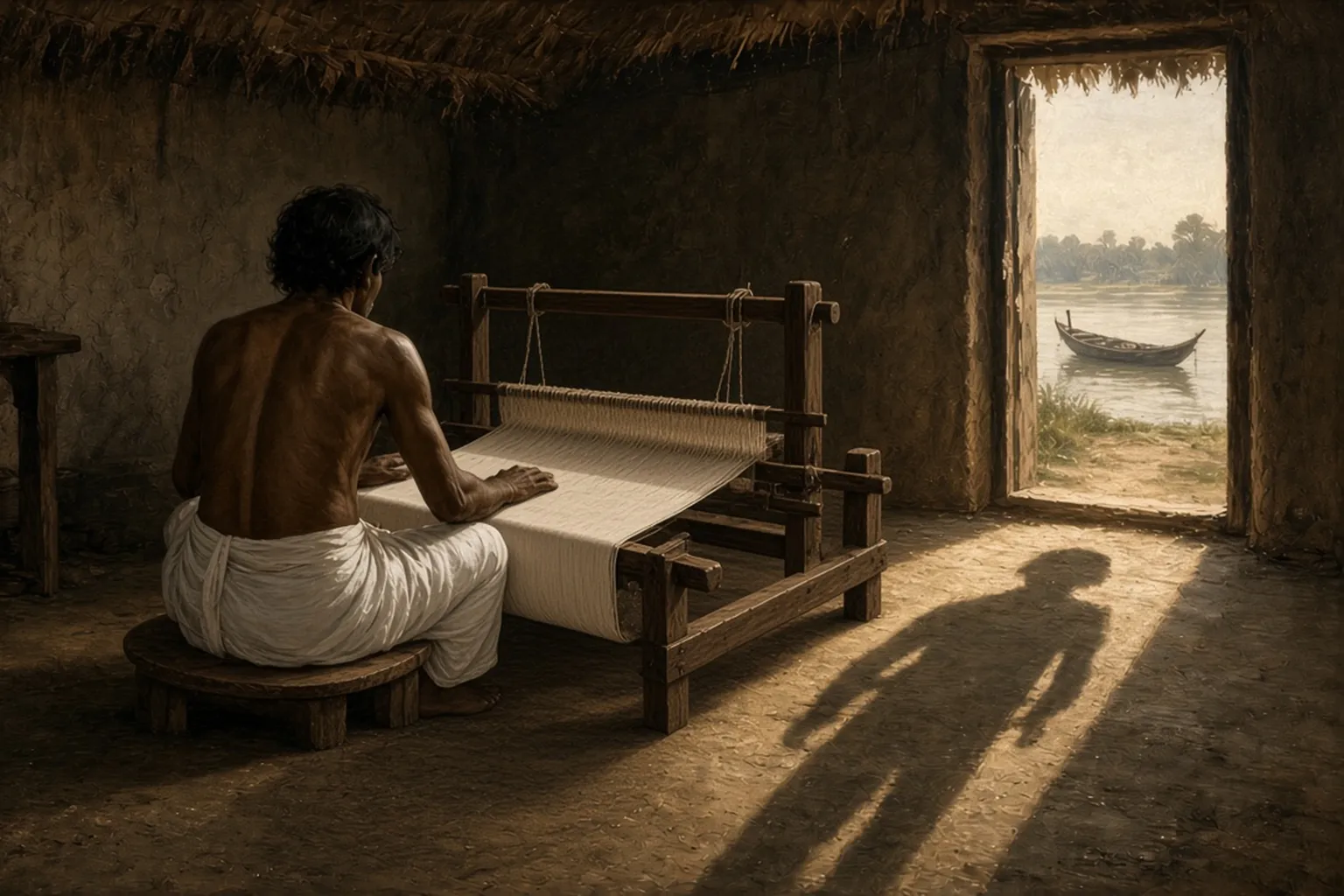
Sometime in the 1760s, in the silk country around Murshidabad, a man who wound raw silk for a living cut off his own thumb. Nobody wrote down his name or his village. There may have been one such man, or twenty. What survives is that an Englishman in Bengal heard about it, put it in a letter, then put it in a book, and the book outlived everyone in it.
Most Bengalis know a different version. In that one the British cut off the thumbs of Bengal’s weavers so the looms would go quiet and English cloth could take over. I grew up with it. I have said it myself, in my video on the famine of 1770, where I said that cutting the fingers of Bengal’s weavers and starving its farmers made the blood-stained money that became the seed money of British industry. When I went looking for where the thumbs came from, the trail led back to that one Englishman. What he wrote is harder to forget than what I said.
The previous story followed the silver counted by the Jagat Seths in Murshidabad. Much of that silver came to Bengal to pay for cloth and silk. This one is about the hands.
The man who wrote it down
William Bolts arrived in Bengal as a junior servant of the East India Company in 1760. Within six years, by his own account, he had made £90,000 in the duty-free inland trade that Company men ran for themselves after Plassey. He left the Company’s service in 1766, kept trading, and fell foul of the council in Calcutta. In 1768 they deported him to England.
On 5 September that year, before he sailed, he wrote to the President and Council at Calcutta with a long list of what he called the Company’s mismanagement. Its sixth paragraph reads:
“In the provision of the Honourable Company’s investment, the rigorous and oppressive measures taken with the manufacturers, in some places, have occasioned nagaads, or winders of raw silk, to cut off their thumbs, to prevent their being forced to work; though it is better since an increase of pay took place.”
Four years later, in London, he published Considerations on India Affairs, a full-length attack on the Company. On page 194 the same people appear again:
“the winders of raw silk, called Nagaads, have been treated also with such injustice, that instances have been known of their cutting off their thumbs, to prevent their being forced to wind silk.”
Read the two lines slowly. The thumbs belong to silk winders. The knife is in their own hand, and the point of it was to make themselves useless to the man who wanted their labour. In the letter, Bolts even adds that things improved once the pay went up.
Bolts had every reason to make the Company look as bad as he could, and he did not hold back. Yet nowhere does he say a Company man cut anyone’s thumb. In 1927 the economist J. C. Sinha of Dacca University made exactly this point: had the story of the weavers’ thumbs any foundation, “a sworn enemy of the English East India Company like Bolts would certainly have referred to it.” Sinha had searched the Company’s early records for both versions and found nothing. He was honest about the limits of that. Silence in the Company’s own papers, he admitted, came “from what may be regarded as an interested quarter”. He added a plainer argument. Cloth was the Company’s most important export from Bengal, and he could not believe it would maim the people who made it.
What the weavers did go through
The rest of Bolts’s chapter is about weavers, and it is hard reading.
When a Company gomasta, or agent, reached an arang, a weaving town, he set up his office and summoned the brokers and the weavers. He made them sign a bond to deliver so much cloth, by such a date, at such a price, and paid part of the money in advance. “The assent of the poor weaver is in general not deemed necessary,” Bolts wrote. When weavers refused the money, “it has been known they have had it tied in their girdles, and they have been sent away with a flogging.”
Weavers were entered in the gomasta’s books and not allowed to work for anyone else, “being transferred from one to another as so many slaves.” The prices fixed on their cloth were “in all places at least fifteen per cent. and in some even forty per cent.” below what it would fetch in the open bazaar. A weaver who tried to sell quietly to the Dutch or French agents found the English gomasta’s peons set to watch him, and they would “not unfrequently” cut the piece out of the loom when it was nearly finished. Weavers caught selling, and the brokers who helped them, were “seized and imprisoned, confined in irons, fined considerable sums of money, flogged,” and stripped of their caste.
The silk winders were treated worst of all. During Lord Clive’s second spell as governor, Bolts wrote, the Company’s sepoys were sent to break open the houses of the Armenian merchants at Saidabad, beside Murshidabad, who had dealt in silk “from time immemorial”, and drag the nagaads from their work to the English factory. That is the world in which a man takes a blade to his own hand.
Was Bolts exaggerating? Sinha did not think so. Bolts held a grudge, he wrote, but his account is backed by the Company’s own papers. In November 1768 the directors in London wrote that the weavers “are unwilling to engage in [Company’s business] because we do not pay them a fair price.” In April 1773 the weavers of Santipore, one of Bengal’s great weaving towns, took their complaints to the President at Calcutta. The papers drawn from that inquiry said that what they were paid came to “no more and in some instances less than the cost of the materials”, that “their labour is extracted from them without any repayment,” and that they were forbidden, “under pain of corporal chastisement and forfeitures,” to work for private merchants.
Bolts also gave all this a starting point. Under the Mughal government, and even under the Nawab Alivardi Khan, he wrote, “the weavers manufactured their goods freely, and without oppression.” A gentleman then living in England had once bought eight hundred pieces of muslin at his own door in the Dhaka province in a single morning, brought to him by weavers of their own accord. The gomastas’ pressure began, by Bolts’s account, in Siraj-ud-daula’s time, when more than seven hundred families of weavers around Jangalbari left their country and their trade at once.
How the story travelled
For more than a century the passage sat in Bolts’s book. Then, in 1902, Romesh Dutt, who had retired as Commissioner of Orissa, quoted it at length in The Economic History of India under Early British Rule. He quoted faithfully, spelling the winders “Nagoads” and trimming the text with dots. The gomasta, the girdle, the prices and the silk winders all survived. Dutt’s book became the standard account for a generation of Indian readers.
On 2 February 1921, Sarala Devi Chaudhurani wrote in Gandhi’s weekly Young India to “MY BENGALI BROTHERS AND SISTERS”, urging them back to the spinning wheel. She quoted Bolts too, with Dutt’s dots in Dutt’s places and even Dutt’s bracketed explanation of the assessors as “examiners of fabrics”. She was quoting Dutt’s quotation. A little further on she quoted “an honest English administrator”: “The springs of their industry were stopped, the sources of their wealth were dried up.” Those words are Dutt’s own, from the same chapter, and Dutt was a Bengali. Within twenty years the book had become an extract, and the extract had started to lose its author.
Eight weeks later Gandhi wrote a short note in the same paper under the heading “Who cut the thumbs?” Under the Company, he wrote, the labour of these artisans “was so cruelly impressed that they were obliged to cut off their own thumbs in order to avoid imprisonment. Many speakers mix up facts and say that the Company’s servants cut off the thumbs of artisans. In my opinion, such cutting off would be less cruel than the terrorism which resulted in self-mutilation.”
So by 1921 both versions were already in circulation, and the most famous man in India was correcting the one that is now more common. Even his own correction had drifted a little. The silk winders had become “artisans”, and escaping the winding had become escaping prison. Each retelling sat a step further from page 194.
Another image joined the thumbs along the way. In Capital, Karl Marx quoted a line that he said “the Governor General reported 1834-35”: “The misery hardly finds a parallel in the history of commerce. The bones of the cotton-weavers are bleaching the plains of India.” Marx gave no document for it. His subject was hand-loom weavers losing their living to machine-made cloth, two generations after Bolts, and the line says nothing about thumbs. In the version many of us carry, mine included, the forced bonds of the 1760s and the factory cloth of the 1830s have folded into a single picture of a blade and a loom.
The hands that are left
Historians who have since gone through the Company’s records describe the same change Bolts complained of. Om Prakash calls it a move from negotiation to coercion: a market in which weavers and brokers bargained gave way, once the Company held power in Bengal, to a system built on forcing them. The governor Harry Verelst told the directors in 1767 that a great number of weavers had “deserted their profession to seek for subsistence from a less precarious calling.” Nobody has found an order to cut a hand.
That leaves the nagaad. He sat in the country around Saidabad winding the raw silk the Company wanted for its cargoes home. He was poor enough to be dragged from an Armenian merchant’s house by sepoys, and he valued the choice of whom to work for more than his own thumb. We do not have his name. We have two sentences from a man who had his own quarrel with the Company, and one small detail he did not need to include: when the pay went up, it got better.