
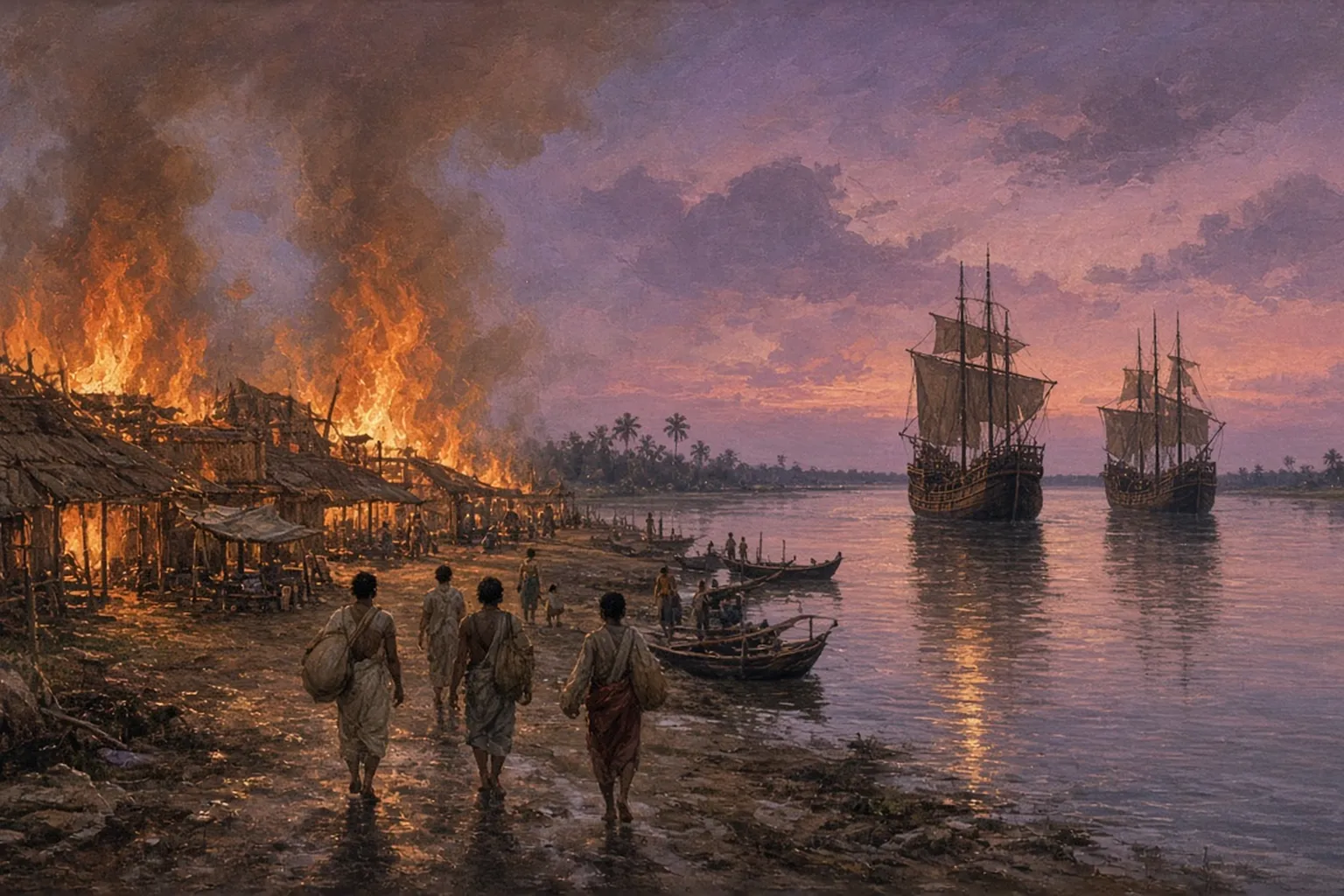
In the late 1560s a Venetian merchant called Cesare Federici sailed up the Hooghly towards Satgaon, the town Bengalis call Saptagram, and stopped at a place he called Buttor. Every year, he wrote, the people there “make and unmake a village, with houses and shops made of straw.” The village stood as long as the ocean ships rode at anchor. When the last ship left for the Indies, every man went to his own plot and set fire to his house. On his way upstream Federici saw the place crowded with people and boats. On his way back down he found “nothing left but the sign of the burnt houses,” a sight, he said, “which thing made me to marvel.”
The ships stopped at Buttor because they could go no further. The river above was too shallow. Small boats carried the cargo the last tide’s rowing up to Saptagram, the richest port in western Bengal. That burning village was a sign that the money was already learning to live somewhere else.
So what happened when the Ganges moved east? Between roughly 1550 and 1660 the river’s main flow left the Bhagirathi-Hooghly channel in the west and poured into the Padma. Saptagram first lost its big ships and then, in 1632, its customs house. Its money went two ways. One stream ran downstream with its merchant families, to Hooghly and to the riverside villages where Calcutta would later grow. The other went east with the water itself, into new rice land and a new capital at Dhaka.
In my Saptagram and Saraswati episodes I told how the Ganges shifted its main stream from the Bhagirathi towards the Padma in the sixteenth century, and how that change slowly dried up the Saraswati and lost us the port of Saptagram. I did not tell the other side of the story that day. The river that starved a port in the west filled the jungles and wetlands of the east with new silt. The river side of that story is told in the death of the Saraswati and the river that made Saptagram. This one follows the money.
A port worth a fortune
The Portuguese, who arrived in the early 1500s, had a name for each of Bengal’s two great harbours. Chittagong in the east was Porto Grande, the Great Haven. Saptagram was Porto Pequeno, the Little Haven. Little was a relative word. Federici counted thirty or thirty-five ships, great and small, loading there every year with rice, cotton cloth, lac, “great abundance of sugar,” dried and preserved myrobalans, long pepper and sesame oil.
The Bengali poets of the early 1500s wrote about the town’s rich merchants and their houses with walls around them, tall doorways and windows set with glass. The subarna baniks traded gold, the gandha baniks perfume and spices, the kansa baniks bell metal. Foreign gold arriving at the port went through subarna banik hands to be tested for weight and purity.
The biggest fortune we can put a number on belonged to two brothers from Krishnapur, just outside the town: Hiranya and Gobardhan Majumdar. They held the revenue contract for the Saptagram country. According to the Chaitanya Charitamrita, the life of the Vaishnava saint Chaitanya, they collected twenty lakh coins a year and paid twelve lakh of it to the sultan. A lakh is a hundred thousand. When a rival tax official lost his share and complained to the court, Hiranya fled and the officers arrested his nephew instead.
That nephew was Raghunath Das, Gobardhan’s only son and heir to all of it. He talked his way out of custody, and some time later he slipped away from home and walked to Puri to follow Chaitanya. He lived the rest of his life as a renunciant, eating what he was given. Saptagram’s richest boy gave his fortune up long before the river took it away.
The river stops coming to the door
By the time Federici came, the Saraswati was failing. Each extra unloading at Buttor meant extra boats, extra hands and extra days, and every one of them added to the price of Saptagram’s goods. Merchants do that sum quickly.
The Portuguese moved first. In 1579–80 a captain called Pedro Tavares went to Akbar’s court and came back with permission to build a settlement a few miles downstream on the main river. That was Hooghly. Saptagram carried on for a while: in 1622 English agents at Patna still saw Portuguese boats arriving from Satgaon with goods from Southeast Asia. Then in 1632 the Mughals drove the Portuguese out of Hooghly and moved the customs house from Saptagram to Hooghly. When the customs house left, the port was finished. How the capital and the river traded places is told in the river that changed Bengal’s capital.
The families who followed the water
Most of Saptagram’s merchants settled in Hooghly. Five families went further. Four Basak families and one Seth family had seen how much trade the anchorage at Buttor drew, and they moved down to the opposite bank, the east side of the Hooghly, where the water ran deep. They cleared the jungle, dug tanks and built a shrine to their family deity, Gobindaji. The settlement took his name: Gobindapur.
A little to the north they set up a market for cotton and yarn by the river, the Sutanuti hat. In between lay Kalikata, and Kalikata was already old. A Bengali poem about the snake goddess Manasa, Bipradas Pipilai’s Manasavijay, which gives its own date as 1495, sends the merchant Chand’s boats down the east bank past Kalikata to moor at Betor, the landing Federici called Buttor. A century later Akbar’s revenue rolls, set down in Abu’l Fazl’s Ain-i-Akbari, listed Kalikata among the estates of Sarkar Satgaon, the revenue district run from Saptagram.
On 24 August 1690 an East India Company agent named Job Charnock landed at Sutanuti to set up a trading post. From then on the English wrote about the place in letter after letter, which is why its story so often seems to begin in 1690. In 1698 the Company bought the right to rent Sutanuti, Kalikata and Gobindapur from the local zamindars, the Sabarna Roy Choudhury family, for 1,300 rupees. The Seths and Basaks were the leading cloth merchants of Sutanuti, and they supplied the Company with cloth for years.
Charnock is still often called the founder of Calcutta. In 2003 the Calcutta High Court accepted a panel of historians’ finding that the city has no single founder and no birthday.
At the end of my Saptagram episode I said that one family after another, their business and their capital, had begun to move south, and that the legacy of Saptagram’s merchants would one day give birth to a new city. The city that grew there is Calcutta. Kalikata was already an old name, and the city grew slowly around the three villages, but the cloth market at its heart was run by people whose grandparents had traded on a river that no longer exists.
The other side of the river
Now look east. In 1574 Akbar’s chronicler Abu’l Fazl noted that at Tanda, the Afghan capital, the Ganges split in two. One branch ran south towards Satgaon. The other ran east towards Sonargaon and Chittagong. Over the following century the eastern branch kept taking more of the water. When the French gem merchant Jean-Baptiste Tavernier travelled through in 1666, the old channel south towards Satgaon could no longer be navigated.
The west lost more than one city to this. Around the same time the Ganges also abandoned its channels near Gaur, the old capital of Bengal’s sultans. The city was hit by a terrible epidemic and was abandoned.
In the east the same water was doing the opposite. Every monsoon the Padma spread the main load of Ganges silt over the eastern delta, and forest and marsh turned into land that could grow wet rice. Mughal revenue officers handed out tracts of jungle to men who would organise the clearing and pay revenue on the fields. The Padma also gave east Bengal a direct waterway to north India, so its rice and cloth now travelled cheaply to the empire’s markets.
The historian Richard Eaton set the Mughal revenue figures for 1595 and 1659 side by side, region by region. Over those sixty-four years the revenue demand for south-east Bengal rose 117 per cent and the north-east’s rose 97 per cent. The south-west, Saptagram’s region, rose 54 per cent. The north-west, around Gaur, fell by 13 per cent. Across the whole province the demand went from about 64 lakh rupees to just over a crore. The state was following the silt.
A French traveller, François Pyrard, spent the spring of 1607 in Chittagong and watched “an infinite number of vessels” arriving every day for rice. To the lands around the Bay, he wrote, Bengal was “a very nursing mother, who supplies them and their entire subsistence and food.” In 1629 the Portuguese friar Sebastião Manrique counted more than a hundred ships leaving Bengal’s ports each year loaded with rice and other food.
A capital where the water was
In 1610 the Mughal governor Islam Khan Chishti moved the capital of Bengal from Rajmahal to Dhaka and renamed it Jahangirnagar, after the emperor. Ordinary people and foreign traders kept calling it Dhaka. When Manrique was there in 1640 he called it a “Gangetic emporium” of more than two hundred thousand people. Around 1515 Gaur, the sultans’ great capital, had been reckoned at about forty thousand.
The cloth came with the city. Weavers around Dhaka made muslin so famous that in Central Asia the finest muslin was simply called Daka.
The money did not stay in Dhaka either. In the early 1700s the capital moved again, west to Murshidabad, and the province’s silver found a new keeper in a family of bankers. That is the next story.
What the river left behind
Saptagram today is a railway halt called Adi Saptagram, a few paddy fields and a quiet stretch of ground. The Saraswati is a thin ditch, the skeleton of a dead river. A merchant from the old port would not find his way home.
In my episode I said that Saptagram lost to nature. Its merchants did not lose. They took their trade down the river, and in the east the same river made a new fortune for people who had never seen Saptagram.
And the village that was burned every year outlived the port it served. Buttor is Bator now, a neighbourhood of Howrah, across the river from the ground the Basaks cleared.