
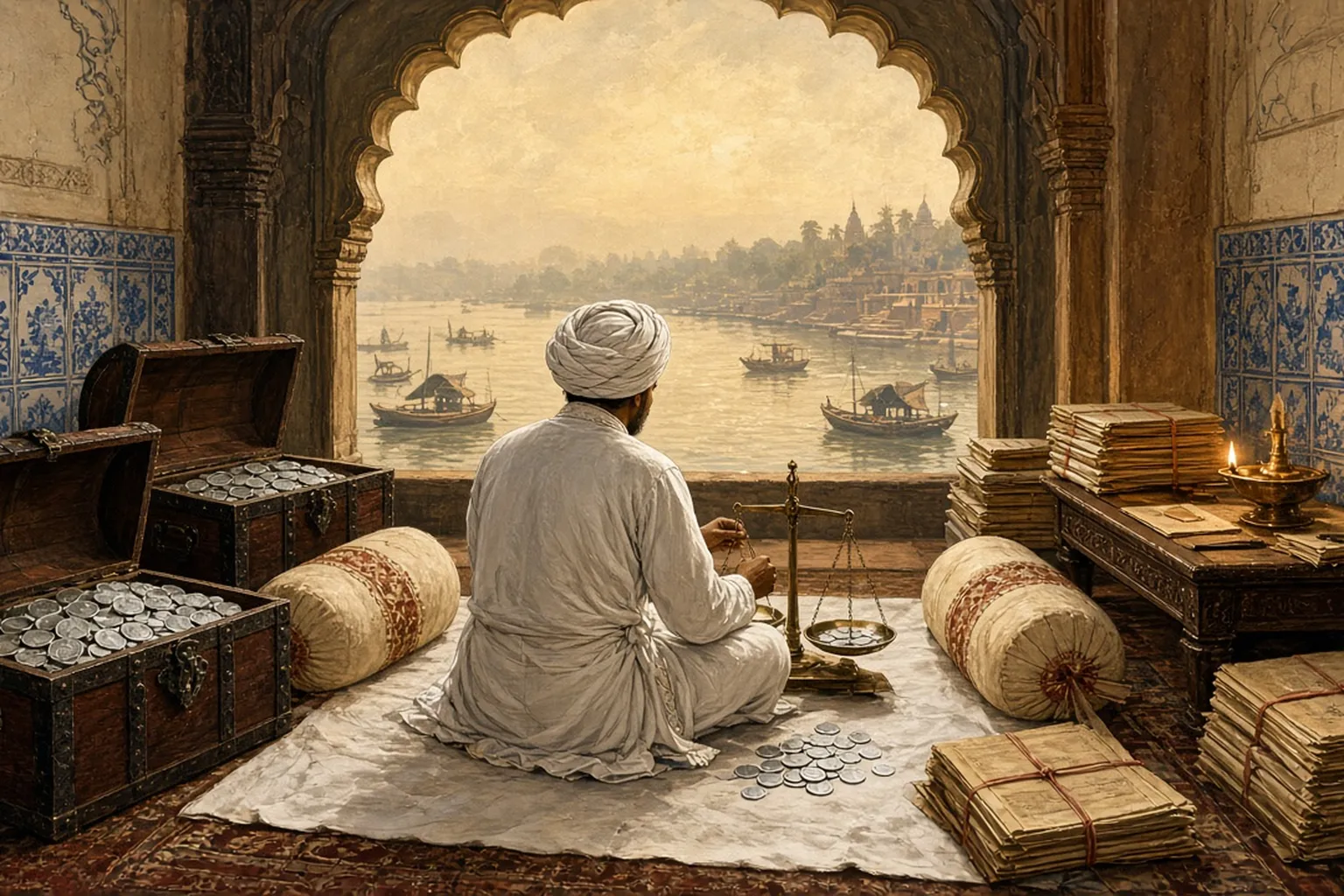
Every year, it was said, ten thousand boatmen passed under the walls of the fort at Monghyr, on the Ganges in Bihar, and every one of them could point to the tower. From that tower, in 1763, the Nawab of Bengal’s men threw two bankers into the river. Every old woman in Monghyr knew what the banker’s servant, Chuni, said to the executioners: he begged them to kill him with his master, and when they refused he jumped into the river after him.
The Company’s own commander, Major Adams, heard it differently. On 18 October 1763 he wrote to Calcutta that “all accounts likewise agree” the two men had been put to death near Barh, further down the road to Patna, and their bodies left unburnt under a guard of sepoys. Monghyr kept its tower anyway.
They were Jagat Seth Mahtab Rai and his cousin Maharaja Swarup Chand. For forty years their family had been the bankers of Bengal, the richest province of the Mughal Empire. The Jagat Seths ran the Nawab’s mint, received his revenue, sent his tribute to Delhi on paper and lent money to the English, Dutch and French. In 1757 they helped decide who would rule Bengal. Six years later, the Nawab they had helped into power next had them killed.
From Patna to the new capital
The previous story ended with Bengal’s capital moving west to Murshidabad in the early 1700s. A banking family moved with it.
In 1652 Hiranand Sahu, a Marwari Oswal Jain from Nagar in Marwar, came to Patna and opened a kothi, a banking house. Among his early customers were English Company men buying saltpetre. His eldest son, Manik Chand, went to Dhaka near the end of the century, when it was Bengal’s capital, and became a favourite of the province’s finance chief, Murshid Quli Khan. When Murshid Quli moved his offices up the Bhagirathi to the town that took his name, Manik Chand went too. (How that move happened is told in the river that changed Bengal’s capital.)
The emperor Farrukhsiyar honoured Manik Chand with the title “Seth” (some historians give it as Nagar Seth, banker of the city). When he died in 1714, his nephew Fateh Chand took over. In 1717 the officer in charge of the Murshidabad mint died, and Fateh Chand was put in his place. A few years later, in the fourth year of his reign, 1722–23, the emperor Muhammad Shah made him Jagat Seth, Banker of the World, as a hereditary title. With it came robes, an elephant, and an emerald seal with the title engraved on it, which he was to hand down to his descendants.
What a banker of the world did
Bengal’s money came in many shapes. Arcot rupees struck by the Dutch, French and English, and a dozen other coins, passed through its markets, and every one had to be turned into the Nawab’s sicca rupee. Even a sicca lost 3 per cent after a year, until it went back to the mint to be struck fresh. Every exchange and every recoining earned a fee, called batta, and the house of Jagat Seth set the rates.
The English tried for years to get the right to coin their own silver at Murshidabad. They failed. The Calcutta Council was told that while Fateh Chand stood so high with the Nawab there was no hope, “he alone having the sole use of the mint, nor dare any other shroff buy or coin a rupee’s worth of silver.” The house bought almost all the bullion that came into Bengal.
It also received land revenue from zamindars and tax collectors, and between 1728 and 1740 part of the tribute owed to Delhi went north as drafts on the family’s Delhi kothi. In my episode I called the hundi the UPI of the eighteenth century. You paid money in at one kothi, carried a paper, and were paid at another, hundreds of miles away. No silver had to travel the roads.
Between 1718 and 1730 the English borrowed on average about 4 lakh rupees a year from the Murshidabad kothi alone. The Dutch called Fateh Chand the greatest money-changer in Hindustan; his name appeared so often in their books that the directors in Holland were not sure whether he was a man or an institution. When he claimed 2,45,000 rupees from the English in 1730, he got it, and the Calcutta Council concluded that “Futteh Chand must be satisfied.”
How rich is rich
In 1742 the Maratha raiders the Bengalis called bargis, led by a defector named Mir Habib, made a sudden dash on Murshidabad. They went for the Seths’ house, “which they seemed to single out,” and carried off two crore rupees. The English translator of the Persian history Siyar-ul-Mutaqherin wrote that the loss “affected him so little, that he continued to give government bills of exchange at sight of full one cror at a time.” In the script for my Lakshmi episode I wrote that even after this, Jagat Seth stayed Jagat Seth. He had not been ruined.
Ghulam Husain Khan, who wrote the Siyar, said their wealth was such “that there is no mentioning it without seeming to exaggerate.” The Company servant William Bolts, writing in 1772, put the fortune at about seven crore rupees, “as his countrymen calculate.” N. K. Sinha, who edited J. H. Little’s history of the family, thought that at their height they held at least fourteen crore.
The comparisons with London started early. A Captain Fenwick, writing on the affairs of Bengal in 1747–48, called Mahtab Rai a greater banker “than all in Lombard Street joined together,” a line William Dalrymple brought back into print. Clive said Murshidabad was as rich as London, “with this difference that there are individuals in the first possessing infinitely greater property than any of the last city.” And in 1783 Edmund Burke spoke of Indian banking houses that had “once vied in capital with the Bank of England.” He named no one. Little was sure he meant the house of Jagat Seth. A Bengali poet put it more simply: as the Ganges pours into the sea by a hundred mouths, so wealth flowed into the Seths’ treasury.
A slap in the durbar
Fateh Chand died in 1744, and Mahtab Rai and Swarup Chand inherited the house. In 1756 Siraj-ud-daula became Nawab.
He needed the emperor’s order confirming him, usually won through the Seths’ influence in Delhi. It did not come. A Company report from September 1756 describes what happened in full court: Siraj reproached Jagat Seth for not getting the order and told him to raise three crore rupees from the merchants. When Jagat Seth pleaded that the merchants were already hard pressed, he “received a blow on the face and was confined.” The general Mir Jafar and other officers demanded his release and, refused, said they would not draw their swords for Siraj until Delhi confirmed him.
From then on the Seths kept a guard of 2,000 men around their house. According to Luke Scrafton, the Company’s man at Murshidabad, the two cousins never went out at the same time.
Plassey from the counting house
The Seths were not soldiers. Their work in 1757 was done in rooms. They first backed a commander called Yar Latif Khan, then persuaded him to join Mir Jafar, and Mir Jafar’s bargain with the English was what turned the battle. Jean Law, head of the French factory and the Seths’ rival at court, wrote that “the path which led to the battle of Plassey had its beginning in Murshidabad and not in Calcutta and it was the Seths who placed the feet of the English in the path.”
In my episode I said Plassey was hardly a battle at all, just a business deal. In Bengali villages a landholder in trouble hires a lathiyal, a man with a stick. The Seths, I said, chose the East India Company as theirs, and they expected it to go home once the job was done. What the wider Plassey settlement took from Bengal is told in how rich Bengal was before Plassey. Here is the part that happened in the Seths’ house.
On 29 June 1757, six days after the battle, Clive put Mir Jafar on the throne, and the two men went to the Seths’ house to settle the money. The treasury held far less than the English had been promised. Jagat Seth, “after a long but friendly debate,” fixed the terms: half the sum at once, two-thirds of that in coin and one-third in jewels, plate and goods, and the rest in three yearly payments.
Omichand, the Calcutta merchant who had carried messages for the plot, sat in the outer hall, off the carpet. He had been shown a forged treaty promising him a share. When the meeting ended, Scrafton told him: “Omichand, the red paper is a trick; you to have nothing.” He nearly fell to the floor. Soon boats carried the silver of Jagat Seth’s award down to Calcutta.
The new keeper of the silver
The Company opened its own mint in Calcutta, but for some years the Seths’ hold on the province’s coin protected them. In 1760 they helped replace Mir Jafar with his son-in-law Mir Qasim. He moved his court to Monghyr and soon quarrelled with the Company over its servants’ private trade, carried on under duty-free passes called dastaks. In March 1763 he abolished all customs duties for two years, so that every trader paid the same, and the Company objected. Mir Qasim knew which side the Seths would take. He had their house surrounded and the cousins brought to Monghyr, where he asked them, with every courtesy, to build a banking house and carry on as before. When the war turned against him, he had them killed.
After 1763
Mahtab Rai’s son Khushal Chand became the third Jagat Seth. In 1765 he and his cousin wrote to Clive that they were melting down their household vessels and pawning jewels to pay the ransom for two younger brothers whom Mir Qasim had dragged into exile. Clive made Khushal Chand the Company’s banker. Before leaving India he offered Khushal Chand a pension of three lakh a year. Khushal Chand turned it down. He was spending a lakh a month.
Then the ground went. In 1772 Warren Hastings moved the government treasury from Murshidabad to Calcutta, and the Seths stopped being the Company’s bankers. When Khushal Chand died suddenly in 1783, family legend says, he had buried the treasure and never told anyone where. In 1844 Jagat Seth Gobind Chand applied for a pension and was granted 1,200 rupees a month.
Mahimapur
Around 1920 J. H. Little, headmaster of a Murshidabad school, walked out to Mahimapur, where the family had lived. Behind a broken gateway a path ran through jungle to the Bhagirathi. It had been a road with seven gates, and the ground around it had once held 4,000 people. A mound was all that remained of the hall where the Nawab and Clive had sat with Jagat Seth. A banyan gripped the walls of the old treasury. A Vishnu temple still stood, its front covered in Dutch tiles of Bible scenes, a sign of some old bargain with the Dutch at nearby Cassimbazar.
আজও মুর্শিদাবাদে গেলে জগৎ শেঠের প্রাসাদের অবশেষ দেখা যায়। Go to Murshidabad today and you can still see what is left of Jagat Seth’s palace.
Some time after 1947, N. K. Sinha called on the eighth Jagat Seth, also named Fateh Chand, at his house in Mahimapur. The heir of the Banker of the World talked about how hard it was to collect the rents from his zamindari in Jessore. Bengal, Sinha wrote, had turned the banker into a zamindar.
The silver the Seths counted came to Bengal to pay for cloth. The hands that made that cloth are the next story.