
The Morning Bengal Turned Off Uttam Kumar
The night before Mahalaya, I used to check the radio. Was it working properly? Then the alarm. Then I’d go to sleep half scared, in case I woke up late.
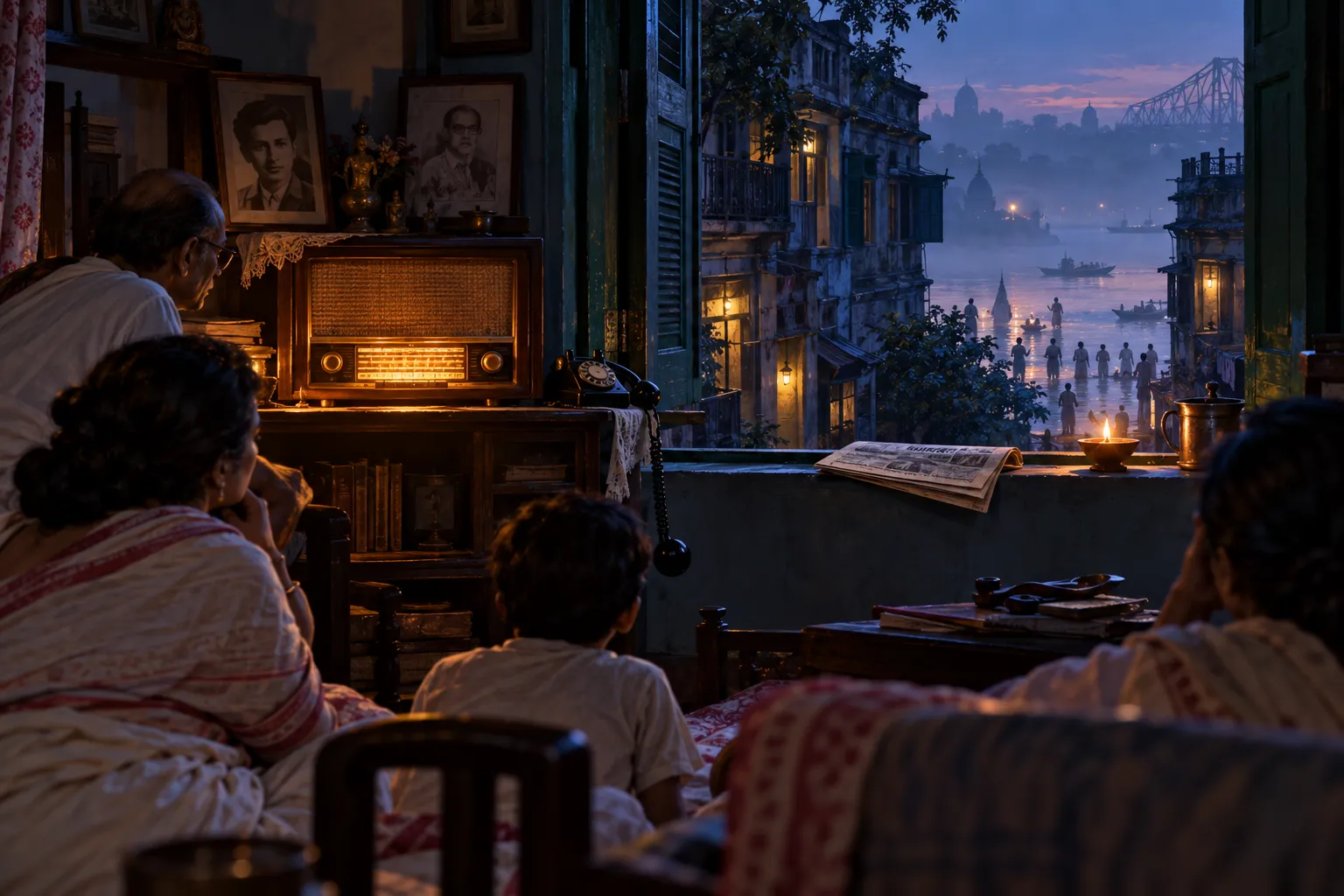
Then the dawn. Sometimes half awake, sometimes half asleep, Birendrakrishna Bhadra’s voice coming out of the radio while the outside slowly turned pale. And it wasn’t only our radio. The same sound was coming from every house in the para at the same time. The moment the last song of Mahishasuramardini finished, I ran to watch the Mahalaya programme on DD Bangla.
I don’t think your memory is very different. That is the whole point of this story.
Because once, for one year, somebody tried to change that dawn.
A song for spring, moved to autumn
The programme is younger than most of us think. In the early 1930s, at the Calcutta radio station, Banikumar put together a Chandi-based piece for a spring broadcast, Basanteswari. It kept changing names and days for a few years, until 1937, when it became Mahishasuramardini and settled on Mahalaya for good. Banikumar’s script, Pankaj Kumar Mullick’s music (Raichand Boral on the early versions), Bhadra’s voice. From the early fifties it went out at 4 AM. And for decades it was done live, every single year, until a recording was finally made in the sixties. That recording is what we still wake up to.
Even then it had survived a fight. Bhadra was a Kayastha, and some Brahmins objected to a non-Brahmin reciting the Chandi. Banikumar threatened to call off the whole production if Bhadra was dropped. The shehnai players were Muslim ustads, and once they started playing over Bhadra’s recitation by mistake. It was kept. That’s a story for another day.
1976
By the seventies, then, the programme had been running for over forty years. Somebody at All India Radio decided it was time for something new.
The new thing was called Debim Durgatiharinim. Script by Dr Dhyanesh Narayan Chakraborty. Music by Hemanta Mukhopadhyay. Sanskrit by Gobinda Gopal Mukhopadhyay. Singers: Lata, Asha, Sandhya, Manna Dey, Manabendra. And narrating it, Uttam Kumar, with Basanta Chaudhuri, Chhanda Sen and Partha Ghosh.
On paper you could not beat that line-up. Mahanayak plus half of Bengal’s playback royalty.
Uttam Kumar himself didn’t want to do it.
Ashima Mukherjee, the AIR producer, remembered it years later. She and Hemanta had to persuade him. He was paid a cheque of Rs 150. And before the recording, the biggest star in Bengal asked one question: “Mar khaabona toh?” I won’t get beaten up, will I?
He knew. Of everyone involved, he seems to have been the one who understood Bengali listeners best.
4 AM, 23 September
Mahalaya fell on 23 September 1976. The radios came on in the dark the way they always did. Out came the new programme.
And the phones at All India Radio started ringing at 4 AM.
Think about that hour. People hadn’t had tea yet. They were angry enough to find a telephone, in 1976, and call the radio station. The anger went down to the river too. Men standing waist-deep at the ghats for tarpan, offering water to their dead ancestors, were protesting. At the holiest moment of the year, they were complaining about the radio.
It is said some AIR offices were even stoned. Maybe. People like to add a stone or two to a good story.
What nobody disputes is that it didn’t work. The songs were fine. Hemanta was Hemanta. Lata was Lata. But nobody had asked Bengal whether it wanted a better Mahalaya. It wanted its own.
Bhadra came into the office by half past twelve that day. He said he hadn’t listened. And he said that it was the first time he understood how many people knew him, and loved him.
Imagine finding that out after more than forty years at the microphone, and only because they took you off the air.
Back where it belonged
AIR backed down fast. Bhadra’s Mahishasuramardini came back by that very Puja, some say, on Shashthi. The next year at the latest. Either way, it has gone out every Mahalaya since, and Debim Durgatiharinim became the answer to a quiz question.
Nobody blames Uttam Kumar. That’s the odd part. He had seen it coming and said so. Even people who adored him on screen did not want him at 4 AM on Mahalaya. They wanted the voice they had been half asleep to as children, the one their parents had been half asleep to.
By 1976 people didn’t really choose to hear it. They woke up into it, year after year, in the same half-dark, in the same house. You could change the cast of a film. You could not change the voice that told Bengal the goddess was on her way.
Fifty years on
This year Mahalaya fell on 10 October. Fifty years since that morning, give or take a calendar.
All India Radio still broadcasts Bhadra’s recording every Mahalaya. Most of us have it on our phones now, on YouTube, on some app. The alarm is still set the night before, though. Somewhere a child is still checking whether the radio works.
And at 4 AM, in a lot of paras, it still comes from every house at once.