
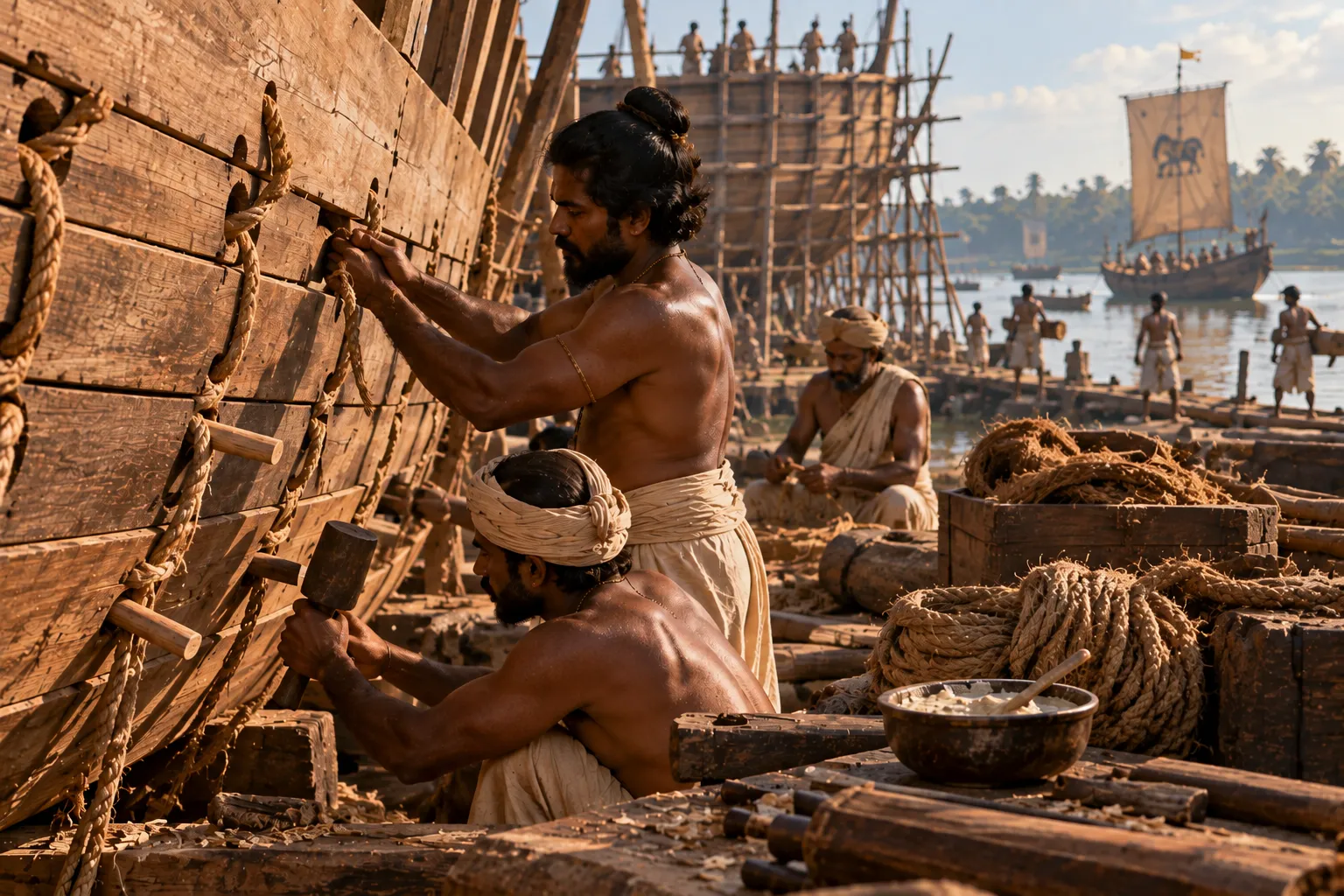
How Do You Build a Ship Without Iron Nails?
Imagine building a wooden ship and deliberately leaving the iron nails out.
It sounds like a technological limitation. In the shipbuilding traditions associated with the Indian Ocean, however, it could be a deliberate choice. Wooden planks could be joined with fibre cordage and wooden pegs, producing a hull that was not completely rigid but had some capacity to flex.
For vessels working around Bengal, that flexibility may have mattered more than the apparent simplicity of the technique.
The ship that was stitched together
The method is generally described as sewn-plank construction. Instead of fastening planks primarily with metal nails, builders connected them using strong natural fibres passed through or along the plank seams, with wooden pegs helping secure the structure.
The research material associates this tradition with the Tankai method and describes coconut-fibre cordage, wooden joining elements and a lime-based sealing material used together in the construction of the hull.
The result was a very different kind of wooden structure from one held together by rigid metal fasteners.
The planks were still firmly connected, but the hull could retain a degree of movement.
Why would flexibility matter?
A ship at sea is constantly being stressed.
Waves lift one part of the hull while another drops. Currents push against the sides. A vessel entering shallow water may touch the bottom. In Bengal’s river and coastal environments, grounding on mud or sandbanks was not an imaginary possibility.
A completely rigid joint can concentrate force around the fastening. A more flexible construction can distribute some of that stress through the structure.
The research specifically connects sewn-plank construction with the ability of vessels to “give” rather than fracture when grounded or exposed to difficult conditions.
That makes the technique easier to understand.
The objective was not simply to avoid iron.
It was to build a hull that could tolerate movement.
Rope was part of the structure
Natural fibre can sound weak when compared with iron.
But in a sewn-plank hull, fibre was not being used as a casual substitute for a nail. It was part of the structural system.
The research identifies coconut coir for its elasticity and lightness, alongside other plant fibres valued for durability or tensile strength. These materials could be twisted into strong cordage and incorporated into the seams of the vessel.
The technology therefore depended on understanding the properties of natural materials.
The shipbuilder had to know how much tension the cordage could tolerate, how it interacted with timber and how the seams could be sealed against water.
The rope was doing engineering work.
And then came the sealant
Holding planks together is only half the problem.
A wooden hull also has to keep the water outside.
The research describes a lime-based putty or sealing material being applied between planks to reduce water ingress.
This gives us a useful way to think about the construction method. Timber, fibre, wooden pegs and sealant were not separate tricks. They were components of a single system.
The timber provided the body of the vessel.
The fibre helped bind it.
The pegs secured the joints.
The sealant kept the water out.
The strength of the ship came from the way these materials worked together.
Why avoid iron?
The Yukti Kalpataru, a Sanskrit technical text traditionally associated with King Bhoja of Malwa, is central to the evidence used in the research. It describes shipbuilding traditions and is presented as warning against the use of iron fastenings in sea-going vessels.
The research material attributes this prohibition partly to concern about magnetic effects, although that explanation should not be treated as a modern scientific understanding of magnetism.
What we can say more securely is that the text preserves a tradition in which iron was not regarded as necessary for joining the hulls of sea-going vessels.
That is significant in itself.
It tells us that metal was not the only way to engineer a durable wooden ship.
A technology suited to movement
The real advantage of sewn construction may have been its relationship with the environment.
Bengal’s waterways were not uniformly deep or predictable. River channels shifted, mudbanks formed and coastal waters were influenced by tides. A vessel that could tolerate occasional grounding had an advantage over one whose rigid joints were more vulnerable to sudden stress.
The research associates sundari (Heritiera fomes) and other timbers with vessel construction in Bengal, while noting the importance of resistance to saline and tidal conditions.
The timber and the joining method therefore addressed related problems.
One helped the ship survive the water chemically.
The other helped it survive the water mechanically.
Not every Bengali ship was identical
There is an important qualification.
The Yukti Kalpataru is not a Pala Bengal shipyard manual. It is a broader Indian technical text associated with a ruler of Malwa, and its classifications cannot automatically be treated as a record of exactly what every Bengali shipbuilder did.
Nor does the evidence justify claiming that every vessel in Bengal was built without iron.
What the evidence does give us is a documented Indian shipbuilding tradition involving sewn planks, natural fibres and wooden joining elements, alongside regional evidence that makes such techniques relevant to understanding Bengal’s maritime technology.
That is a more modest claim—but also a much stronger one.
The strange logic of strength
Modern eyes tend to associate technological sophistication with harder materials.
Iron seems stronger than rope. A rigid fastening seems more secure than a flexible one.
But ships operate in motion.
A hull does not exist in a static world. It bends, twists, rises and falls. A construction method that allows controlled movement can sometimes protect the whole structure precisely because it does not demand that every joint remain perfectly rigid.
That is the fascinating possibility behind sewn-plank construction.
The ship was strong partly because it could move.
A forgotten engineering tradition
Very little of this technology survives in the form we would most like to examine.
Ancient wooden vessels rarely survive intact in Bengal’s humid environment. Rope decays. Timber is reused. Shipyards disappear beneath later settlements or changing river courses.
We are left with technical descriptions, archaeological fragments and surviving traditions from the wider Indian Ocean world.
Yet those fragments reveal an important principle.
The absence of iron does not mean the absence of engineering.
A ship could be designed around timber, fibre, wooden pegs and sealant, with flexibility treated as an advantage rather than a weakness.
For sailors working through Bengal’s rivers and coastal waters, that may have been exactly the point.
The question, then, is not really “How could they build a ship without iron nails?”
It is a more interesting one:
What if they did not need them?