
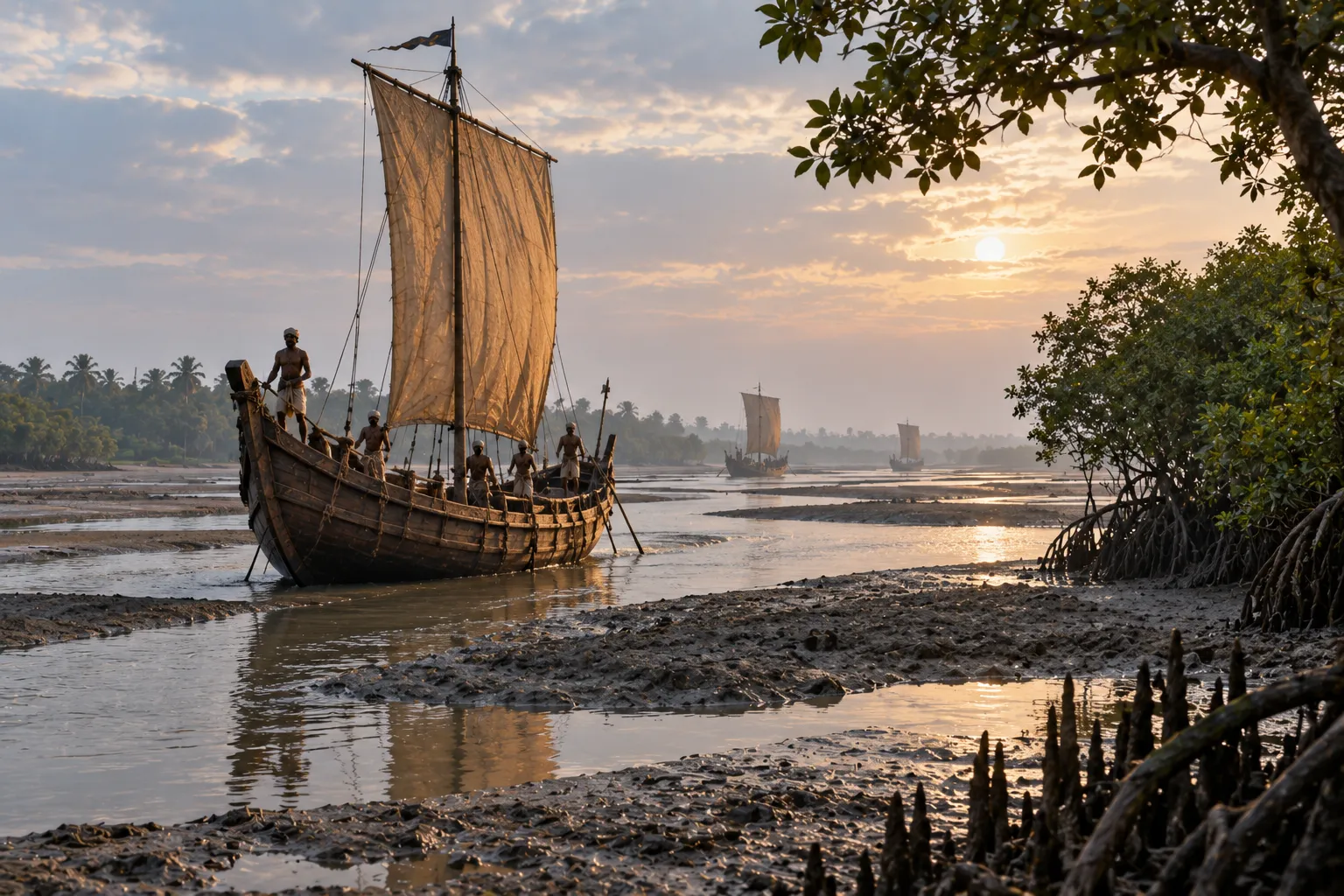
Why Ancient Bengali Ships Were Designed to Survive the Delta
A ship built for Bengal had to accept one uncomfortable fact: the water would not stay the same.
Channels could shift, silt could accumulate, banks could erode and shallow stretches could appear where deeper water had once been. In tidal areas, the level and character of the water changed again with the movement of the tide. For a shipbuilder, this meant that “good design” could not simply mean building the strongest or largest vessel possible.
It meant building a vessel that could survive the place where it was going to work.
The delta was part of the design
Bengal offered an extraordinary network of waterways, but those waterways were not uniform.
A boat travelling through a narrow river channel faced different problems from one crossing a broad tidal estuary. A vessel intended for coastal or sea travel needed different qualities again. The surviving shipbuilding tradition therefore makes more sense when we stop imagining a single standard Bengali vessel and instead think about different ships for different waters.
The Yukti Kalpataru, a Sanskrit technical text traditionally associated with King Bhoja of Malwa, makes precisely this kind of distinction. It divides vessels into Samanya, or ordinary vessels associated with riverine use, and Visesa, or special vessels associated with sea voyages.
The text is not a Bengal-specific shipyard manual, so it cannot tell us that every Bengali vessel followed these classifications. But it preserves an important principle: the environment in which a ship operated mattered to its design.
Why a river needed a different ship
A deep-draft vessel can carry substantial loads and perform well in deep water. In a shallow river, however, the same characteristics can become liabilities.
Bengal’s rivers were constantly reshaped by sediment. A route that appeared navigable could contain shallow stretches, submerged banks or newly deposited silt. A vessel operating in such conditions needed to be able to move through water without depending on a consistently deep channel.
That helps explain the importance of the river-vessel categories preserved in the Yukti Kalpataru. The research describes a range of Samanya vessels, from relatively small craft to much larger boats, reflecting different requirements within the riverine environment.
The lesson is simple but easily overlooked: a smaller boat was not necessarily an inferior boat.
Sometimes it was the boat that could go where the larger one could not.
The problem of mud
For a Bengali shipbuilder, the riverbank itself was part of the operating environment.
A vessel could encounter mud or a sandbank during ordinary movement. In a landscape where channels changed and water levels fluctuated, grounding was a practical possibility rather than an extraordinary accident.
This is one reason the sewn-plank construction tradition is relevant here. Using fibre cordage and wooden joining elements, it produced a hull with some flexibility. The research specifically connects that flexibility with the ability to tolerate grounding and difficult water conditions.
The important point for this story is not how the stitching worked.
It is why a ship that could give slightly under stress could make sense in the delta.
The wood mattered too
Adaptation began before the first plank was shaped.
The research identifies several timbers associated with Indian shipbuilding traditions and gives particular attention to sundari (Heritiera fomes), a tree characteristic of the Sundarbans. It describes timber selection in terms of properties such as hardness, flexibility, workability and resistance to saline conditions.
That tells us something fundamental about pre-modern shipbuilding.
A builder did not simply ask, “What is the strongest wood?”
The better question was, “What does this part of the ship need to survive?”
A hull exposed to wet, tidal and sometimes saline conditions had different material requirements from a structure designed for a sheltered inland setting.
Not every ship had to do everything
The distinction between river and sea-going vessels becomes particularly important when we look beyond the delta itself.
Bengal’s waterways ultimately opened into the Bay of Bengal. Ships moving along rivers, through tidal estuaries and into coastal waters belonged to a connected maritime system, but the physical demands of those environments were not identical.
The Yukti Kalpataru distinguishes Samanya vessels from Visesa vessels and further describes different forms within those broad categories. The research associates the sea-going class with larger vessels capable of operating in coastal and maritime conditions.
Again, this should not be turned into a claim that we know exactly which named vessel sailed from which Bengali port.
What it gives us is something more useful: a way of thinking about vessel ecology.
The right boat for the right water
This also changes how we should imagine naval power.
A modern observer might instinctively measure a fleet by the size of its largest ship. But in a delta, versatility could be more valuable than sheer scale.
A smaller craft could enter a narrow channel. A larger vessel could carry heavier loads in deeper water. Another design could be better suited to coastal travel. A fleet containing different kinds of vessels could therefore operate across environments that a single ship could not handle equally well.
The research’s classification of multiple river vessels points towards this diversity.
Naval strength could lie in having choices.
The coast changed the equation
Once a vessel left the sheltered complexity of the river network, another set of problems appeared.
Open water exposed ships to stronger waves, wind and longer passages away from land. Coastal and maritime vessels therefore needed greater capacity and different structural requirements from craft intended primarily for inland waterways.
This does not mean that Bengal had a sharp boundary between “river boats” and “sea ships.” The waterways formed a continuum, and vessels could be part of a wider system connecting inland routes with the coast.
But the shipbuilder still had to think about the conditions waiting beyond the river mouth.
The delta was the beginning of the journey, not necessarily its end.
Adaptation was the real technology
This is what makes Bengal’s ships interesting even when the surviving evidence is frustratingly incomplete.
We do not possess a preserved Pala-era fleet that can be measured plank by plank. We cannot reconstruct every vessel from a single technical manual. Even the Yukti Kalpataru, valuable as it is, belongs to a broader Indian intellectual and technical tradition rather than Bengal alone.
Yet the fragments point towards a coherent idea.
Ships were designed around the environments in which they had to function.
The choice of timber, the size and type of vessel, the distinction between river and sea-going craft, and construction methods that could tolerate movement all make more sense when viewed as responses to particular physical conditions.
Bengal did not ask the river to behave
Perhaps that is the most revealing way to understand the technology.
A shipbuilder could not stop the river from silting. He could not prevent a bank from shifting or a tide from rising and falling. He could not make every channel deep enough for the largest vessel.
What he could do was build a vessel that expected those things to happen.
That is why the story of Bengal’s ships is not really a story about conquering the delta. It is a story about adapting to it.
The most successful vessel was not necessarily the biggest, the heaviest or the most rigid. It was the one whose materials, size and construction allowed it to keep working when the landscape refused to remain still.
In Bengal, the river was never merely the road beneath the ship. It was part of the engineering problem.