
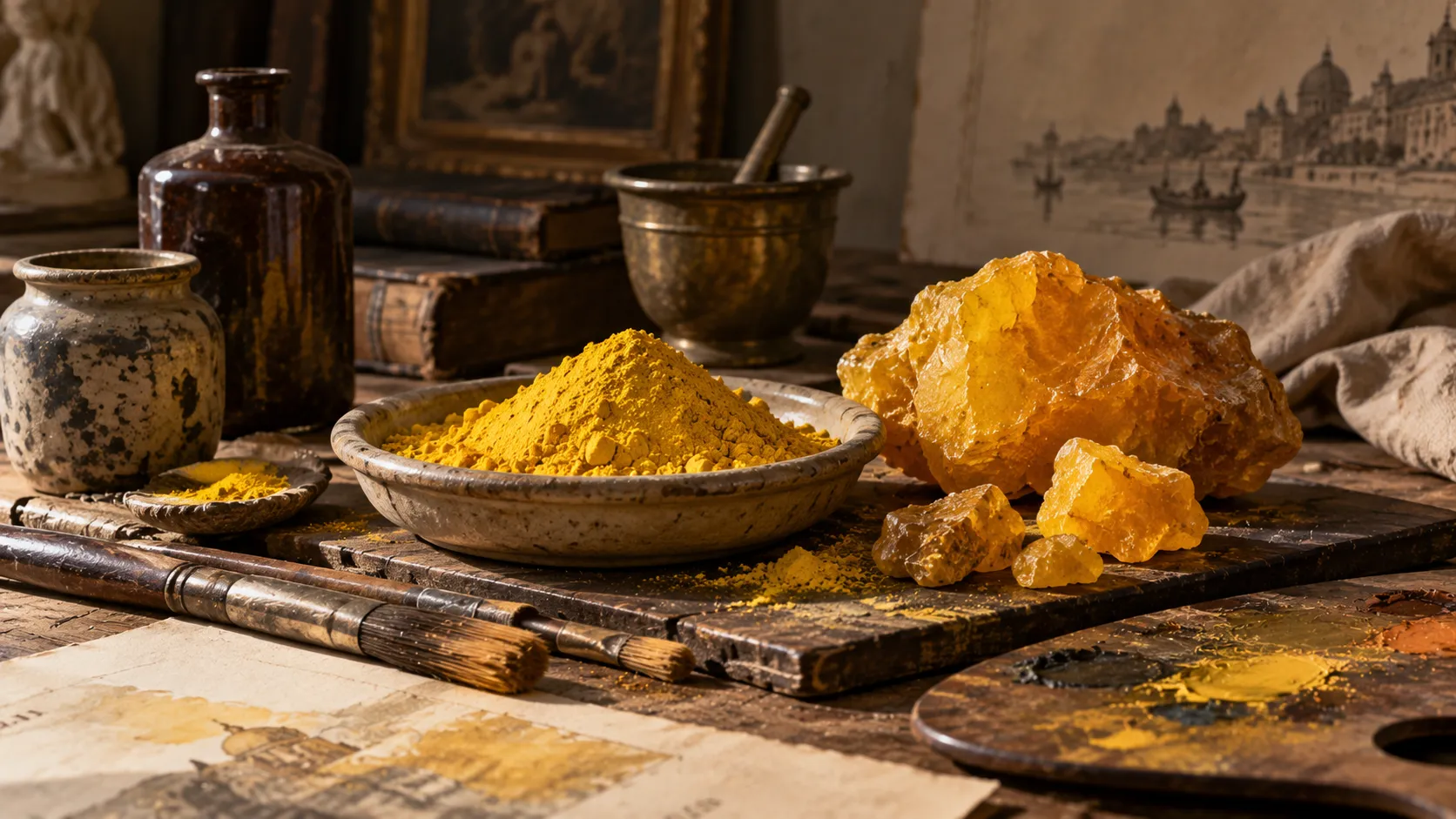
The Cow Urine That Became an International Art Trade in Bengal
Imagine a golden-yellow pigment travelling from rural eastern India to the studios of European artists. It was prized for its luminous colour, yet its origins were far removed from the world of painting. The story began with cattle—and a trade that connected rural production with the commercial networks of Bengal.
The pigment was known as Indian Yellow, or Peori (also written Piuri). During the nineteenth century, it became part of an international market linking producers in the Indian subcontinent with European suppliers of artists’ colours.
Behind the beautiful yellow lay an extraordinary production process.
A colour with a mysterious origin
Indian Yellow was valued for its transparent, golden hue. Artists could use it to create effects of light, warmth and depth. But its precise origin remained a subject of curiosity in Europe, where accounts offered different explanations for how the pigment was made.
In 1883, a Bengali official and museum curator, Trailokyanath Mukharji, investigated its production. Working on behalf of Sir Joseph Hooker of the Royal Botanic Gardens at Kew, Mukharji traced the pigment’s manufacture to Monghyr, now Munger, in Bihar.
His investigation connected a specialised rural industry to a much wider commercial world.
How Peori was made
The research describes a community of milkmen, or Gwalas, who maintained cattle for producing the pigment.
According to the account, the animals were fed a restricted diet centred on mango leaves and given very little water. Their urine became intensely yellow and was collected for processing.
The liquid was concentrated over low fires, filtered through cloth and pressed into small, moist lumps. These were then dried and cured into yellowish-green spheres known as Gogoli or Purree.
The process transformed a biological product into something that could be stored, transported and sold.
But the method came at a cost. The research describes the restricted feeding as causing severe nutritional distress in the cattle. The pigment’s distinctive colour was therefore inseparable from the conditions of its production.
From Monghyr to Calcutta—and beyond
Indian Yellow was not simply a curious village product. It entered a larger commercial system.
The research traces consignments from Monghyr down the Ganges to Calcutta. There, merchants stored the pigment in wholesale warehouses around Burrabazar. From the city, commercial connections carried it towards European markets, including suppliers such as the London art-materials firm Winsor & Newton.
Calcutta’s role was that of a commercial bridge: a place where a product made in the interior could be gathered, traded and sent into international circulation.
This was one of the less familiar sides of the city’s nineteenth-century economy. Alongside better-known commodities, Calcutta’s trading networks handled materials whose origins were embedded in rural life.
The pigment’s journey linked cattle-keeping communities in Bihar, river transport, Bengal’s wholesale merchants and the European market for artists’ colours.
The cost behind the colour
Mukharji’s 1883 documentation brought the production process into wider discussion. The research paper reports that the treatment of the cattle drew public condemnation.
By the early twentieth century, the trade was also facing competition from synthetic dyes. The paper places the end of commercial Peori production around 1908, associating it with animal-protection legislation and the growing availability of manufactured alternatives.
The precise legal history and timing require further verification, but the broad transition described in the research is clear: a traditional pigment trade was being challenged by changing public attitudes and new technologies.
A colour that carried a history
Indian Yellow’s story unsettles the familiar separation between art and commerce.
A colour admired on an artist’s palette could depend on a chain of labour and production far removed from the studio. In this case, that chain ran through rural Bihar and the river and trading networks of Bengal before reaching European suppliers.
Calcutta did not necessarily make the pigment, but it helped make its international trade possible.
The golden colour that travelled abroad carried a less visible history with it: cattle, specialised rural production, river transport and the merchants who connected local commodities to distant markets.
The story of Indian Yellow reminds us that the history of art is sometimes also the history of the extraordinary things people learned to sell.