
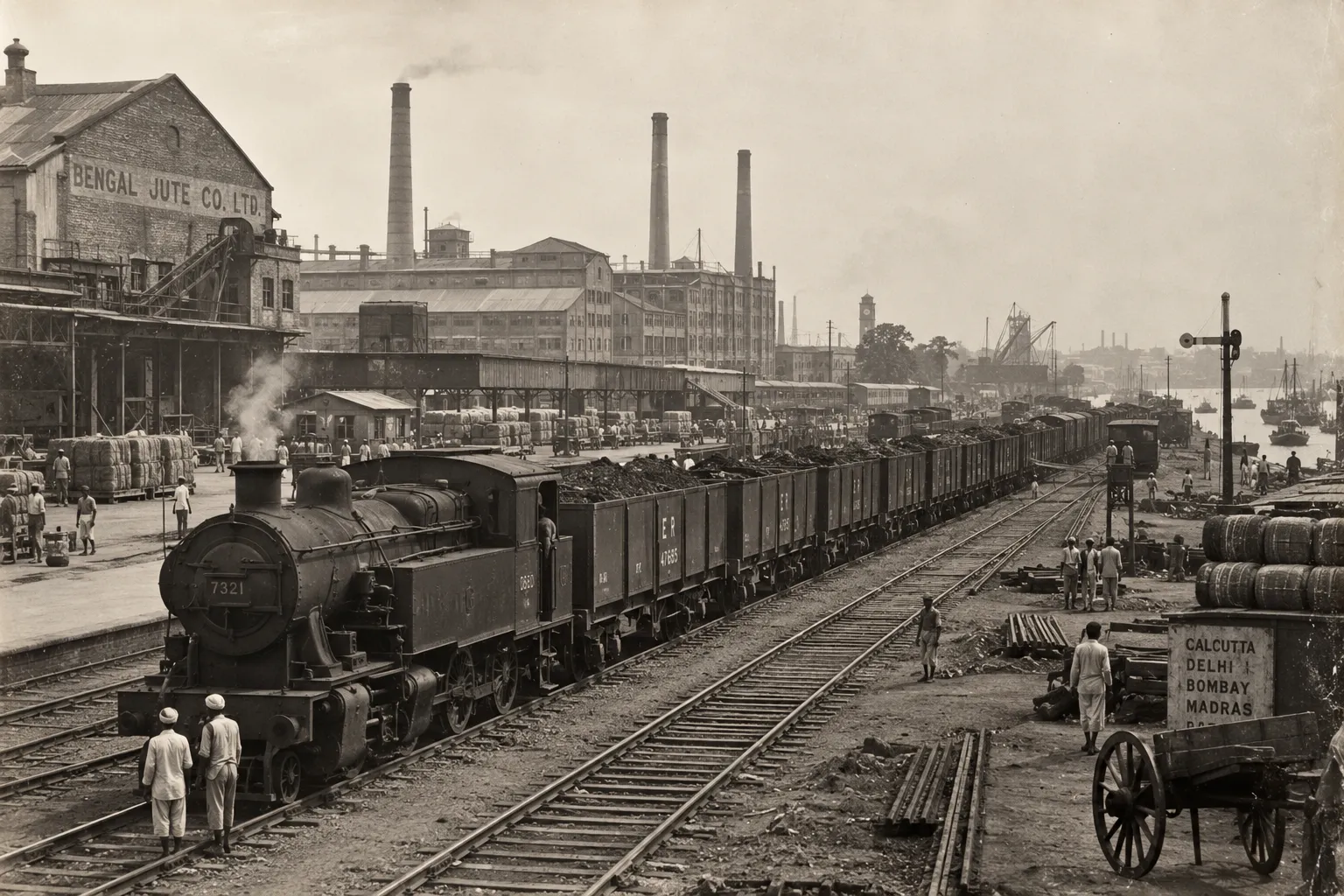
The Freight Policy That Changed Bengal’s Industrial Future
A factory owner once had a very simple reason to build near Bengal.
The raw materials were there.
Coal came from the Raniganj belt. Iron and steel came from the mineral-rich regions of eastern India. The railways connected these resources to the industrial centres around Calcutta, Howrah and the wider eastern manufacturing belt. Geography itself was an economic advantage.
Then the price of moving those materials was changed.
Not by nature. Not by a new mine. Not by a technological breakthrough.
By policy.
In 1952, the Government of India introduced the Freight Equalization Scheme, designed to make the transport cost of key industrial raw materials broadly uniform across the country. Coal, iron ore, steel and cement could now be transported hundreds or thousands of kilometres without the full geographical disadvantage that distance would normally impose.
The intention was national: encourage industrialisation beyond the traditional industrial centres.
The consequence for eastern India was much more complicated.
When distance stopped mattering
Before the scheme, a factory’s location could make a substantial difference to its costs.
A manufacturer in West Bengal located relatively close to steel and coal supplies had an obvious advantage over a manufacturer in Maharashtra or Tamil Nadu. The eastern factory spent less money getting heavy raw materials to its doorstep.
That advantage was one reason industrial activity had concentrated around the eastern mineral belt and the Calcutta–Asansol corridor in the first place.
The Freight Equalization Scheme tried to remove this difference.
Under the system, the price paid for certain basic industrial materials was calculated through a common pricing mechanism rather than simply reflecting the actual distance they travelled. A manufacturer far from the steel-producing region could therefore obtain basic steel at a price that did not fully reflect the enormous railway journey behind it.
For an industrial planner, geography had suddenly become less decisive.
The mine could be far away.
The factory did not have to be.
The strange problem with equalising freight
At first glance, this might seem like a sensible way to spread industry.
But the scheme created an important asymmetry.
The freight advantage was neutralised for basic raw materials. The freight cost of the finished product was not similarly equalised.
That distinction changed the calculation for an entire generation of manufacturers.
Imagine a company making machinery from steel.
Before equalization, locating close to the steel-producing region made sense: raw materials were cheaper to obtain, and the factory could build on that geographic advantage.
After equalization, the steel could cost roughly the same whether the factory was in eastern India or far away in the west. But the finished machine still had to reach its customers.
If most of those customers were in the growing markets of western and southern India, there was now a strong reason to build the factory closer to them.
The raw material could travel cheaply. The finished product could not.
The logic of location had quietly reversed.
The factory followed the market
This was not an overnight migration of every factory.
Industrial geography rarely changes that simply.
But the incentives accumulated.
Manufacturers considering new plants had less reason to choose Bengal merely because Bengal was close to the mines. As industrial investment expanded in states such as Maharashtra and Tamil Nadu, new factories also created demand for suppliers, skilled workers, financial services, transport infrastructure and other supporting businesses.
The result was an economic snowball.
Once enough factories moved, it became easier for the next factory to move there too.
Research examining industries with different dependence on steel and different distances from the eastern raw-material base finds evidence that the policy altered the geography of production.
Bengal lost more than a cheap source of steel
This is why the Freight Equalization Scheme matters in the larger history of Bengal’s industrial decline.
The damage was not simply that a factory somewhere else received cheaper steel.
What Bengal gradually lost was an industrial ecosystem.
A large factory creates suppliers. Suppliers create specialised workshops. Workshops create skilled labour. Banks, transport companies, engineers and service businesses gather around them. Over time, these connections become an advantage of their own.
Once that ecosystem becomes concentrated somewhere else, removing the original policy distortion does not automatically bring it back.
The Freight Equalization Scheme was eventually abolished in 1992. By then, four decades of industrial investment had already helped deepen manufacturing clusters elsewhere.
The railway had not disappeared.
Bengal’s coal and iron had not disappeared either.
What had changed was the economic meaning of distance.
A policy meant to spread industry
There is an important irony here.
The policy was created in the name of balanced regional development. Its purpose was not to punish Bengal or Bihar. The aim was to make industrialisation possible in regions that lacked the eastern belt’s natural resource advantages.
In that sense, the policy was pursuing a legitimate national objective.
But equalising one cost did not equalise everything.
It removed one of the eastern region’s strongest advantages while leaving market access, infrastructure, industrial clustering and the cost of moving finished goods to customers to shape investment decisions.
The country became more industrialised.
But the geography of that industrialisation changed.
And once factories, suppliers, workers and capital began clustering in new places, the change became increasingly difficult to reverse.
The geography of an industrial country
We often imagine industrial decline through visible things: a closed mill, a silent factory chimney, a railway siding no longer in use.
But sometimes the decisive change happens much earlier, in a calculation made on a sheet of paper.
Where should the next factory be built?
How much will its steel cost?
How far is its market?
What will it cost to send the finished product there?
For Bengal, the answers to those questions had once pointed naturally east.
After 1952, they began pointing elsewhere.
The railway still connected India.
But the economics of the railway had changed.
And with it, the map of where India made things.