
The Feast That Began With a Bowl of Chire
Most of us have eaten doi-chire on a hot morning without thinking twice. Cool, soft, a little sweet, a banana sliced on top. Breakfast. Nobody writes poems about it.
Somebody did write about it, though. Around four hundred years ago Krishnadasa Kaviraja sat down to tell the life of Chaitanya, and in the middle of that long book, the Chaitanya Charitamrita, he stopped to describe one day at Panihati, on the Ganga a little north of where Kolkata is now. The day doi-chire fed a crowd so big the riverbank ran out.
It starts with a scolding.
The thief under the tree
Raghunath Das was rich. Very rich, son of a landowning family, and miserable with it. He wanted to leave home and follow Chaitanya, and his family kept pulling him back. When he heard Nityananda had come to Panihati, he went.
Nityananda was sitting on a rock under a tree by the river, singers all around him. Raghunath didn’t dare come close. He bowed from far off.
Nityananda saw him anyway. “You’re a thief,” he said. “You keep away from me. Now that I’ve caught you, I’ll punish you.”
Everyone waited.
The punishment: feed my people chire and curd.
You can almost hear the laugh go round.
Two pots each
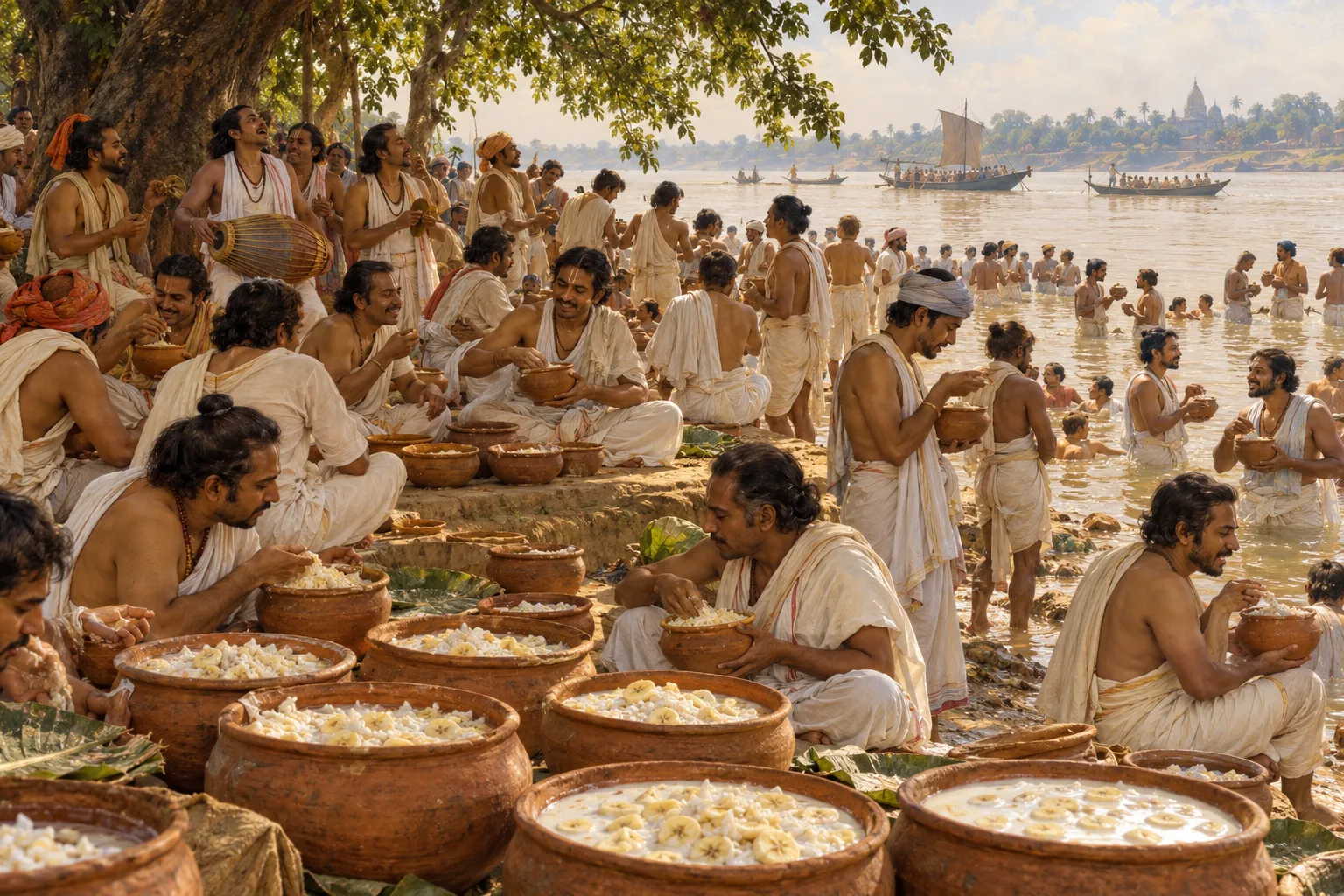
Raghunath was delighted. He sent his men running to the village and the villages beyond, to buy. Chire, doi, milk, sweets, sugar, bananas, whatever the markets had. And pots. Big round earthen ones, two hundred, then more, up to four hundred.
Word got out the way it always does in Bengal. Brahmins came, gentlemen came, shopkeepers, people who only came to look. Raghunath sent for more food. More pots.
The chire was soaked two ways. Half went into yogurt with sugar and banana. The other half into thickened milk, with a banana the text calls chanpa kola, ghee, sugar and camphor. Camphor! In food. It must have smelled like a temple.
Every guest got two pots, one of each.
Then the space ran out. Those who couldn’t fit on the platform took their pots down to the bank. Those who couldn’t fit on the bank walked into the Ganga and stood in the water, eating.
I keep coming back to that picture. Hundreds of people waist-deep in a river, spooning curd-soaked rice out of clay pots. Laughing, probably. Nobody in the book calls it a mess. It’s the best part.
Mercy, by the potful
Nityananda sat on the platform with the biggest pots. Raghava Pandit turned up, laughed at the whole sight, and brought cooked prasad as well. Then, as Krishnadasa tells it, Nityananda called Chaitanya himself into the scene, though Chaitanya was far away in Puri, and the two of them walked among the eaters feeding each other bits of chire like old friends sharing a joke. A few devotees saw it. Most didn’t.
“Eat,” Nityananda told the crowd, “and say Hari.”
For one afternoon the Ganga at Panihati became the Yamuna of Krishna’s cowherd picnics. Delta mud and Brindaban, the same thing that day.
Afterwards he gave Raghunath the leftovers from his own pots. Next morning, under the same tree, he blessed him: whatever is holding you back will fall away. It did. Raghunath left home for Puri soon after and never went back.
So the punishment set him free. Funny sort of sentence.
Why chire
Think about it from the kitchen side. To feed that many people with rice you’d need fires, giant handis, cooks, hours. Chire needs none of it. Buy it dry, soak it, sweeten it, ladle. Four hundred pots fill up fast.
There’s one more thing. In old Bengal, cooked rice came with rules about who could eat with whom, and who could cook for whom. Soaked chire sat lighter in that world. Krishnadasa doesn’t spell it out. He just shows us brahmins and shopkeepers and strangers eating from the same pots on the same bank, and lets us notice.
Still on the calendar
Panihati hasn’t forgotten. Every year, around the bright thirteenth of Jyoishtho, people still gather there for the chire-doi festival, the Danda Mahotsav, the festival of the punishment. Temples far from Bengal keep it too. Pots of soaked chire, curd, sweets, and the early-summer heat pressing down.
Next time you eat doi-chire on a hot morning, think of it. A rich young man who couldn’t come close. A saint who called him a thief. Four hundred pots. A river full of people, eating.