
When the Bengali Merchant Disappeared from Bengali Literature
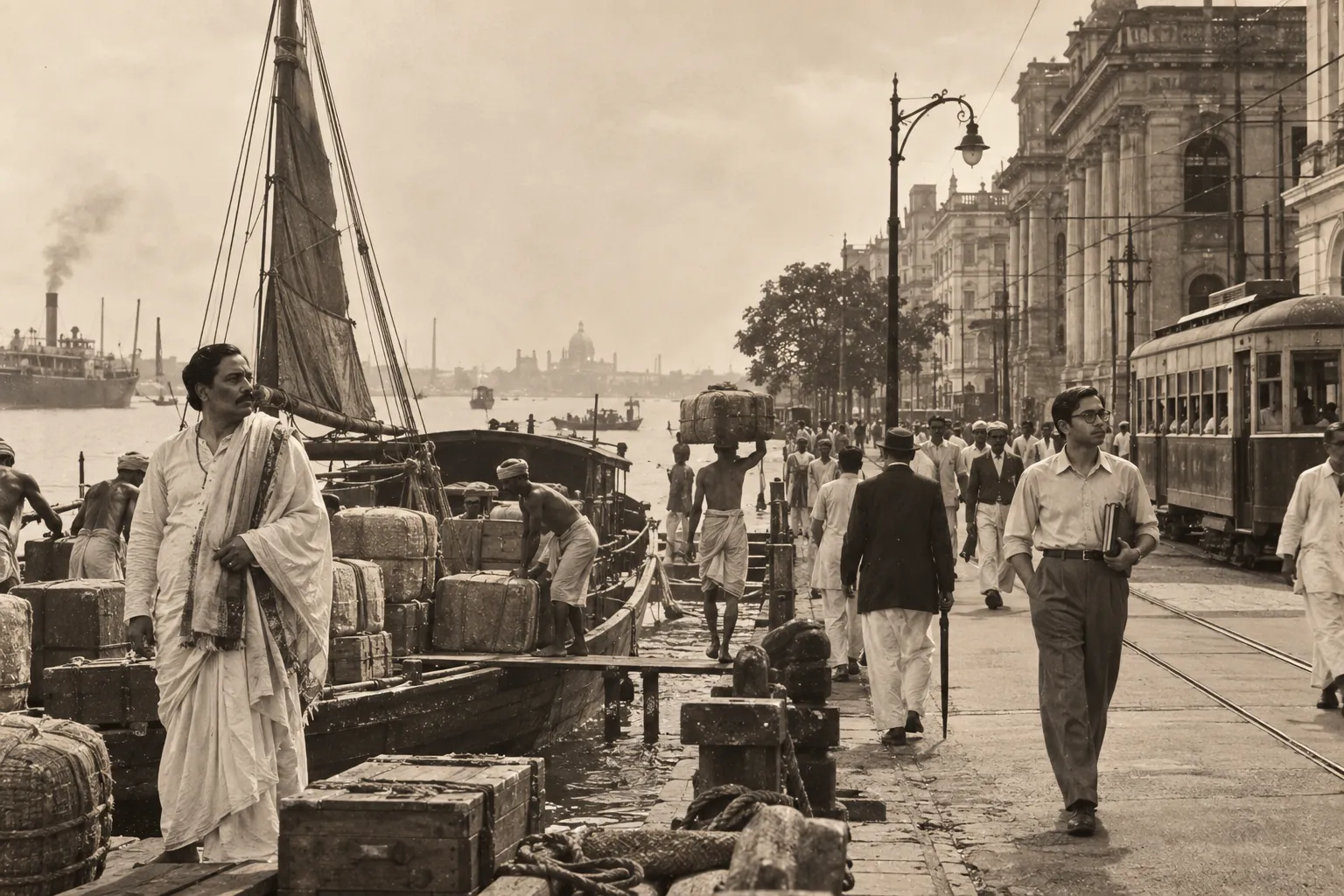
There is something curious about the history of the Bengali merchant in literature. In the older stories, the merchant could be one of the most powerful figures in the entire narrative. He owned ships, travelled to distant lands, accumulated wealth and confronted dangers far beyond the familiar world of the village. Chand Sadagar of the Manasamangal tradition is perhaps the best-known example, but the merchant figures of Chandimangal—Dhanapati Sadagar and Srimanta—belong to the same imaginative world. Their wealth is not merely a background detail. Trade gives these characters their mobility, their ambitions and much of the drama of their lives.
Modern Bengali literature inherited a very different social landscape. As the nineteenth century gave way to the twentieth, the zamindar, the peasant, the teacher, the lawyer, the clerk and eventually the factory worker became familiar figures in Bengali fiction. The city grew more important, and with it came the rented room, the office, the tram, the college, the political meeting and the anxiety of living on a salary. The merchant did not disappear from Bengal during this transformation. Yet somewhere along the way, he became much less central to the stories Bengali literature told about itself.
That is a more interesting question than whether Bengalis stopped doing business. When did the merchant stop being one of the most natural literary figures through whom Bengali society imagined ambition and success?
When the merchant could be a hero
The merchant of medieval Bengali literature was not simply a shopkeeper or trader. He belonged to a world of rivers, ports and long-distance commerce, and his occupation connected the domestic world of Bengal with places beyond it. Chand Sadagar’s voyages and wealth give the Manasamangal tradition an unusually expansive geography. In the Chandimangal, Dhanapati Sadagar and his son Srimanta similarly move through a world in which commercial activity, travel and social status are closely connected.
This older literary imagination is significant because it gave commerce a certain kind of prestige. The merchant could be adventurous and worldly precisely because he was a merchant. His livelihood required movement and risk, and those qualities could become the material of a compelling story. Wealth did not have to be explained through inherited land or social rank; it could be something acquired through enterprise.
That literary figure gradually became less familiar.
The village remained, but commerce moved into the background
The Bengali fiction of the first half of the twentieth century developed a powerful interest in rural society. The decline of zamindari, the pressures on cultivators, poverty, debt, caste, religious life and the changing relationships within village communities became subjects of major fiction.
In Pather Panchali, the economic difficulties of Apu’s family are inseparable from the texture of rural life. Ganadevata offers a much larger picture of village society, where land, cultivation, caste and changing economic relationships shape the lives of entire communities. Satinath Bhaduri’s Dhorai Charit Manas moves even further away from the familiar educated middle-class world to portray marginal communities and their struggle to survive.
There is plenty of economic activity in this literature. People cultivate land, borrow money, work as artisans, teach, serve religious institutions and depend on complicated local relationships. Markets and money are never entirely absent. What is striking is that the independent merchant rarely becomes the central figure through whom this economic world is understood.
The difference from the older merchant tales is subtle but important. Economic life remained a major subject of Bengali literature, while commercial ambition ceased to occupy the same imaginative position.
The city changed the protagonist
By the middle decades of the twentieth century, Bengali literature was increasingly drawn towards the city. Calcutta and the industrial belt offered writers an entirely different social landscape, shaped by migration, employment, overcrowding, industrial labour and the expansion of the educated middle class.
Manik Bandopadhyay’s fiction repeatedly confronts the relationship between economic circumstances and individual life. His characters are often caught between poverty, desire, work and the demands of survival. Premendra Mitra explored the uncertainties and alienation of modern urban existence, while Bimal Mitra’s Saheb Bibi Golam captured the decay of an older social order as Calcutta moved towards a different kind of modernity.
Yet the city that emerged from this literature was not primarily a city of entrepreneurs. Its memorable inhabitants were more often employees, professionals, workers, students and people struggling to find a secure place within an increasingly complicated urban society.
The distinction matters because the city itself was becoming an important centre of commerce and industry. Business was expanding in the real world even as the literary imagination increasingly concentrated on the people who worked within the modern economy rather than those who owned or directed it.
The respectable road to success
Behind this literary transformation lay a much larger change in Bengali society.
The growth of English education and modern professions during the nineteenth century had helped create the educated bhadralok middle class. Education could provide access to government service, law, teaching, medicine and other professions. These occupations offered something that commercial enterprise could not always guarantee: a recognisable path towards respectability and social mobility.
Business, by contrast, required capital and involved uncertainty. A successful entrepreneur could become extremely wealthy, but failure could also destroy a family’s resources. For a middle-class family investing its limited capital in education, a degree and a respectable profession could appear a safer route to advancement than a speculative commercial venture.
Over time, this distinction became part of the cultural imagination.
The successful Bengali was increasingly imagined as someone who had studied, qualified, obtained a position and established a respectable household. The drama surrounding his life came from examinations, employment, promotion, marriage, family obligations and financial insecurity. This was precisely the world that modern Bengali fiction was particularly well suited to explore.
The merchant’s old association with risk and mobility had been replaced by a different ideal: security through education and professional status.
After Partition, the middle-class city became the great literary world
Partition intensified this shift.
The arrival of refugees from East Bengal transformed West Bengal’s cities and suburbs. Families had to find homes, rebuild livelihoods and educate children under difficult circumstances. For many, education and employment offered a route towards stability in a world where property and social position had been violently disrupted.
This experience produced an enormous body of stories about ordinary urban survival. The rented house, the colony, the office and the family became increasingly important literary spaces. In the fiction of Ashapurna Devi, the changing Bengali middle-class household became a particularly rich subject, with questions of education, gender, family authority and social mobility unfolding across generations.
The transformation was not simply economic. It changed what Bengali readers could recognise as an important life.
A person struggling to preserve a family on a modest salary could become a compelling protagonist. A young man searching for employment could embody an entire generation’s uncertainty. A woman negotiating the limits of an educated middle-class household could become the centre of a novel.
The businessman was still there in society.
But he was increasingly somewhere outside the main literary spotlight.
The 1970s and 1980s made the contrast sharper
By the 1970s and 1980s, Bengali fiction had absorbed an even wider range of urban experience. Samaresh Basu’s work moved through industrial settlements, working-class communities, political movements and changing forms of urban aspiration. His later fiction also engaged with newer sectors of city life and a more cosmopolitan social world.
That development is revealing. The urban economy was becoming more diverse, and literature was beginning to notice occupations such as sales, journalism, advertising and corporate employment. The city was no longer simply the world of the old clerk.
Yet even as these newer forms of work entered fiction, the entrepreneur rarely became the defining figure of modern Bengali aspiration.
Samaresh Majumdar’s Uttaradhikar, Kalbela and Kalpurush offer another view of the generation that came of age around the 1960s and 1970s. Education, politics, relationships, professional uncertainty and the changing city dominate the lives of its characters. In Buddhadeb Guha’s fiction, the modern Bengali world could be more affluent and cosmopolitan, populated by professionals and upper-middle-class families with considerably greater freedom and purchasing power than earlier generations.
The middle class had changed. Its surroundings had changed. Its economic possibilities had changed. But the literary ideal had not necessarily become entrepreneurial.
The Bengali entrepreneur remained strangely peripheral.
So where did the Bengali businessman go?
The answer cannot simply be that he vanished.
Bengali businessmen continued to run shops, trading firms, manufacturing enterprises and commercial organisations. Bengali entrepreneurship did not end, and literature continued to contain businessmen as secondary characters and social types.
The more revealing change was in literary centrality.
The merchant of the older tradition could carry an entire narrative because commerce itself gave him a distinctive dramatic identity. In modern fiction, the businessman was much less likely to represent the central aspirations of Bengali society. His wealth might make him interesting, but it did not necessarily make him admirable. His business might explain his circumstances, but it rarely defined the moral or emotional journey of the protagonist.
The teacher could embody knowledge. The lawyer could embody the new professional order. The journalist could represent political and intellectual engagement. The student could embody the future. The businessman did not acquire an equally powerful symbolic role.
This is particularly striking because nineteenth-century Bengal had produced entrepreneurs such as Dwarkanath Tagore, Ramdulal Sarkar and Mutty Lall Seal. Their lives remind us that commercial ambition was not foreign to Bengali society. The question is therefore not why Bengalis never became merchants. They clearly did.
The question is why the merchant became less important to the stories Bengalis told about what it meant to become successful.
Literature remembers what society values
Seen over a longer period, the change becomes part of a much larger story.
The merchant of the Manasamangal world lived through voyages and commercial risk. The fiction of the early twentieth century became absorbed in the village, its land and its social hierarchies. As Calcutta became more dominant, the literary protagonist increasingly became an educated urban resident trying to negotiate employment, family and modern life. By the 1970s and 1980s, even a more affluent and cosmopolitan Bengali literature continued to find its strongest subjects among professionals, workers, students and families rather than entrepreneurs.
None of this means that Bengali literature was hostile to business. Nor does it mean that every Bengali aspired to a government or professional job.
It suggests something quieter and perhaps more revealing: literature tends to make visible the forms of ambition a society considers culturally meaningful.
For a long time, the merchant could embody that ambition. His ships represented movement, his wealth represented achievement and his journeys opened the story onto a larger world. Modern Bengali literature gradually found its protagonists elsewhere, particularly among people whose status came through education, employment, family and cultural accomplishment.
The Bengali merchant did not disappear from Bengal.
He disappeared from the centre of the Bengali literary imagination.
And that may tell us something important about Bengal itself. A society can change its economic behaviour without immediately changing its cultural ideals; but when literature begins to stop imagining commercial enterprise as the natural path to achievement, it reveals that the meaning of success has already begun to move somewhere else.