
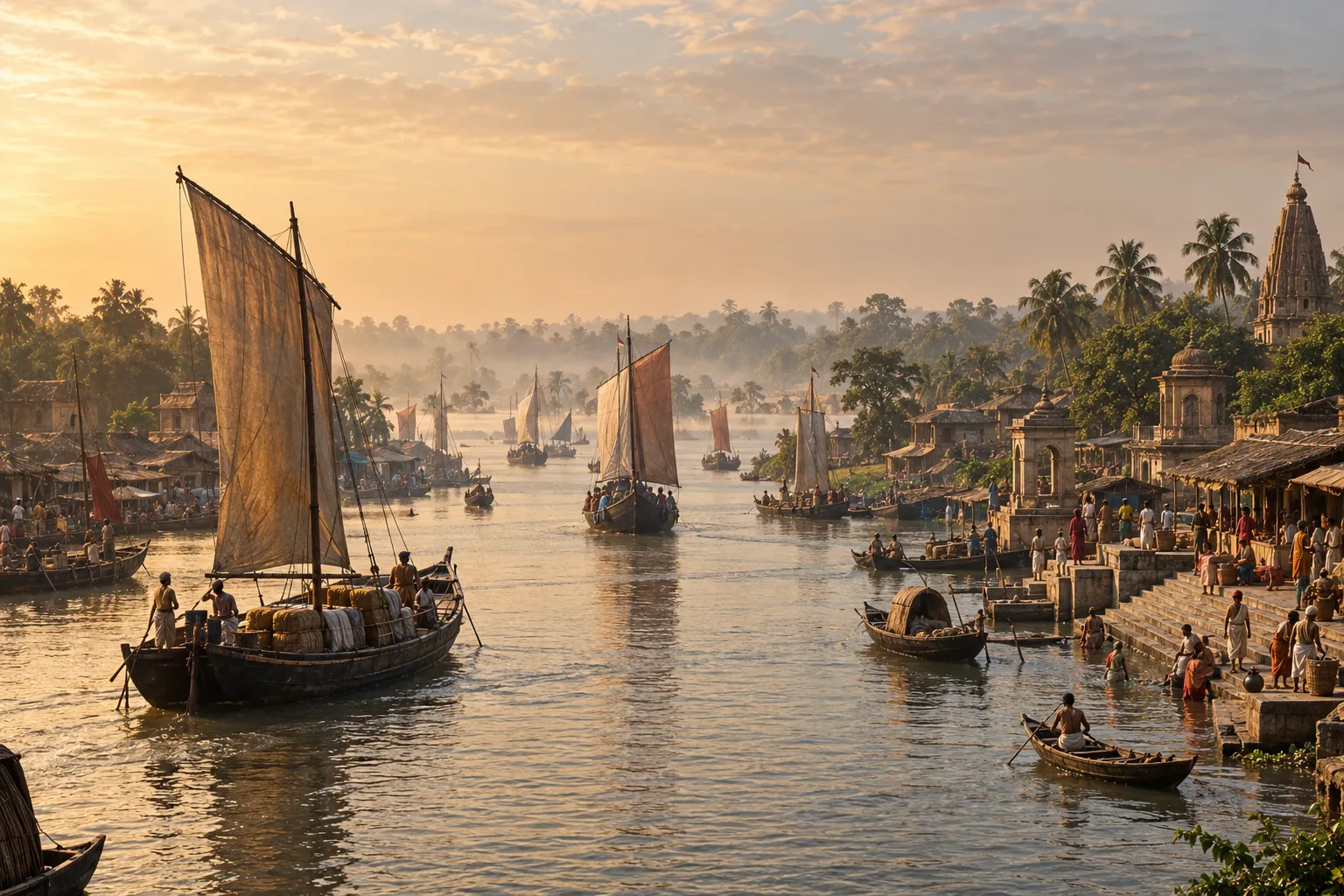
When the Saraswati Lived in Poetry
Today, if we want to find Bengal’s lost Saraswati, we look for clues.
An old map. A faint curve in the landscape. A buried layer of river sediment. A satellite image showing where water once moved.
But there was a time when nobody needed to search for the river.
It was simply there.
Boats travelled along it. Merchants depended on it. Pilgrims came to its banks. And Bengali poets wrote it into their stories.
Long before the Saraswati became a vanished river, it had already become part of Bengal’s literary imagination.
Two very different traditions preserve that world: the Manasamangal, with its merchants, ships and journeys, and the Vaishnava literature surrounding Chaitanya, where Tribeni becomes part of a sacred geography.
Together, they reveal something that maps cannot quite capture.
They show what the river meant to the people who lived in its landscape.
The river of Chand Sadagar
One of the most striking appearances of the Saraswati comes in the Manasamangal tradition associated with Bipradas Pipilai.
At the heart of the story is Chand Sadagar, the wealthy merchant whose journeys are inseparable from boats, rivers and the dangers of travel.
He sets out with a fleet of fourteen ships.
The journey belongs partly to the world of myth and devotion, but its geography is recognisably riverine. The narrative brings Chand Sadagar’s fleet through the landscape of Tribeni and Saptagram, where the Ganga, Saraswati and Jamuna are named together.
One line describes the rivers in terms of their size:
“The Ganga and Saraswati, the Jamuna are all so large.”
The importance of this passage is not that it gives us a precise measurement of the Saraswati.
It does not.
A Mangalkavya is poetry, not a navigation chart.
Its value lies somewhere else.
The river exists here as part of an active world of movement.
Ships travel.
Merchants take risks.
Places are connected by water.
And the river is large enough, in the imagination of the poem, to belong to the world of great journeys.
A landscape where commerce became story
This is one reason the Saraswati’s appearance in Manasamangal matters.
The poem does not isolate the river as a geographical object.
It places the river inside a human landscape.
Chand Sadagar’s journey brings together commerce, geography, faith and storytelling. The river is the medium through which these worlds meet.
That is striking when we remember what happened to the Saraswati later.
The river would gradually become too shallow for the large vessels that once used it. Saptagram would lose its commercial importance. The channel would fragment and decline.
But the poem preserves an earlier moment.
Not as a technical record of river depth, but as a cultural memory of a Bengal in which rivers were the roads.
The distinction matters.
Literature cannot prove every geographical detail of a river’s history.
But it can reveal what kinds of landscapes people imagined, remembered and considered meaningful.
Then the river becomes sacred
There is another literary Saraswati, and it feels very different.
By the 16th century, the landscape around Tribeni had also become deeply associated with Vaishnava religious culture.
Vrindavana Dasa’s Chaitanya Bhagavata, written around the middle of the 16th century, describes the sacred geography associated with Tribeni and the Muktabeni—the river landscape where the Ganga, Saraswati and Jamuna were understood together.
Here the river is no longer primarily the route taken by a merchant fleet.
It is a place of pilgrimage, devotion and sacred memory.
That change is important.
The same landscape could hold very different meanings at once.
For merchants, rivers were routes.
For pilgrims, they could be sacred places.
For poets, they could become part of a story.
The Saraswati belonged to all three worlds.
Three rivers, one landscape
Tribeni is especially interesting because its significance comes from this layering.
The physical river system and the sacred geography grew around one another.
The name Tribeni itself evokes a meeting of three streams, while Muktabeni appears in the literary and religious tradition associated with the place.
This was not simply a question of where one channel flowed into another.
It was a way of understanding the landscape.
The river system became part of a larger cultural map in which particular places acquired religious meaning.
And literature helped preserve that map.
A modern reader looking at a narrow watercourse near Tribeni might struggle to imagine the scale or importance of the historical river.
A poem can do something different.
It can show us how people inhabited the landscape.
The river literature remembered
The most fascinating thing about these texts is that the Saraswati does not appear as a lonely river.
It appears alongside people.
Chand Sadagar travels through its world with his fleet.
Merchants move through the river network.
Pilgrims encounter the sacred geography of Tribeni.
The river connects places, stories and communities.
This gives us a different way of thinking about a lost river.
A river can disappear physically while remaining culturally present.
Its channel may fill with silt.
Its water may retreat.
Its old course may become difficult to recognise.
But its name can survive in a poem.
Its landscape can survive in a pilgrimage tradition.
Its journeys can survive in a story.
The river can become literature before it becomes history.
What poetry can—and cannot—tell us
There is a temptation, when studying old texts, to treat every geographical reference as hard evidence.
That would be a mistake.
The Manasamangal is a literary work shaped by mythology, devotion and oral traditions. The Chaitanya Bhagavata is a hagiographical text concerned with the life and sanctity of Chaitanya and the Vaishnava world.
Neither should be read as a modern historical survey.
But that does not make their geographical references unimportant.
Quite the opposite.
They allow us to see the Saraswati from another angle.
Historical maps can show where the river was drawn.
Sediment can show where the river once flowed.
Literature can suggest how the river existed in the cultural imagination of Bengal.
Each preserves a different kind of memory.
When a river becomes memory
Eventually, the Saraswati’s physical life began to fade.
Its channels narrowed. Its flow weakened. Its commercial importance declined.
But the literature had already done something that the river itself could not do.
It had given the river a place in stories that could outlive the water.
That may be why the Saraswati remains so intriguing today.
We search for it in maps because maps remember its course.
We search for it in the soil because the land remembers its water.
But we can also search for it in Bengali literature, where another kind of memory survives.
There, the Saraswati is not yet a lost river.
It is a river of ships, merchants, journeys, pilgrims and sacred places.
A river people did not need to reconstruct because they were still living inside its world.
And perhaps that is the most moving thing literature can give us.
Not a measurement.
Not a map.
Not a perfect historical record.
But a glimpse of a landscape before it became lost.
The Saraswati disappeared from the land. In Bengali literature, it remained part of the world.